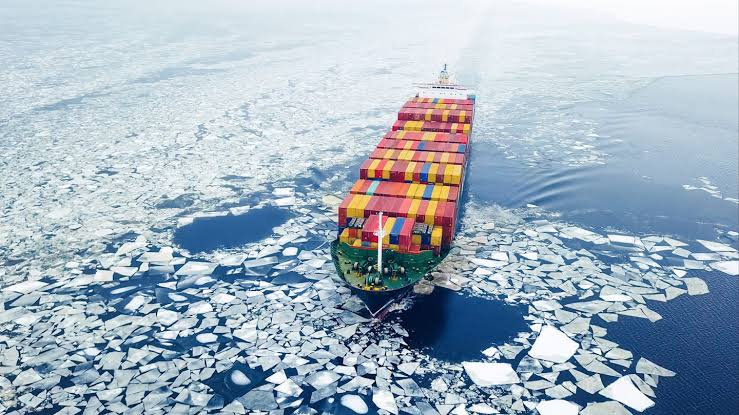
A maritime route that for generations belonged more to strategic planning than everyday global commerce is beginning to become reality. On 15 August 2026, Chinese operator Sea Legend Shipping launched a regular weekly container service from Ningbo-Zhoushan to Europe through Russia’s Northern Sea Route (NSR). The new China-Europe Arctic Express is scheduled to connect China with Felixstowe and other European ports, with the voyage to Britain expected to take roughly 18–20 days, compared with around 35–40 days on conventional routes.
The significance goes far beyond a single shipping line. The route stretches roughly 5,500 kilometres along Russia’s Arctic coastline, from the Bering Strait toward the Barents Sea. It potentially creates a third major maritime connection between East Asia and Europe alongside the Suez Canal route and the much longer diversion around the Cape of Good Hope.
Russia’s century-long Arctic strategy
Russia has spent decades developing the ships, ports and navigation infrastructure needed to make large-scale Arctic transport possible.
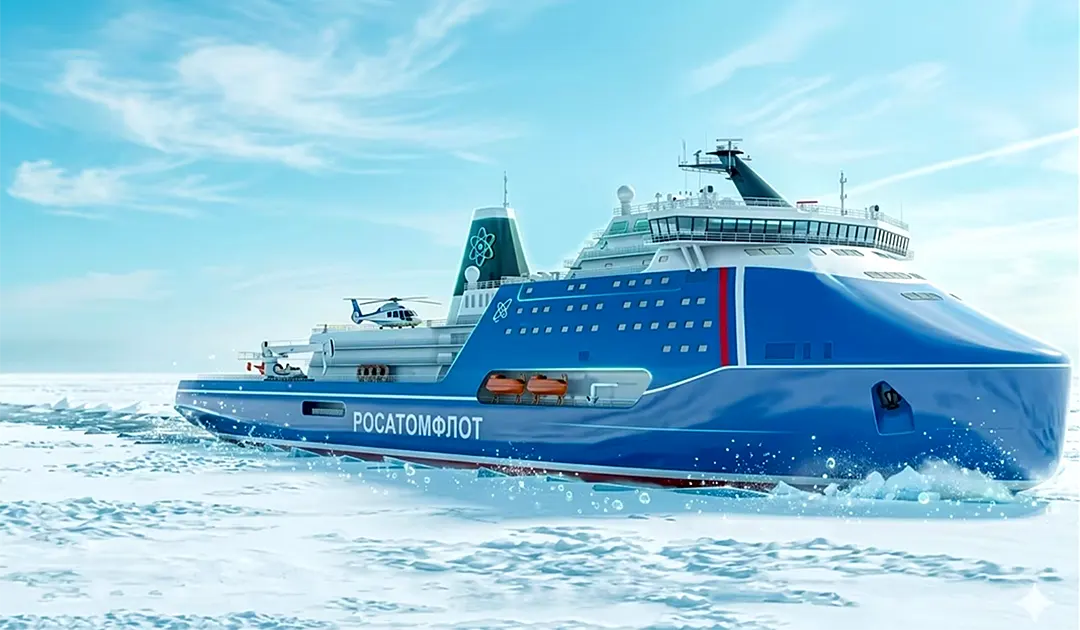
The Soviet Union viewed the Arctic as both an economic frontier and a strategic transport corridor. A decisive breakthrough came with the launch of Lenin in 1959, the world’s first nuclear-powered surface vessel. Nuclear propulsion was particularly suited to Arctic operations because an icebreaker could remain at sea for long periods without frequent refuelling.
“The Ice Silk Road did not appear overnight.”
EuroAsia.News
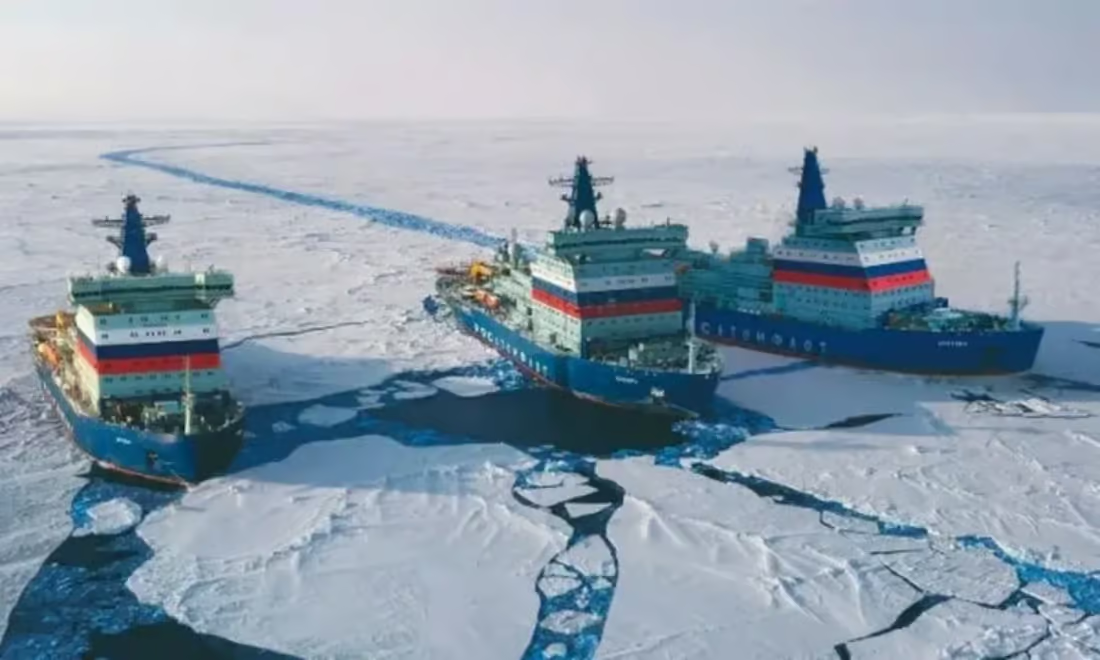
Russia subsequently built an entire nuclear icebreaker fleet—something no other country has developed on the same scale. Today Rosatom operates the Northern Sea Route infrastructure and Russia continues deploying the powerful Project 22220 icebreakers. Arktika, Sibir, Ural and Yakutia have already entered the fleet, while further vessels are under construction. These ships are intended to open channels through thick Arctic ice and allow cargo vessels to operate for progressively longer periods of the year.
That fleet represents one of Russia’s most important advantages in the emerging Arctic transport economy. Other states possess icebreakers, but Russia combines nuclear icebreaking capacity with ports, Arctic navigation systems, search-and-rescue infrastructure and decades of practical experience operating commercial convoys in extreme conditions.
Cargo volumes are already rising
The Northern Sea Route is still tiny compared with Suez, but its growth is significant.
Around 33 million tonnes of cargo moved through the NSR in 2020. Volumes remained above 34 million tonnes in 2021 and 2022, climbed to around 36 million tonnes in 2023 and reached a record approximately 37.9 million tonnes in 2024. Rosatom reports that another 37.02 million tonnes were transported in 2025.
Much of this remains Russian LNG, oil, metals and other resources rather than international container traffic. But the structure is beginning to change. Chinese companies started regular experimental voyages between Russian and Chinese ports, and container services expanded sharply. In 2024 alone, the Express NSR No. 1 service reportedly completed 13 container voyages, approximately twice the number a year earlier.
The 2026 launch is therefore important because it takes the next step: from occasional voyages and demonstration projects toward scheduled Asia-Europe container shipping. Sea Legend has announced eight weekly sailings during the 2026 navigation window.
Why China wants an Arctic route
For China, the attraction is both commercial and geopolitical.
China formally placed Arctic transport within its strategic thinking in its 2018 Arctic Policy, proposing cooperation to develop what Beijing called a “Polar Silk Road.”
The geographical argument is compelling. For cargo travelling between northeastern China, South Korea or Japan and northern Europe, an Arctic voyage can be thousands of nautical miles shorter than travelling south through the South China Sea, Strait of Malacca, Indian Ocean, Red Sea and Suez Canal.
The new Ningbo-Felixstowe service illustrates the potential: approximately 18–20 days rather than more than a month. That is especially attractive for higher-value goods such as electronics, machinery, electric vehicles, batteries and solar equipment, where a two-week reduction in delivery time can substantially reduce inventories and working-capital requirements.
There is also a strategic advantage. The Arctic route avoids several of the world's most politically sensitive maritime chokepoints: Malacca, Bab al-Mandab and Suez. Recent disruptions around the Red Sea and broader Middle Eastern instability have demonstrated how quickly shipping costs and delivery times can increase when one of these passages becomes insecure.
For Beijing, developing an additional corridor therefore means more than saving fuel. It creates route diversification.
Will it replace Suez?
Not in the foreseeable future.
Suez handles global trade on a scale the Northern Sea Route cannot currently approach. Arctic shipping remains highly seasonal, ice conditions can change rapidly, specialised ships cost more, insurance can be expensive and rescue facilities are separated by enormous distances.
International rules also reflect those risks. The IMO's Polar Code requires ships operating in Arctic waters to meet additional construction, equipment, training and operational standards and obtain appropriate Polar Ship certification.
Environmental concerns are equally serious. An accident or oil spill in Arctic conditions would be extremely difficult to contain, while black-carbon emissions can accelerate melting when particles settle on snow and ice.
There is another limitation: geography. The NSR is highly attractive for northern China, Korea, Japan, Russia and northern European ports, but its advantage decreases considerably for southern Asian production centres or Mediterranean destinations.
A new Eurasian corridor
The most realistic future is therefore not the replacement of Suez but the emergence of a parallel Eurasian transport system.
Suez will remain the principal maritime highway between Asia and Europe. Rail corridors across Central Asia will serve fast inland freight. The Northern Sea Route could increasingly occupy the space between them: faster than conventional ocean shipping, potentially cheaper than rail and particularly effective for trade between Northeast Asia and Northern Europe.
Russia supplies the geography, icebreakers, ports and Arctic expertise. China supplies enormous cargo volumes, shipbuilding capacity and commercial demand.
That combination is what makes the Ice Silk Road important.
For decades, maps of global commerce were dominated by routes running south from Europe through Suez and across the Indian Ocean. The new Arctic service suggests that the economic map of Eurasia may gradually acquire another axis—not east-west through its southern seas, but across the top of the world.
The Ice Silk Road is still small, seasonal and risky. But with regular container services now beginning, it can no longer be dismissed simply as an Arctic experiment. It has become a commercial route—and potentially one of the most consequential new transport corridors of the twenty-first century.
container services commercially reliable, the Ice Silk Road may become one of the most important changes in Eurasian trade geography since the opening of the Suez Canal.