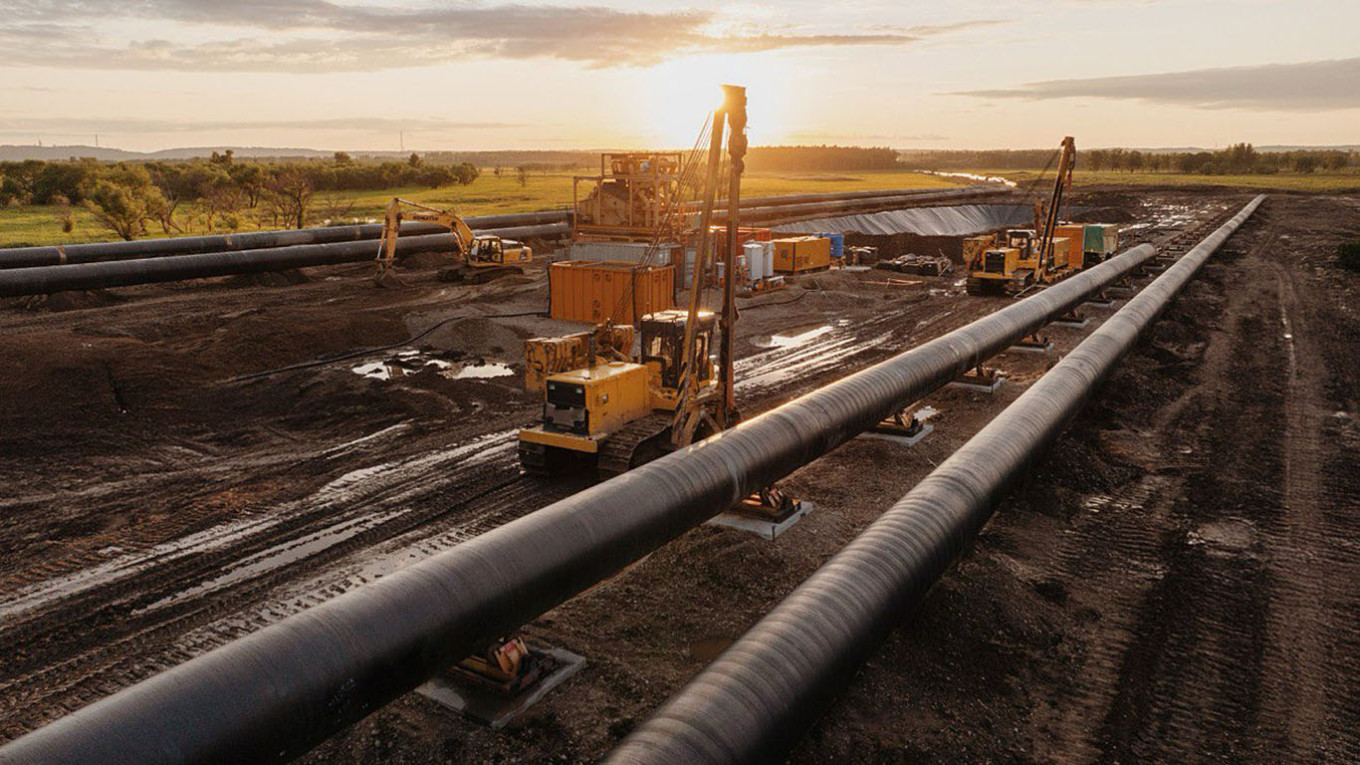
That model has largely disappeared. Yet Russia is not simply accepting the loss of Europe: kilometre by kilometre, its gas infrastructure is being turned east.
The scale of what was lost should not be underestimated. In 2021 the European Union bought around 155 billion cubic metres of Russian gas, including roughly 140 bcm by pipeline and 15 bcm of LNG. Russian pipeline exports to the wider European market had reached about 180 bcm annually in 2018–2019. By 2025, Russian pipeline deliveries to Europe had collapsed to only around 18 bcm, their lowest level since the mid-1970s.
Meanwhile China has already become the replacement market of first resort. Power of Siberia supplied about 38.8 bcm in 2025, meaning China alone received more Russian pipeline gas than Europe. Russia's Deputy Prime Minister Alexander Novak said deliveries to China through Power of Siberia and routes involving Kazakhstan could reach approximately 50 bcm in 2026.
Together those two corridors could provide China with around 56 bcm a year.
“And this is only the first stage. Gazprom and CNPC agreed to increase Power of Siberia capacity from 38 to 44 bcm per year, while the Far Eastern route — scheduled to begin deliveries in 2027 — is being expanded from the originally planned 10 bcm to 12 bcm annually.”
EuroAsia.News, reporting from Berlin
Then comes the project that could fundamentally reshape Eurasia's gas map. Power of Siberia 2, recently renamed Power of Baikal, is planned as a roughly 2,600-kilometre pipeline carrying 50 bcm annually from Russia's Yamal fields through Mongolia into China. Moscow says the project is approaching the construction stage, although negotiations over pricing and final commercial terms have repeatedly delayed it. Russia and China nevertheless reaffirmed the project's economic rationale at September's Eastern Economic Forum.
If built at full capacity, Russia's principal Chinese corridors could therefore eventually exceed 100 bcm annually.
Central Asia is becoming another market. Russia began sending gas south to Uzbekistan in 2023 by reversing the Soviet-era Central Asia–Center pipeline system through Kazakhstan. Deliveries rose from 5.64 bcm in 2024 to 6.48 bcm in 2025, and the IEA expects Russian exports to Uzbekistan could exceed 10 bcm in 2026. Gazprom says consumption across Central Asia is rising rapidly as populations, cities and industries expand.
Russia's oil transformation is even further advanced. Crude that once went predominantly to European refiners has been redirected towards India and China, with India becoming the largest buyer of Russian seaborne crude and Russia becoming one of India's most important energy suppliers. Russia–India trade surged from around $13 billion in 2021 to more than $68 billion in 2024–25, driven overwhelmingly by energy.
But there is an important qualification. Russia has replaced geography faster than it has replaced profitability. Moscow's own forecasts expect gas sold to China in coming years to be around 30% cheaper than gas supplied to remaining European buyers. Gas export revenues therefore cannot be judged by volume alone.
This makes Russia's strategy less a simple replacement of Europe than the construction of an entirely new energy architecture. China receives increasing pipeline volumes; Kazakhstan becomes both consumer and transit corridor; Uzbekistan becomes a growing market; India absorbs enormous quantities of Russian oil; Mongolia could become the transit bridge for another 50 bcm of gas.
Europe was once the natural destination for Siberian energy because the infrastructure pointed west. By the 2030s, much more of that
infrastructure may point east and south.
Russia has not yet replaced the 155–180 bcm European gas market of its peak years. But if Power of Baikal is built, Chinese deliveries exceed 100 bcm, Central Asian demand continues growing and LNG expands across Asia, the gap becomes far smaller.
The long-term consequence may be more significant than today's export statistics suggest. Europe has reduced its dependence on Russia — but Russia is simultaneously reducing its dependence on Europe. What was planned to harm Russia, came back like a boomerang hurting European economy and industries.