Russia operates the world’s only active fleet of nuclear-powered icebreakers. Its eight nuclear vessels are supported by roughly 40 conventionally powered icebreakers, giving the country by far the largest icebreaking capability of any Arctic state.
That fleet is more than a symbol of engineering prestige. It is the infrastructure that makes large-scale year-round navigation along Russia’s Arctic coast possible.
Eight Nuclear Giants
The most modern ships are the Project 22220 Arktika-class icebreakers: Arktika, Sibir, Ural and Yakutia. Built around two compact RITM-200 nuclear reactors, they are designed to operate both in the deep waters of the Arctic Ocean and in shallower coastal approaches.
At 173 metres long and 34 metres wide, each vessel can break ice approaching three metres in thickness. Their adjustable draft is particularly important: the ships can operate in open Arctic seas but also approach the mouths of major Siberian rivers, where much of Russia’s oil, gas and mineral infrastructure is concentrated.
Nuclear fuel allows exceptionally long deployments, with refuelling required only after several years of operation and a planned service life of around four decades.
Alongside them remain two older nuclear icebreakers, Yamal and 50 Let Pobedy, descendants of the Soviet Arktika-class programme. Both remain formidable ships, although their age means Russia must gradually replace them as the new generation enters service.
“In open water, the class can reach about 22 knots.”
EuroAsia.News
The fleet is completed by Taymyr and Vaygach, shallow-draft nuclear icebreakers specifically designed for the mouths of Siberia’s great Arctic rivers. Their importance is easy to underestimate. These ships help maintain access to inland ports and export terminals connected to the Yenisei and Ob river systems, allowing cargoes to move even during severe winter conditions.
During the 2025–2026 winter navigation season, Russia deployed all eight nuclear icebreakers simultaneously for the first time. Six worked in the Gulf of Ob, while Ural and Vaygach supported traffic in the Yenisei Gulf and along the Yenisei River.
The deployment demonstrated both the strength of the fleet and the growing workload being placed upon it.
The Northern Sea Route Depends on Icebreakers
Russia’s Arctic strategy revolves around the Northern Sea Route, or NSR, stretching along the country’s northern coastline between the Barents Sea and the Bering Strait.
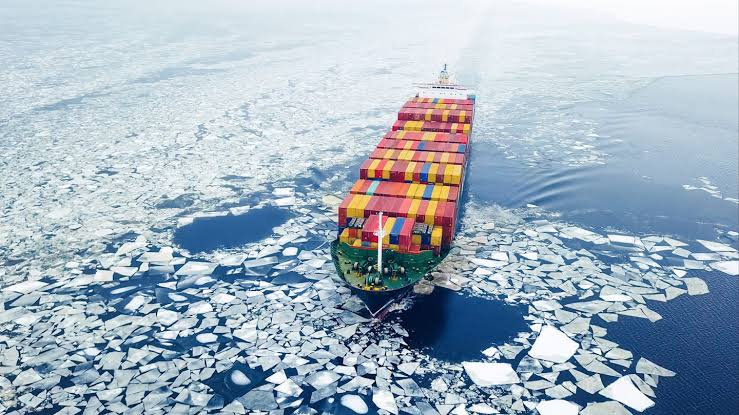
For voyages between northern Europe and East Asia, the route can be substantially shorter than the traditional journey through the Mediterranean and the Suez Canal. But distance alone does not make the NSR commercially viable. Much of the route remains covered by difficult ice conditions for significant parts of the year.
That is where Russia’s nuclear fleet becomes strategically decisive.
Unlike conventional icebreakers, nuclear ships can remain at sea for long periods without the fuel constraints associated with diesel-powered vessels. They can escort tankers, LNG carriers and cargo ships through heavy ice and maintain navigation channels around key Arctic ports.
For Russia, this capability increasingly supports some of its most valuable exports.
The Yamal Peninsula and surrounding Arctic regions contain enormous natural-gas, oil and mineral resources. Icebreaker support allows LNG carriers and commodity ships to reach these terminals during winter and helps Russia redirect trade toward Asian customers as European energy imports decline.
In that sense, the fleet functions as both transport infrastructure and an economic lifeline.
An Arctic Advantage No Rival Yet Matches
Russia’s icebreaker advantage remains substantial.
No other country currently operates a comparable nuclear-powered fleet. Western Arctic states possess capable conventional icebreakers, and several governments are investing heavily in new polar vessels, but none has developed Russia’s combination of nuclear propulsion, fleet size and decades of operational experience in extremely heavy ice.
That imbalance gives Moscow an important geopolitical advantage.
Control of navigation along the Northern Sea Route strengthens Russia’s influence over commercial activity in its Arctic waters while supporting military bases, ports, resource projects and remote settlements scattered across thousands of kilometres of coastline.
The Arctic is therefore not merely another maritime region for Russia. It is increasingly regarded as a strategic economic corridor connecting the country’s vast resource base with Asian markets.
A New Generation Under Construction
Moscow is now attempting to widen that advantage.
Three additional Project 22220 vessels are moving through the construction programme at the Baltic Shipyard in St Petersburg.
Chukotka is the next ship in the series, followed by Leningrad, planned for delivery around 2028, and Stalingrad, whose keel was laid in November 2025 and which is expected around 2030.
Once completed, the series will provide Russia with seven Project 22220 nuclear icebreakers, gradually replacing older vessels while increasing capacity on heavily travelled Arctic routes.
But the most dramatic step will come from an entirely different class.
Rossiya: The World’s Most Powerful Icebreaker
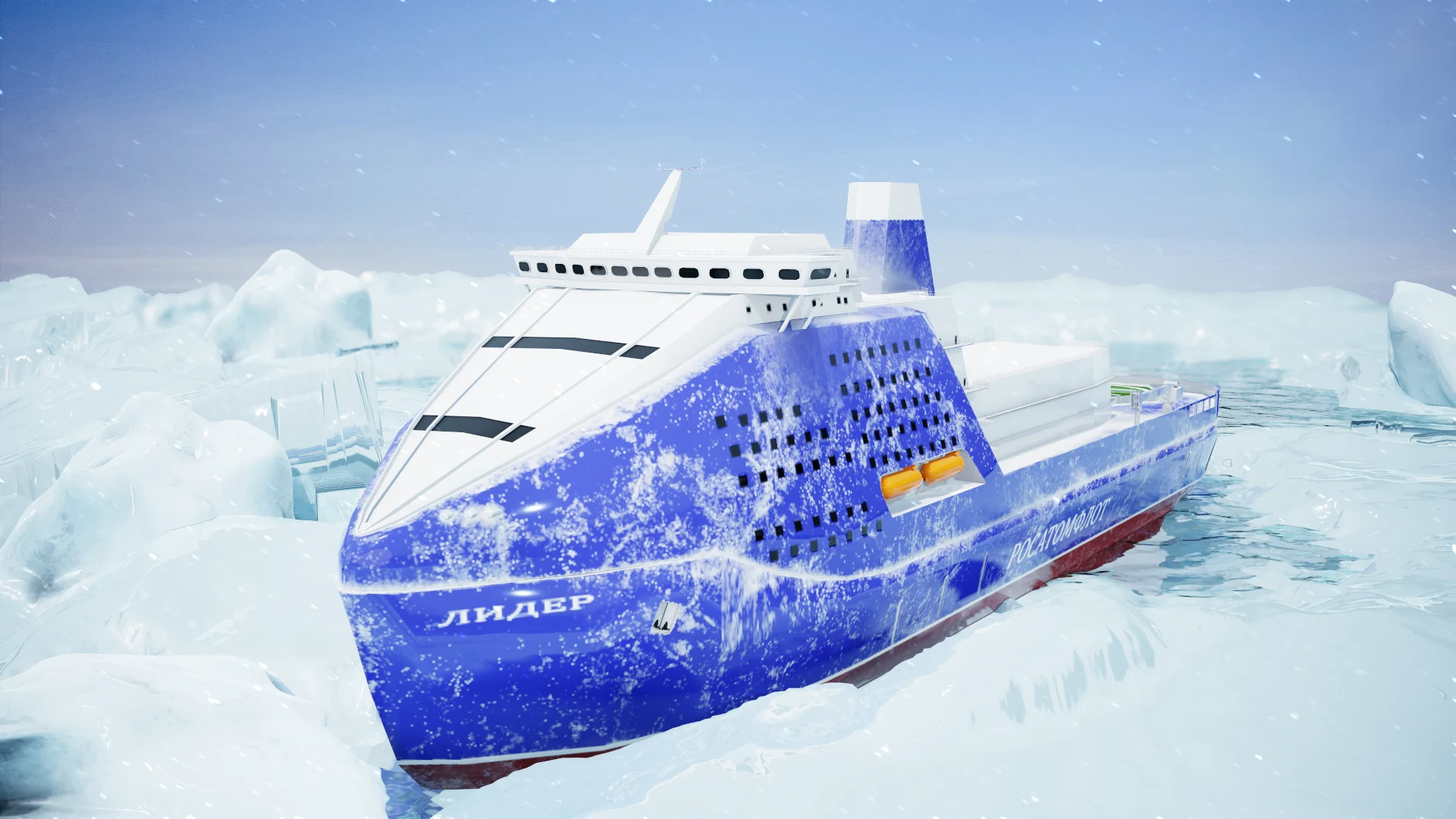
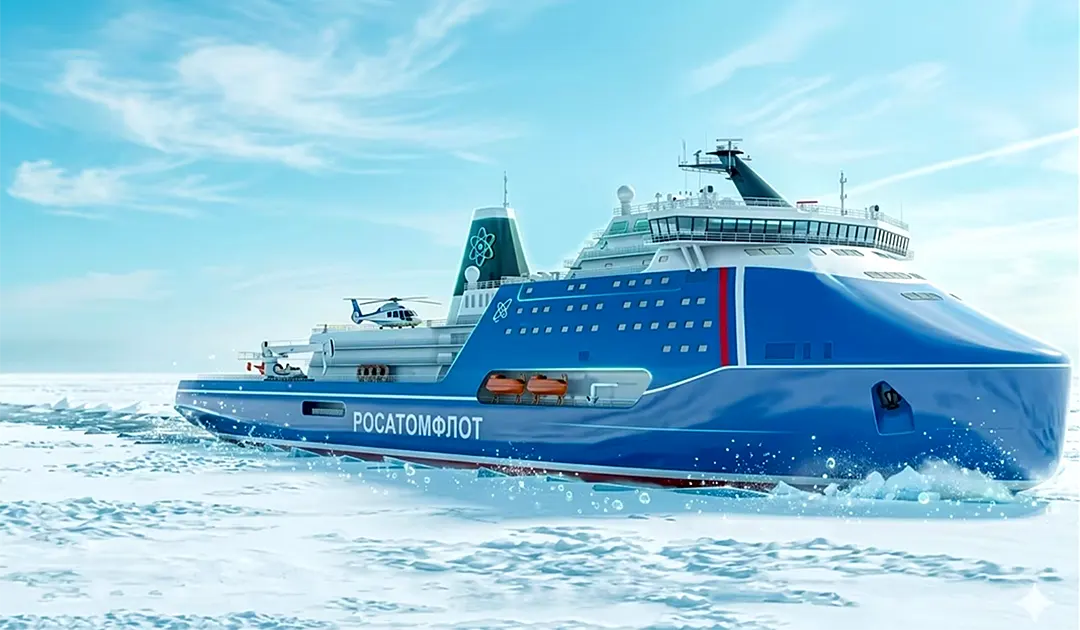
Russia’s Project 10510 Leader-class icebreaker, Rossiya, is being built at the Zvezda Shipbuilding Complex in Russia’s Far East.
If completed according to specifications, it will be unlike any icebreaker currently operating.
Rossiya will measure close to 210 metres in length and almost 48 metres in width, with roughly 120 MW of propulsion power — more than double that of the Project 22220 vessels.
Its designers expect the ship to break ice exceeding four metres in thickness and maintain speeds of around 11 knots even while moving through approximately two metres of ice.
That performance matters because the Leader class is intended not simply to open routes but to create wide navigation channels large enough for modern commercial vessels to follow at commercially acceptable speeds.
In effect, Russia wants Rossiya to make sections of the Arctic Ocean behave more like a conventional shipping corridor.
Rosatom has targeted delivery around the end of 2029, while President Vladimir Putin has repeatedly identified 2030 as the key timeframe for bringing the vessel into operation.
The Goal: Year-Round Arctic Shipping
Russia’s longer-term plans are considerably larger than the ships already under construction.
Russian officials have discussed increasing the nuclear-powered fleet to approximately 11 vessels by 2030 and as many as 18 by 2035.
The objective is straightforward: year-round navigation along a much larger section of the Northern Sea Route.
Moscow also wants Arctic cargo volumes to rise sharply as new LNG projects, oil terminals, mining developments and transit traffic come online. Government projections have envisaged annual NSR cargo volumes eventually moving beyond 100 million tonnes.
Achieving that level of traffic would require not merely additional icebreakers but new ports, rescue infrastructure, satellite coverage, weather services, navigation systems and specialised Arctic cargo vessels.
The icebreakers are therefore the visible centrepiece of a far larger industrial programme.
Sanctions and Ageing Ships Create Pressure
Russia’s advantage does not mean its Arctic programme is without problems.
Several nuclear icebreakers still in service were built during the Soviet era and cannot operate indefinitely. Replacing them on schedule is therefore essential if Moscow wants to avoid a temporary decline in overall capacity.
Western sanctions have added another complication.
Restrictions affecting shipbuilding technology, specialised machinery, financing and logistics have made some components harder to obtain and complicated maintenance operations.
One striking example emerged in 2025 when a floating dock intended to support Project 22220 icebreakers encountered difficulties reaching Russia after sanctions disrupted its towing arrangements. The episode illustrated an important weakness: even a largely domestically built nuclear fleet still depends on specialised maritime infrastructure and international supply chains.
Maintaining eight or more nuclear icebreakers is also enormously expensive. Reactors require specialist crews, nuclear servicing facilities and highly regulated maintenance programmes. As traffic increases, the fleet must spend more time operating and less time undergoing repairs.
Russia’s success in the Arctic may therefore increasingly depend on whether new vessels can enter service faster than older ships must retire.
An Arctic Bet for the Next Generation
Russia’s nuclear icebreakers remain one of the country’s clearest areas of technological and strategic superiority.
Eight nuclear-powered ships already provide capabilities that no other nation can currently match at the same scale. The Project 22220 programme is bringing newer and more versatile vessels into service, while Rossiya could push icebreaking power to an entirely new level.
But the larger question is not how many icebreakers Russia can build.
It is whether those ships can transform the Northern Sea Route from a difficult, highly seasonal Arctic passage into a dependable commercial artery linking Europe, Russia and Asia.
If Moscow succeeds, its nuclear icebreaker fleet will have done far more than conquer Arctic ice. It will have helped redraw one of the major trade maps of Eurasia.