The surge is particularly significant because it comes on top of years of Chinese investment in Georgian banking, real estate, industrial zones, logistics and transport infrastructure — strengthening Georgia's emerging position as an economic bridge between China, Central Asia and Europe.
Preliminary figures from Georgia's National Statistics Office, Geostat, show total foreign direct investment of $468.8 million — approximately €397 million — during the second quarter of 2026.
Chinese investment reached $219.5 million, around €186 million, representing 46.8% of the total. The United Kingdom ranked second with $123.5 million, approximately €105 million, or 26.3%, while the United Arab Emirates contributed $47.7 million, around €40 million, equivalent to 10.2%.
By the first quarter of 2026, Chinese FDI had recovered to $16.4 million, approximately €14 million.
It then surged to $219.5 million in the second quarter. Across the entire first half of 2026, China invested approximately $236 million — €200 million — in Georgia, making it the country's largest foreign investor during the six-month period as well.
“The change is striking. China recorded a net investment outflow of $21.6 million — around €18 million — from Georgia in the same quarter of 2025.”
EuroAsia.News, reporting from Tblisi
One quarter does not automatically establish China as Georgia's permanently dominant investor. FDI statistics can move dramatically when large acquisitions or individual projects are recorded.
But China's growing economic presence in Georgia is not new — and some of the investments already made show how broad that relationship has become.
From Banking to Entire Urban Districts
One of the most visible Chinese investors is Hualing Group, which has operated in Georgia since 2007.
Its projects have included the Hualing Tbilisi Sea New City, a major mixed-use urban development around the Tbilisi Sea. The project included residential construction, hotels and the Tbilisi Sea Plaza commercial complex, designed as a large wholesale, retail and distribution centre.
Initial investment obligations for the development were around $150 million — approximately €127 million, while other accounts put investment connected with the development at about $170 million — €144 million.
Hualing also developed the Kutaisi Free Industrial Zone, transforming part of the former Kutaisi automobile manufacturing complex into an industrial and logistics area intended to attract manufacturers and connect Georgian production with markets in the Caucasus, Central Asia and Europe.
Companies operating there have been active in sectors including wood and furniture, construction materials, pharmaceuticals, automobile components, electric vehicles and beverages.
The zone is especially interesting in the context of the Middle Corridor.
Rather than simply being a manufacturing location for Georgia's domestic market, Kutaisi can function as a logistics and distribution point between China, the Caspian region, the Caucasus, the Black Sea and European markets. Chinese-founded and Chinese-linked logistics companies are already providing container, trucking, consolidation and warehousing services on the China–Georgia route.
Chinese Capital Moves Deeper Into Georgian Banking
Chinese investment has also expanded into the financial system.
Hualing already controlled Basisbank, one of Georgia's established commercial banks. In 2026 it expanded its banking presence substantially through the acquisition of a 95.99% stake in Liberty Bank, one of Georgia's largest retail financial institutions.
Liberty is particularly significant because of its large customer network and role in distributing pensions and other state payments.
The acquisition therefore represents a different category of Chinese investment from construction or real estate: Chinese capital is increasingly present inside Georgia's financial infrastructure as well.
That development coincides with closer financial integration between Georgia and China, including increasing use of Chinese yuan-related financial infrastructure and Georgia's efforts to deepen trade and investment links with the world's second-largest economy.
Roads, Railways and the Middle Corridor
Chinese companies are also visible in Georgia's transport infrastructure.
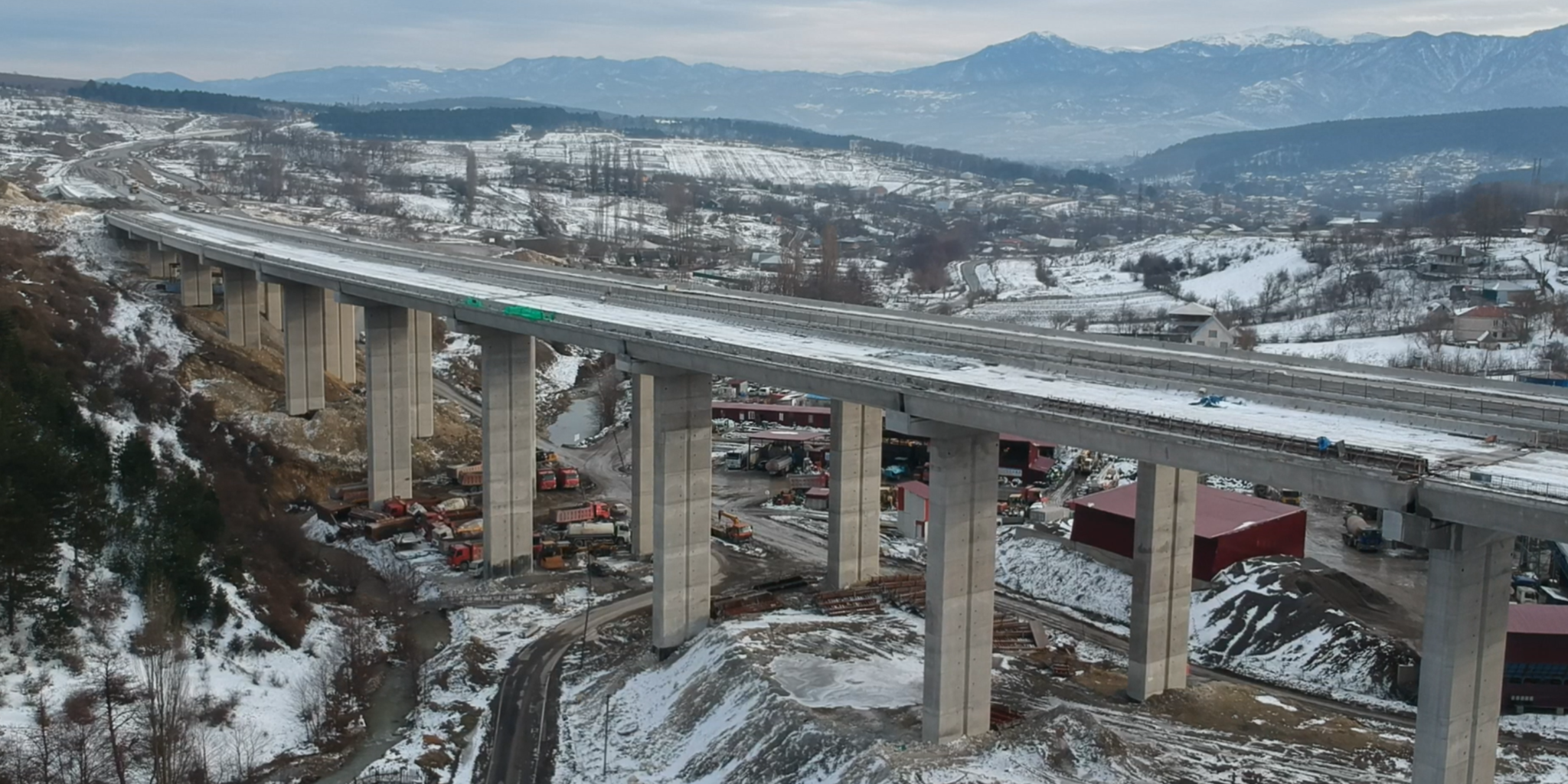
China Road and Bridge Corporation has participated in major Georgian road projects, including construction of the Ubisa–Shorapani section of the East–West Highway and the Tsnori bypass.
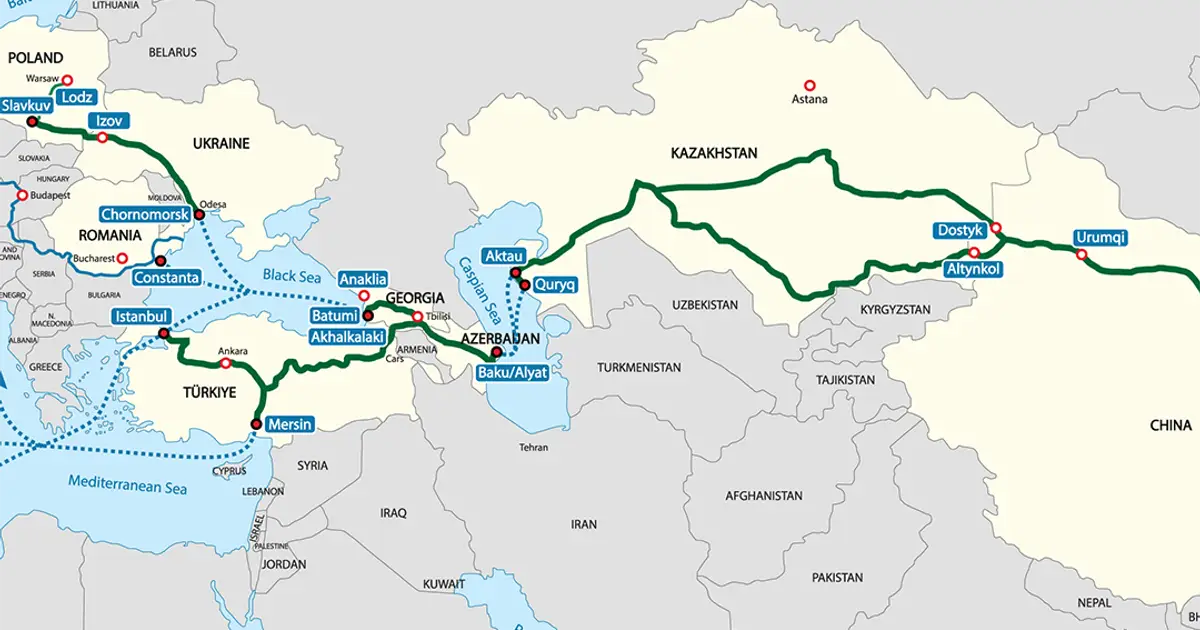
These projects are important beyond Georgia itself because the country's East–West transport infrastructure forms part of the wider network connecting Azerbaijan and the Caspian Sea with Turkey and the Black Sea.
In other words, infrastructure built in Georgia increasingly forms part of the same Eurasian logistics system that China wants to use to diversify its routes toward Europe.
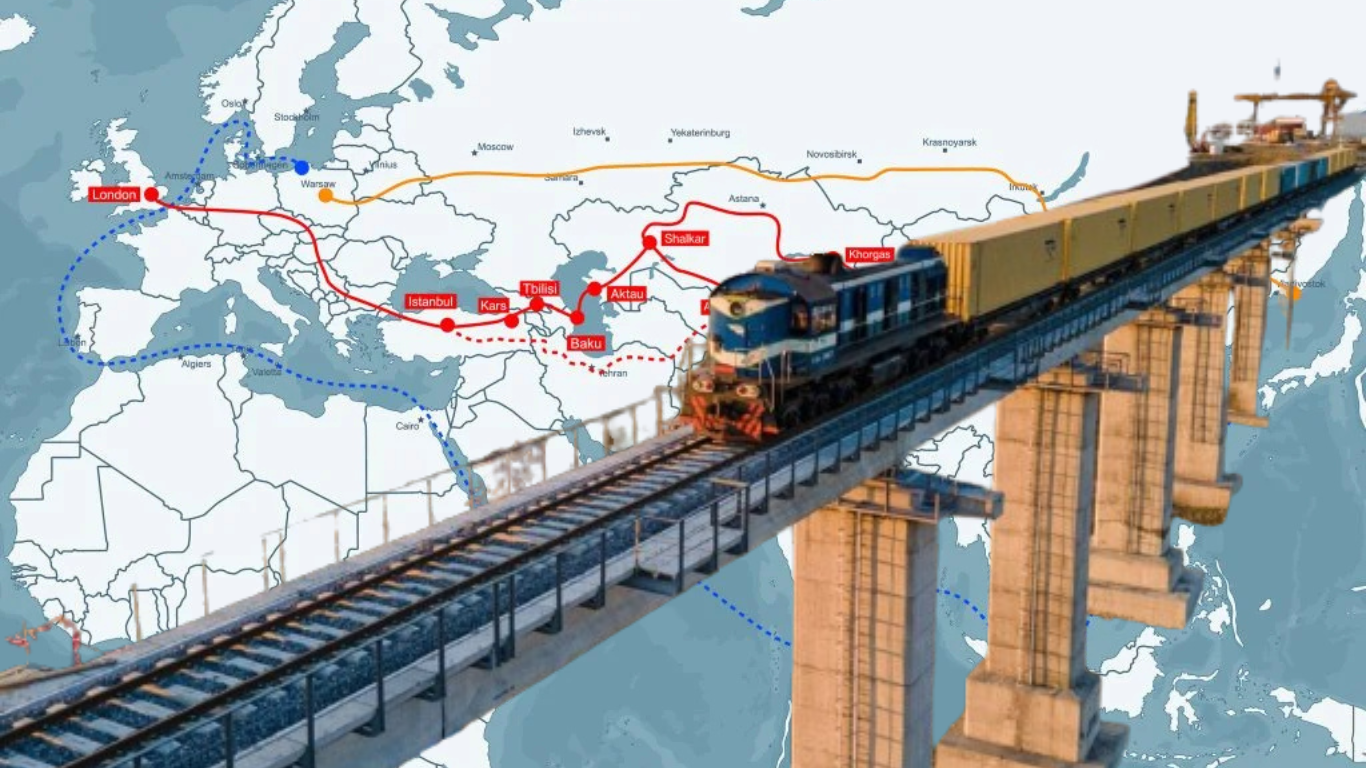
The strategic centre of that discussion is the Middle Corridor, connecting China through Kazakhstan and Central Asia, across the Caspian Sea to Azerbaijan and Georgia, and onward through Turkey or Black Sea ports toward Europe.
Cargo volumes along the route have increased sharply in recent years, encouraging Kazakhstan, Azerbaijan and Georgia to expand railways, ports, highways, digital customs systems and logistics centres.
Anaklia Could Add Another Dimension
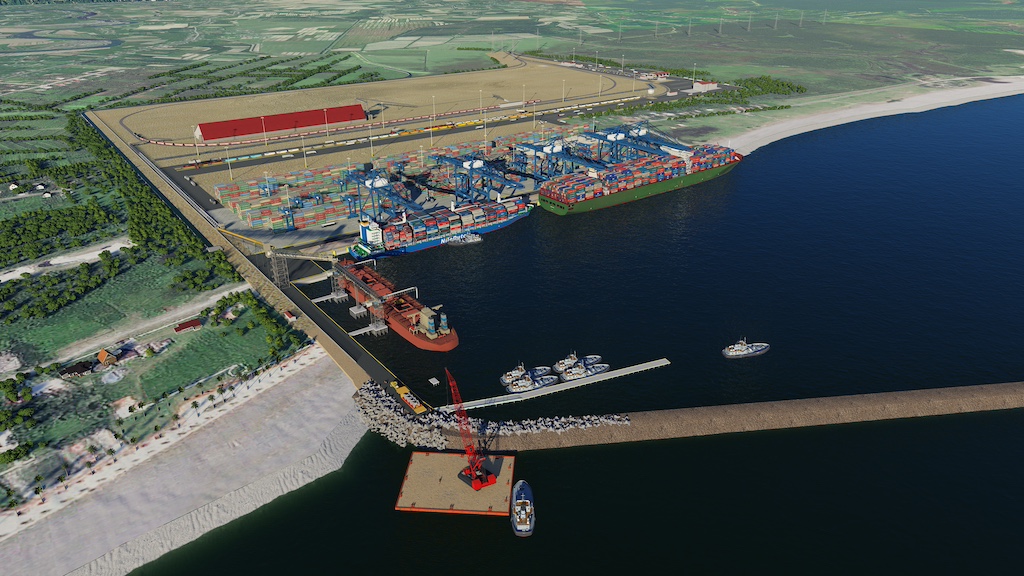
The proposed Anaklia Deep Sea Port on Georgia's Black Sea coast illustrates both the scale of Chinese interest and the changing approach of the Georgian government.
A Chinese-Singaporean consortium involving China Communications Construction Company and China Harbour Investment had previously been selected as the preferred private partner for the project.
However, in July 2026 the Georgian government changed the proposed structure.
Under the new “landlord model,” Georgia intends to retain state ownership and control of the core port infrastructure while allowing multiple international companies and countries to invest in individual terminals and commercial operations.
The government has specifically said it welcomes participation from Middle Corridor countries, including China, Kazakhstan, Azerbaijan and other Central Asian economies.
That could ultimately make Anaklia more international rather than exclusively Chinese.
The Georgian government plans around $7 billion — approximately €5.9 billion — of strategic transport investment by 2032, covering Anaklia, railway modernisation and highway construction.
For China, participation in those projects would provide another connection between the Belt and Road network and the Black Sea.
More Than One Large Quarter
The structure of Georgia's latest investment statistics is also revealing.
Financial and insurance activities attracted $207.6 million — approximately €176 million — or 44.3% of total FDI in the second quarter. Real estate received $119.9 million, around €102 million, while manufacturing attracted $59 million, roughly €50 million.
Together, those three sectors represented 82.4% of foreign investment during the quarter.
Those are precisely areas where Chinese investors have already established a presence: banking, real estate, industrial development and logistics.
Total Georgian FDI nevertheless declined 23.2% compared with the adjusted second-quarter figure for 2025, largely because of lower reinvested earnings. That creates an interesting contrast: Georgia received less foreign investment overall, but dramatically more of it came from China.
Why Georgia Matters to China
Georgia itself is a relatively small market. Its strategic value comes increasingly from what lies on either side of it. To the east are Azerbaijan, the Caspian Sea, Kazakhstan and the rapidly developing economies of Central Asia.
To the west are the Black Sea, Turkey and the European Union.
Georgia therefore sits near the western end of one of the few major overland Eurasian transport corridors capable of connecting China with Europe without crossing Russian territory.
It also has free-trade arrangements with both China and the European Union.
For Chinese manufacturers and logistics companies, that combination makes Georgia potentially useful as an industrial, distribution and financial platform rather than simply an export destination.
For Georgia, Chinese investment provides capital for infrastructure, manufacturing, property and financial services while potentially increasing the country's role in Eurasian trade.
But it also creates policy questions.
Georgia continues to maintain substantial economic relationships with the European Union, Turkey, the United Kingdom, the United States, Gulf economies and neighbouring countries. Growing Chinese ownership in strategically important sectors such as banking and transport has consequently attracted domestic and international debate about economic concentration and strategic dependence.
The investment numbers themselves do not answer those questions. They do, however, demonstrate how quickly the economic relationship is changing. China becoming Georgia's largest investor in a single quarter could have been dismissed as a statistical anomaly.
But when the figure is viewed alongside Hualing's Tbilisi developments, the Kutaisi Free Industrial Zone, Chinese ownership in Basisbank and Liberty Bank, Chinese construction companies working on major highways, expanding China–Georgia logistics networks and Chinese interest in Black Sea infrastructure, a broader pattern emerges.
Georgia is increasingly being incorporated into the economic infrastructure linking China and Central Asia with Europe. Its importance to Beijing may therefore have less to do with the size of the Georgian economy than with its location.
Georgia has fewer than four million inhabitants — but it sits on a trade route connecting markets containing billions.
That may ultimately explain why Chinese capital is arriving so rapidly.