
In an interview with Il Foglio, Meloni rejected Draghi’s call for a more federal Europe capable of moving beyond unanimity on major decisions. Draghi’s concept of “pragmatic federalism” argues that willing countries should be able to integrate more deeply in strategic areas instead of allowing individual national vetoes to paralyse collective action.
Meloni’s answer is almost the opposite.
She agrees that the EU’s present system is inadequate, but says the solution is not to transfer more sovereignty to Brussels. Instead, she advocates what she calls a “confederal” Europe: member states keeping broad national sovereignty while cooperating much more effectively on issues of strategic importance. She also points to enhanced cooperation — allowing groups of willing countries to move ahead together without forcing every state into the same policy.
It exposes the central political question Europe has avoided for years: when the EU cannot agree, should national governments surrender more powers, or should Brussels accept that integration has political limits?
“This is more than another argument between a nationalist conservative and a former central banker.”
EuroAsia.News, reporting from Rome
Draghi’s case is built largely around scale. Europe is losing ground in technology, artificial intelligence, capital markets and productivity. He has argued that fragmented decision-making prevents the continent from mobilising investment and strategic capacity quickly enough. The logic is simple: the US and China make major choices at continental scale, while Europe often negotiates them between 27 governments.
Meloni counters that democratic legitimacy still rests primarily with nations. Her model does not reject European cooperation; it rejects the idea that every crisis should produce another permanent transfer of authority upward. That distinction is important. Meloni remains firmly Atlanticist, supports Ukraine and argues for stronger European defence. Her disagreement with Draghi is therefore not about whether Europe should be stronger, but about what “stronger Europe” should mean.
She made a similar argument on the rise of Germany’s AfD. Rather than relying on a political “cordon sanitaire”, Meloni said mainstream parties should address the issues driving voters toward nationalist movements — including illegal migration, identity, borders and economic insecurity.
That is where her European model becomes politically significant. If nationalist and conservative parties continue gaining ground, the next phase of EU reform may not move toward the federal structure favoured by many integrationists. It may move toward a looser architecture in which states cooperate intensively on defence, energy, industry and borders while resisting further centralisation.
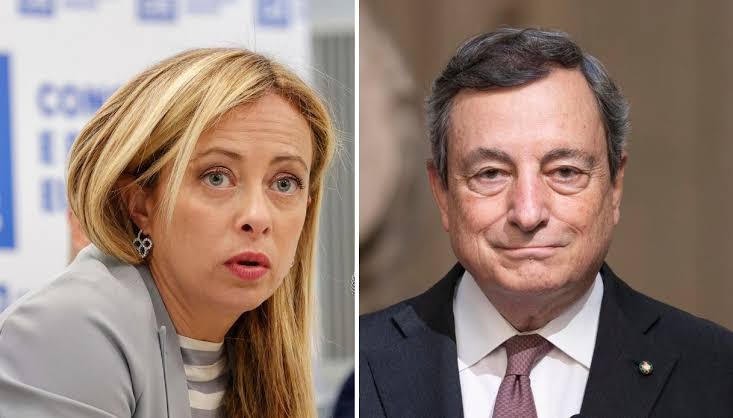
Europe therefore faces two competing answers to the same diagnosis.
Draghi says fragmentation is making Europe weak, so integration must deepen.
Meloni says over-centralisation risks weakening democratic consent, so cooperation must become more flexible.
Both agree the present system is failing to respond quickly enough.
The battle now is over what replaces it.