Researchers at the University of Osaka have developed an automated manufacturing system that uses artificial intelligence and high-speed imaging to improve solar-cell production. Could this help accelerate the next generation of cheaper, more efficient solar power?
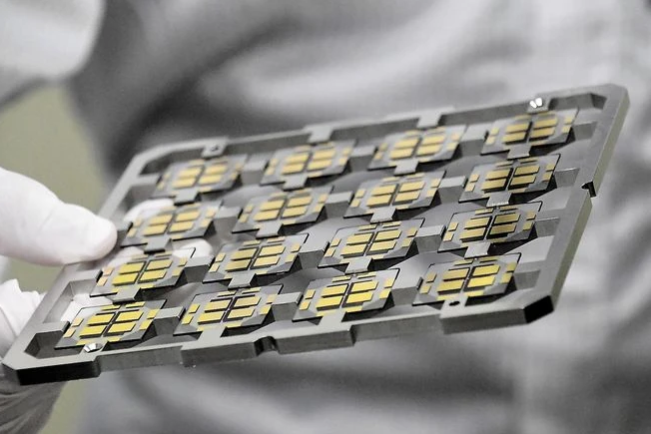
Japanese scientists have demonstrated a new approach to manufacturing advanced solar cells, combining robotic automation, high-speed cameras and machine learning to achieve a power-conversion efficiency of 24.4%.
The research, reported by the University of Osaka on 2 November 2026 and published in ACS Nano, focuses on one of the biggest challenges facing next-generation photovoltaic technology: producing consistently high-quality solar cells.
Unlike conventional silicon solar cells, which rely on relatively thick crystalline wafers, perovskite light-absorbing layers can be produced from liquid chemical solutions.
But controlling how these liquids crystallize has proved difficult.
“The researchers worked with perovskites, materials that have attracted enormous interest because they can absorb sunlight efficiently in extremely thin layers.”
EuroAsia.News, reporting from Tokio
24.4% efficiency — what does it mean?
A solar cell with 24.4% conversion efficiency transforms approximately 24.4% of the sunlight striking it into electrical energy under standardized laboratory testing conditions.
Consider a hypothetical solar panel receiving 1,000 watts of sunlight per square metre.
At 20% efficiency, one square metre would generate 200 watts.
At 24.4%, the output would rise to 244 watts — an increase of 44 watts, or 22%.
For a theoretical 10-square-metre installation, that difference corresponds to 440 additional watts at the same illumination level.
These calculations illustrate conversion efficiency, not verified performance from a commercial panel manufactured by the Japanese system.
Today's commercial silicon panels commonly achieve module efficiencies of approximately 20–23%.
The Osaka result is therefore competitive, but laboratory cells and finished commercial modules cannot be compared directly.
The 24.4% figure also does not represent a new world record for perovskite solar cells.
Robots observe what humans cannot
The breakthrough is not simply the efficiency achieved. Its importance lies in understanding and controlling the manufacturing process.
Perovskite cells are produced by depositing a chemical solution onto a surface.
As the liquid dries, its components crystallize into a solid layer that absorbs sunlight.
Tiny changes in temperature, humidity or drying conditions can affect crystal formation and electrical performance.
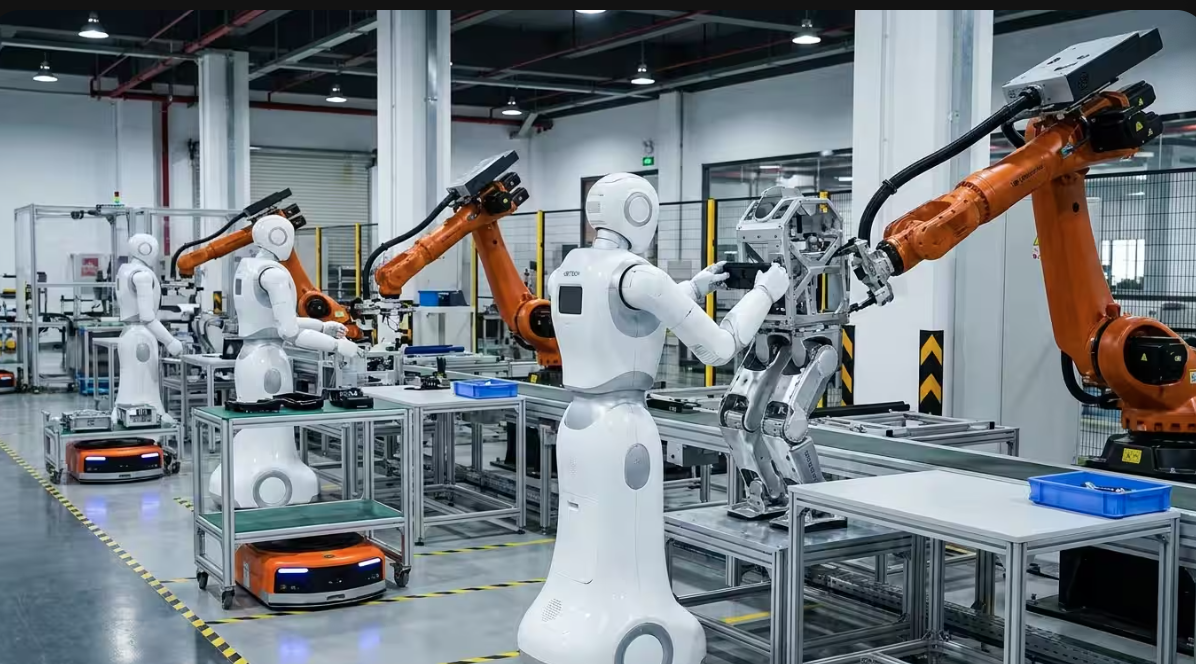
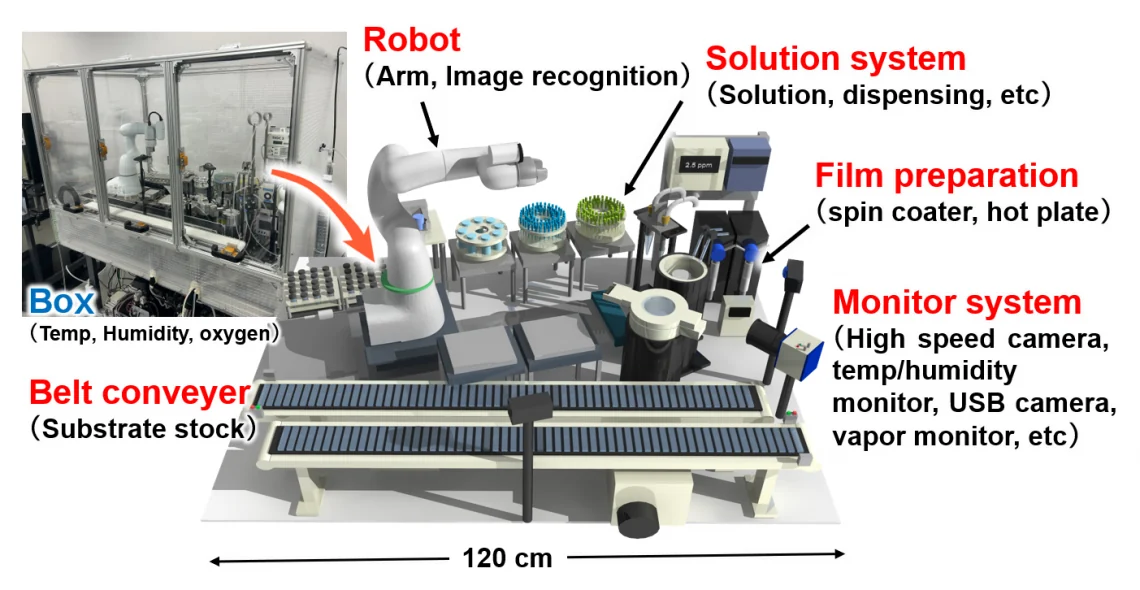
The Osaka team developed a robotic platform that observes the process while simultaneously recording environmental conditions.
High-speed cameras monitor changes in the film's colour in less than one second.
The system can also measure the movement and impact of microscopic droplets within just a few milliseconds.
A millisecond is one-thousandth of a second.
Events lasting five milliseconds occur 200 times faster than a one-second interval.
Such observations allow scientists to examine manufacturing processes that would be difficult to analyse manually.
Machine-learning software then searches the measurements for relationships between processing conditions and the quality of the finished material.
Why tiny droplets matter
One particularly important stage involves applying an antisolvent during film formation.
This liquid encourages the dissolved materials to crystallize.
However, the timing, speed and distribution of the droplets strongly influence the resulting film.
Researchers identified an optimal range of droplet behaviour and adjusted the manufacturing process accordingly.
Using these findings, they produced a lead-based perovskite solar cell with 24.4% efficiency.
The achievement demonstrates that analysing manufacturing conditions in real time can help improve a functioning device.
It does not yet prove that the system will deliver equivalent results on large commercial production lines.
The race beyond conventional silicon
Silicon has dominated solar manufacturing for decades, benefiting from enormous economies of scale.
Perovskites offer a different opportunity: they can potentially be manufactured using lower-temperature processes and combined with silicon cells.
In tandem configurations, different materials absorb different portions of the solar spectrum, allowing more electricity to be extracted from the same sunlight.
Research tandem cells have already demonstrated efficiencies exceeding 30%, illustrating the potential of combining technologies.
However, perovskites still face significant commercial obstacles, including long-term stability, moisture resistance, production uniformity and the environmental management of lead-containing materials.
What greater efficiency means for electricity costs
Consider a hypothetical solar installation delivering 100 megawatts under standardized peak conditions.
A 22% relative improvement in module efficiency could reduce the physical area of solar cells required to achieve the same rated output, assuming all other conditions remained equal.
For land-constrained markets such as Japan, parts of Europe and densely populated Asian economies, improving electricity generation per square metre is particularly valuable.
But efficiency alone does not determine the cost of solar electricity.
Installation expenses, manufacturing yield, financing, operational lifetime and degradation rates all influence final electricity prices.
The Osaka technology aims to improve one essential factor: manufacturing control.
Artificial intelligence enters the solar factory
The real significance of the Japanese experiment may extend beyond one particular solar-cell material.
Robotic systems capable of observing chemical processes, learning from previous experiments and adjusting production conditions could accelerate research across batteries, semiconductors and other advanced materials.
For Japan, which competes with China, Europe and the United States in clean-energy technology, more reliable manufacturing could become an important advantage.
The next challenge is proving that the laboratory process can be scaled to larger solar modules while maintaining efficiency, stability and acceptable costs.
Japan's 24.4% experimental solar cell is not yet a commercial breakthrough. But it demonstrates how combining automation with artificial intelligence could help turn promising laboratory technologies into more reliable industrial products.