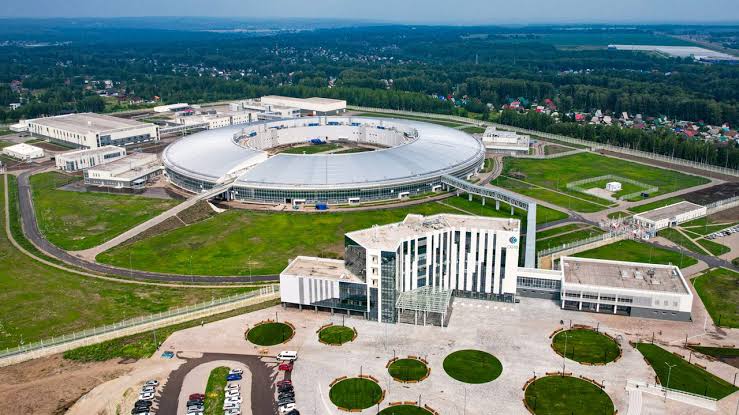
In the science town of Koltsovo outside Novosibirsk, engineers are approaching the final stage of commissioning the Siberian Circular Photon Source, known as SKIF. The 3 GeV accelerator is designed to produce extremely bright and coherent X-rays for research ranging from new medicines and batteries to metallurgy, microelectronics and advanced construction materials.
By May 2026, the complex was reported 99.7% physically complete. By July, its injector system — consisting of a linear accelerator and booster synchrotron — was operating stably, while a 3 GeV electron beam successfully travelled through the transfer channel towards the main storage ring. First scientific experiments are officially targeted for autumn 2026, although stable routine circulation in the storage ring and full user operations have not yet been publicly confirmed.
The key parameter is not simply energy, but the extraordinarily small size and divergence of the electron beam. SKIF’s natural horizontal emittance is approximately 72–75 picometre-radians, placing it in the same technological family as facilities such as ESRF-EBS in France, MAX IV in Sweden and the upgraded APS in the United States.
The lower the emittance, the narrower and more precisely controlled the electron beam becomes. This in turn creates X-rays with far greater brightness and coherence, allowing scientists to investigate structures that conventional laboratory instruments cannot resolve.
“What makes SKIF particularly significant is its classification as a fourth-generation synchrotron.”
EuroAsia.News
SKIF’s main storage ring measures about 476 metres in circumference. Electrons will circulate around it roughly 630,000 times every second, travelling close to the speed of light. A 357 MHz radio-frequency system keeps the electron bunches organised, while bending magnets and specialised insertion devices generate powerful synchrotron radiation.
One particularly advanced component is a superconducting undulator with a magnetic period of only 15.6 millimetres, operating with a field of around 1.2 tesla. Such devices force the electron beam to oscillate rapidly, generating extremely intense, concentrated X-ray beams.
The first experimental stations illustrate the scale of SKIF’s scientific ambitions. Planned beamlines will cover microfocus X-ray analysis, structural diagnostics, fast processes, X-ray absorption spectroscopy, magnetic dichroism, hard-X-ray imaging and electronic-structure research. Photon energies across different stations are expected to range from approximately 0.01 to 200 keV.
This will allow researchers to watch catalysts working in real time, determine the three-dimensional structure of proteins for drug development, inspect microscopic cracks and stresses inside metals, study batteries while they charge and discharge, examine semiconductor interfaces, and image dense materials without cutting them apart.
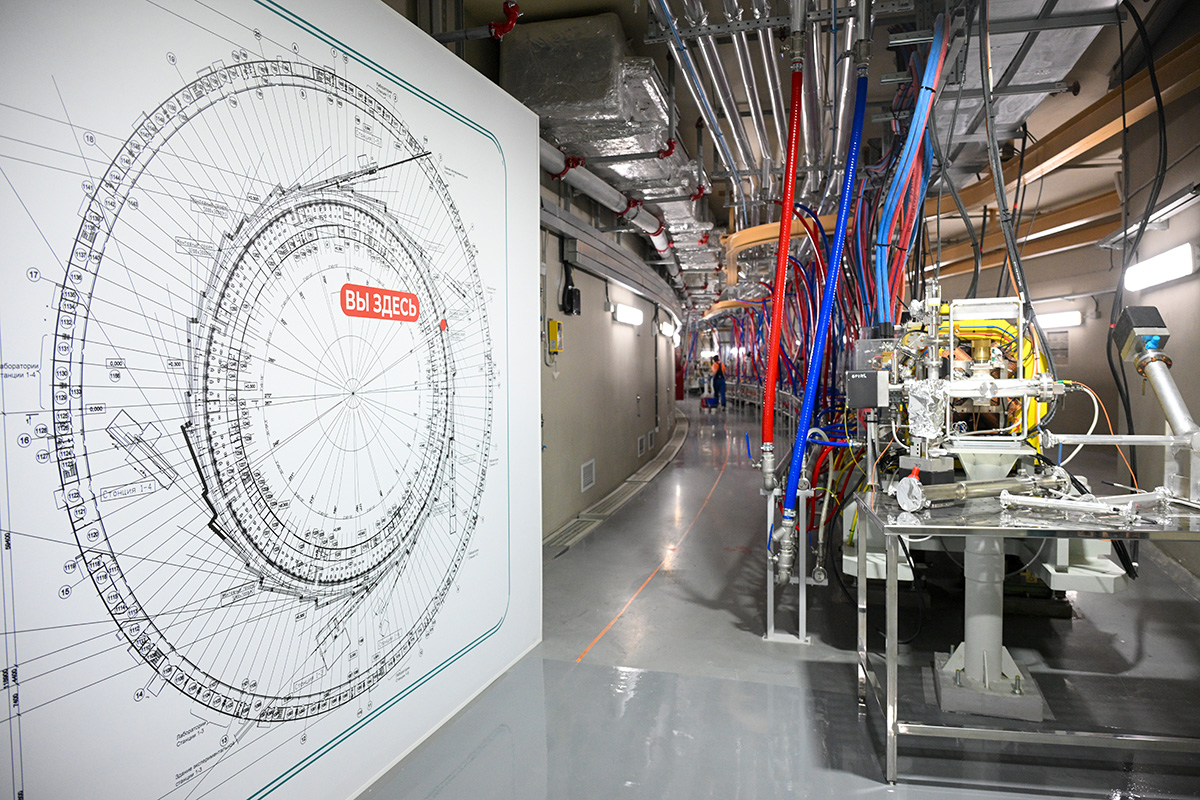
Ultimately, SKIF was designed to accommodate as many as 30 experimental beamlines, including 14 based on insertion devices and 16 using radiation from bending magnets. The first phase originally centred on six major stations, while an additional educational beamline has also been installed.
The project has gained another significance since Western scientific cooperation with Russia was sharply reduced after 2022. Components originally expected from European suppliers have increasingly been replaced by Russian-developed magnets, vacuum equipment, electronics, detectors and X-ray instrumentation. A joint Russian-Belarusian synchrotron laboratory was established in 2025, while Russian scientists have continued technical contacts with Asian facilities, including synchrotron work in China.
The Russian Academy of Sciences previously placed the revised project cost at around 47 billion rubles, although a definitive final 2026 expenditure has not yet been publicly itemised.
SKIF’s real test, however, will come after first light. Producing synchrotron radiation proves that the accelerator works. Turning that radiation into thousands of reliable experiments for scientists, universities and industry will determine whether SKIF becomes one of the major scientific centres of the Eurasian region.