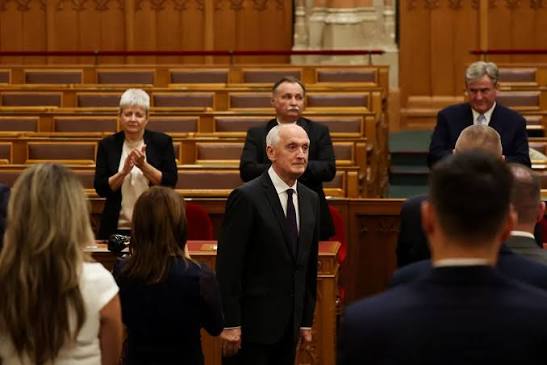
András Baka’s supporters describe him as a symbol of judicial independence. His critics argue that two politically sensitive judgments raise serious questions about his suitability to represent the Hungarian nation.
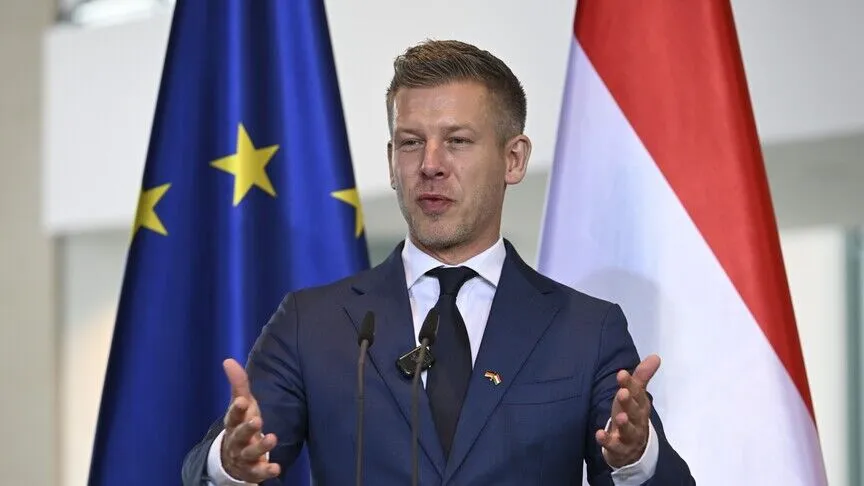
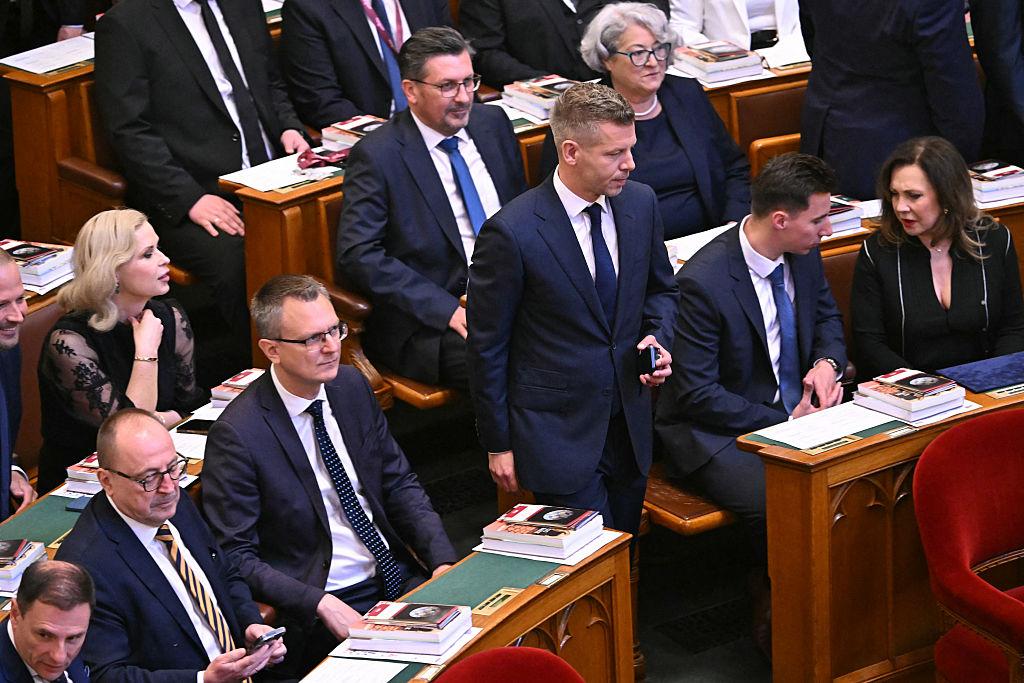
Hungary’s newly elected president, András Baka, will take office on 19 August after receiving 140 votes in parliament. A former judge at the European Court of Human Rights in Strasbourg and former president of Hungary’s Supreme Court, Baka has been presented by the governing Tisza Party as an experienced jurist capable of restoring confidence in the country’s institutions. Yet his election has reopened controversy over his involvement in cases connected to two of the most painful episodes in modern Hungarian history: the 1956 anti-Soviet uprising and the police crackdown of 2006.
Korbely was sent with an armed unit to restore order after revolutionaries had taken control of a prison. During the confrontation, several civilians were shot dead, including a 16-year-old boy.
“The first controversy concerns János Korbely, a Hungarian army officer involved in the fatal events in Tata on 26 October 1956.”
EuroAsia.News Editorial
Hungarian courts later sentenced Korbely to five years in prison, classifying his actions as a crime against humanity. Korbely appealed to the European Court of Human Rights, where Baka was then serving as Hungary’s judge. In 2008, Baka joined the majority of the court’s Grand Chamber in finding that Hungary had violated Article 7 of the European Convention on Human Rights—the principle that nobody may be convicted for an act that was not clearly criminal under the applicable law at the time.
Critics frequently describe this decision as Baka having “acquitted the officer who ordered soldiers to shoot demonstrators.” Legally, however, that description is incomplete. The Strasbourg court did not conduct a new criminal trial, declare Korbely innocent or overturn the Hungarian judgment. It ruled that the classification of his conduct as a crime against humanity had not been sufficiently foreseeable under the law applicable in 1956. Six judges dissented, while Baka supported the majority. Korbely’s five-year Hungarian sentence was subsequently upheld in 2009.
The distinction is legally important but politically less reassuring to Baka’s opponents. They argue that a future head of state, particularly as Hungary approaches the 70th anniversary of the 1956 revolution, should have placed greater moral weight on the victims of communist repression. Supporters respond that a judge’s responsibility is to apply the law independently, even when the result is unpopular or emotionally difficult.
A second dispute concerns the aftermath of the violent demonstrations of autumn 2006. University student Dániel Dukán was arrested after attending an anti-government protest and was accused of throwing a tear-gas grenade at police. He said officers forced him to the ground, assaulted him and detained him for 54 hours. Initially sentenced to two and a half years in prison, he later received a suspended sentence. His conviction was annulled in 2013 under legislation intended to remedy miscarriages of justice associated with the 2006 police operations.
Dukán subsequently sought 4.5 million forints in compensation. The lower courts rejected his claim, finding insufficient evidence that the police action had been unnecessary or disproportionate. In 2018, a Supreme Court panel chaired by Baka upheld the rejection. According to reporting on the judgment, the court interpreted the compensation provisions narrowly, finding that the annulment legislation did not automatically establish liability for measures taken before the original conviction.
Baka had also criticised the annulment law itself, arguing that parliament was retroactively intervening in the work of independent courts. His opponents see this as evidence that he prioritised institutional protection over justice for citizens mistreated during the police crackdown. His defenders regard it as consistent with a long-standing commitment to judicial independence.
That commitment forms the other half of Baka’s political biography. He became president of the Supreme Court in 2009. As part of Hungary’s broader judicial reorganisation, the former Supreme Court ceased to operate in its previous form and was replaced by the newly structured Kúria, with reorganised responsibilities and chambers. Consequently, the former office of president of the Supreme Court also ceased to exist, bringing Baka’s mandate to an end. Baka maintained that the restructuring had been designed, at least partly, to remove him personally after his criticism of the government’s judicial reforms. The government rejected that interpretation and presented the change as an institutional reorganisation rather than a personal dismissal. Baka later brought a case against Hungary, and the European Court of Human Rights accepted his argument that the premature termination of his mandate was connected to his public criticism. That judgment established a violation of his Convention rights, but it did not alter the fact that, under Hungarian law, his original position disappeared as part of the restructuring rather than through an individual dismissal order.
Baka’s record therefore presents two contrasting questions. His supporters cite the separate Baka v. Hungary judgment concerning the termination of his Supreme Court presidency as evidence of his defence of judicial independence. His critics focus instead on his judicial decisions: particularly his vote in the Korbely case, which benefited an officer convicted over the fatal 1956 shootings, and his later role in rejecting compensation claims connected to the 2006 police crackdown. These cases continue to raise doubts about whether his strict legal reasoning was sufficiently balanced by moral responsibility towards the victims.
Hungary’s new president has promised to represent national unity. His first challenge may be explaining how strict legal reasoning, historical responsibility and justice for victims can coexist—especially in a country where the wounds of 1956 and 2006 remain politically and emotionally unresolved.