On 12 April 2026, Hungarian voters delivered the political earthquake that much of Europe had considered almost impossible. Viktor Orbán, who had dominated Hungarian politics since 2010, conceded defeat to Péter Magyar’s centre-right, pro-European Tisza Party. Tisza did not merely win: it secured a two-thirds parliamentary majority, giving Magyar the ability to change Hungary’s constitutional architecture without opposition support.
Magyar had campaigned not simply for another government but for “rendszerváltás” — regime change. His promise was to restore the rule of law, reduce political influence over the courts and prosecutors, fight corruption, reconnect Hungary with the European mainstream and, importantly, free public media from government control.
It is also measured by the restraints it places on itself.
And that is where Hungary’s first hundred days become considerably more complicated.
“But restoring democracy is not measured only by what a government dismantles.”
EuroAsia.News, reporting from Budapest
The day Hungarian television went dark
On 7 July, viewers switching on M1 were confronted not with the evening news but with a black screen.
The news operations of M1, Kossuth Radio and hirado.hu were suspended as interim management began restructuring the state broadcaster. M1 resumed ordinary programming later that evening, but its television news and current-affairs service remained off air. Kossuth Radio’s normal output was also interrupted. The new government celebrated the moment as the end of “political propaganda”.
There was certainly powerful symbolism in the move.
There was also a democratic paradox: a government promising media freedom had begun its media reform by stopping the country's principal public news broadcasts.
On 20 August, Hungary’s national holiday, M1 finally broadcast the first edition of its revamped Híradó. There were encouraging signs. Opposition politicians and government critics appeared in the programme, something that had often been conspicuously absent under the previous system. Reporters Without Borders welcomed the opportunity for a genuine transformation but stressed that Hungary now needed public media that were editorially independent, pluralistic and, crucially, independent of political power.
That last condition had already been tested before the first new bulletin even reached the screen.
Two appointments — and two words from the prime minister
In early August, public-media management announced Hajdú Gábor as the new editor-in-chief of M1 Híradó and Borsa Miklós as one of its presenters.
Both choices immediately became controversial because of their previous careers. Hajdú had worked for Hír TV, Echo TV and companies belonging to the Mészáros group, while Borsa had previously been one of the prominent faces of M1.
Then Péter Magyar entered the discussion.
Under a Telex report about the appointments, the prime minister posted just two words:
“nem hinném…” — “I don’t think so…”
Within hours, Hajdú was reportedly informed that he had become a burden the broadcaster could not carry. The following day, public-media management formally withdrew both Hajdú's and Borsa's appointments.
Political analyst Gábor Török identified the obvious democratic problem: if the prime minister publicly signals that somebody will not hold a senior position at the supposedly independent state broadcaster, and the person is gone the following morning, what exactly is the public supposed to conclude about the broadcaster’s independence?
The question is not whether Hajdú and Borsa were the right people for the jobs. They may have been poor choices for an institution trying to break decisively with the Orbán period.
The question is who should decide.
If public broadcasting is genuinely independent, those decisions must belong to its editors and management — not to Viktor Orbán, not to Péter Magyar and not to whichever politician happens to command a parliamentary majority.
Otherwise Hungary has changed the political direction of its public television without changing the principle behind it.
“Road to Prison”
The same problem arises in another area: the language of criminal accountability.
During the election campaign, Magyar openly promoted what became known as his “Út a börtönbe” — “Road to Prison” — programme. At rallies, phrases involving “prison” and “bars” became part of his political vocabulary. Magyar explained in a February interview that the expression was essentially a brand for restoring independent law enforcement, joining the European Public Prosecutor’s Office and ensuring that people who had committed crimes would face justice.
There is nothing undemocratic about prosecuting corruption.
But the distinction between promising independent justice and a political leader appearing to predict who will go to prison is fundamental.
That distinction came dramatically into view in parliament on 27 July.
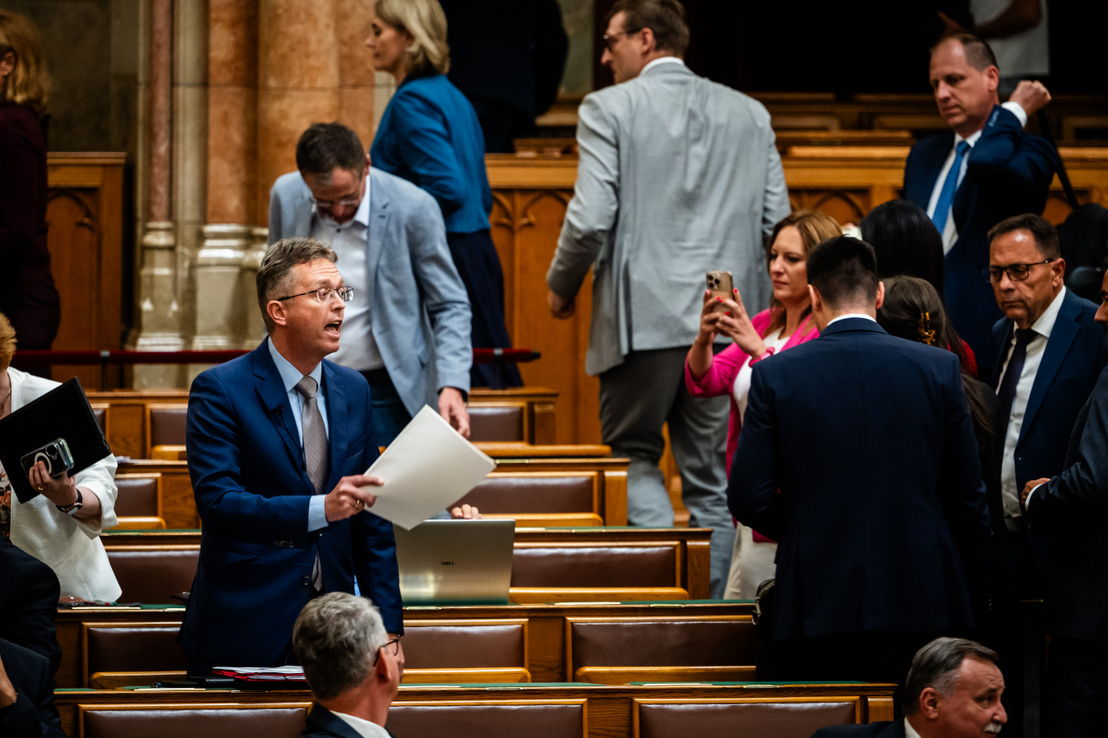
During an increasingly heated session, Magyar addressed former culture and innovation minister and now opposition MP Balázs Hankó, referring to the detention of several people who had worked around him and asking how he could remain sitting in parliament while former colleagues had been taken away by the authorities.
Hankó then requested the floor on the grounds that he had been personally mentioned. He accused Magyar directly of threatening him with imprisonment and asked how a prime minister could know in advance that he would end up in prison.
The presiding officer eventually withdrew Hankó’s right to speak after ruling that he had departed from the subject of his personal response. Hankó continued without a microphone. Fidesz and KDNP MPs then walked out of the chamber, while Tisza MPs responded with applause.
Whether one regards Hankó's interpretation as justified or politically exaggerated, the underlying parliamentary confrontation happened.
And that matters.
Hungarians increasingly joke about the political use of the word “prison.” But there is a serious constitutional question beneath the humour.
A prime minister can promise investigations. A government can establish anti-corruption institutions. Police can investigate, prosecutors can bring charges and courts can convict.
What a prime minister should not appear able to do is announce the destination before those institutions have completed the journey.
Changing the constitution to remove the president
The media overhaul has occurred simultaneously with an extraordinarily rapid reconstruction of Hungary’s constitutional order.
Magyar inherited the same powerful instrument that Orbán used repeatedly: a two-thirds parliamentary majority.
And Tisza has not hesitated to use it.
Prosecutors Seize Fidesz Servers
Another extraordinary episode unfolded around the confrontation with former Culture Minister Balázs Hankó. On July 27, while Hankó was involved in the heated parliamentary proceedings, Fidesz parliamentary group leader János Bóka announced that prosecutors had entered the server facility housing the parliamentary group’s IT systems. Prosecutors subsequently confirmed that servers had been seized as part of the investigation into alleged misuse of funds at the National Cultural Fund (NKA). Fidesz described the operation as part of a politically motivated “show trial” and demanded an extraordinary meeting of parliament’s House Committee.
The affair subsequently took an unusual turn. The Prosecutor General’s Office upheld complaints against the seizure, concluding that confiscating the entire server infrastructure imposed a disproportionate burden because it also disabled activities unrelated to the alleged offences. The servers were eventually returned to Fidesz for safekeeping, although the party was initially forbidden from reconnecting them. The episode added another uncomfortable question to Hungary’s democratic transition: whether an investigation into alleged corruption justified temporarily disabling a major opposition party’s communications infrastructure.
The most controversial example involved President Tamás Sulyok.
Magyar had repeatedly called on Sulyok, elected during the Fidesz period, to resign, accusing him of failing to act as an independent guardian of Hungary’s constitutional system.
When Sulyok refused, parliament changed the constitution.
The 17th Amendment to Hungary’s Fundamental Law, adopted in July, contained a provision terminating the sitting president's mandate. Sulyok ultimately signed the amendment that ended his own presidency, while warning that the measure represented a damaging precedent for Hungary’s constitutional democracy and the rule of law.
The same amendment imposed a 70-year age limit on Constitutional Court judges. Four of the court’s 15 members were consequently required to leave, including its president, Péter Polt. It also shortened future Constitutional Court terms from twelve to nine years, changed how the court’s president is selected and restored some review powers that had previously been restricted.
When a government with a constitutional majority is changing the rules governing senior constitutional offices and, as an immediate consequence, specific incumbent office-holders lose their positions, then what was wrong when supposedly Orbán did it, does it become acceptable for his successors?
The extraordinary irony of President Baka
That question becomes particularly interesting in the case of Hungary’s new president, András Baka.
He served for years as Hungary’s judge at the European Court of Human Rights, later became president of Hungary’s Supreme Court and subsequently worked at the Kúria.
His term as president of the Supreme Court ended three and a half years early when the judicial system was renewed. He claimed that this was done especially to remove him from the court.
Now Baka has returned as president of Hungary.
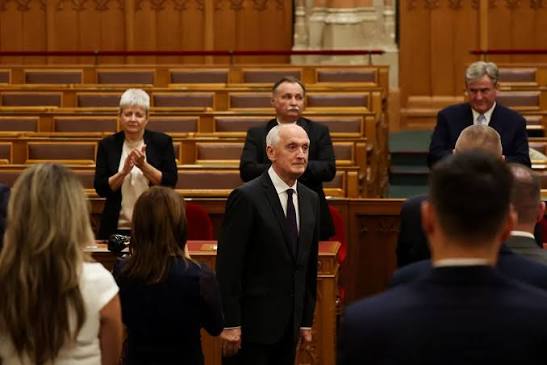
Parliament elected him on 11 August, with Fidesz boycotting the ballot. He took office on 19 August after Sulyok's constitutionally shortened mandate had ended.
A man whose own senior judicial mandate was prematurely terminated through constitutional changes under Orbán has become president after another incumbent's mandate was prematurely terminated through constitutional changes under Magyar.
Democracy is more than replacing the people in charge
Democratic restoration cannot mean that actions become democratic merely because they are undertaken against people associated with the previous government.
A government cannot credibly argue that public broadcasting must be independent while allowing the impression that two words from the prime minister can determine who appears on its management roster.
It cannot convincingly champion judicial independence while creating the impression that political leaders already know which opponents are heading for prison.
And constitutional majorities do not become harmless simply because the politicians exercising them describe their objectives as democratic.
This is the central test facing Péter Magyar.
The real measure of Hungary's new public broadcaster will not be whether it criticises Viktor Orbán. That is now easy.
The test will come when it investigates Péter Magyar, criticises his ministers, questions government contracts, exposes mistakes by Tisza officials or concludes that an opposition politician rather than the government is right.
Will its editors dare to broadcast that report? More importantly:
Will they still have their jobs the following morning?
Hungary undeniably entered a new political era on 12 April.