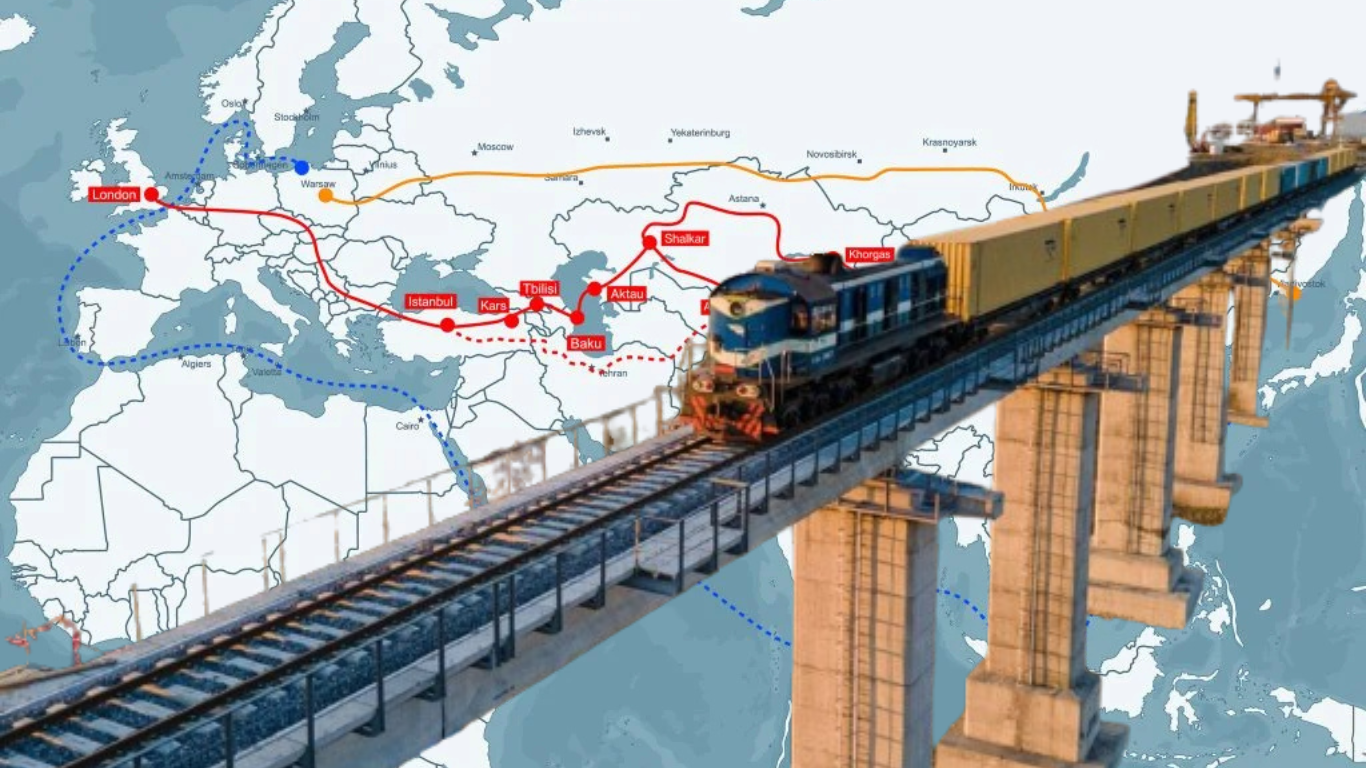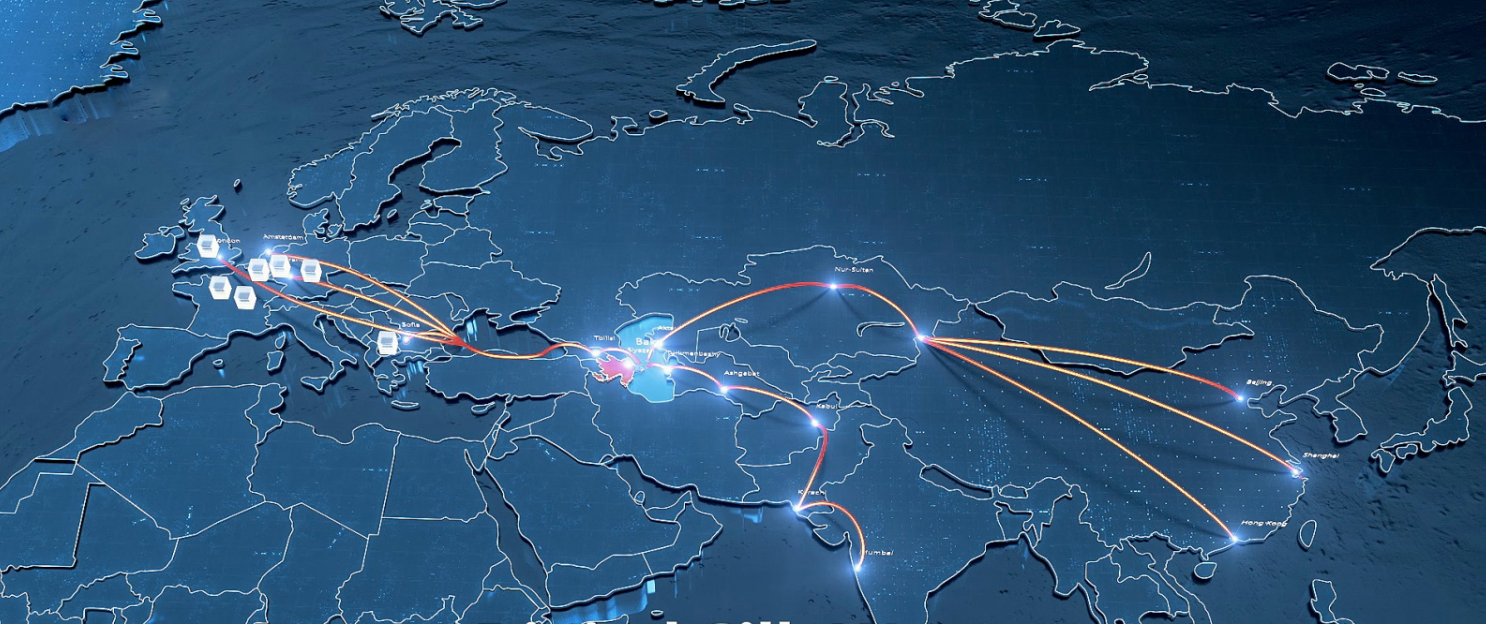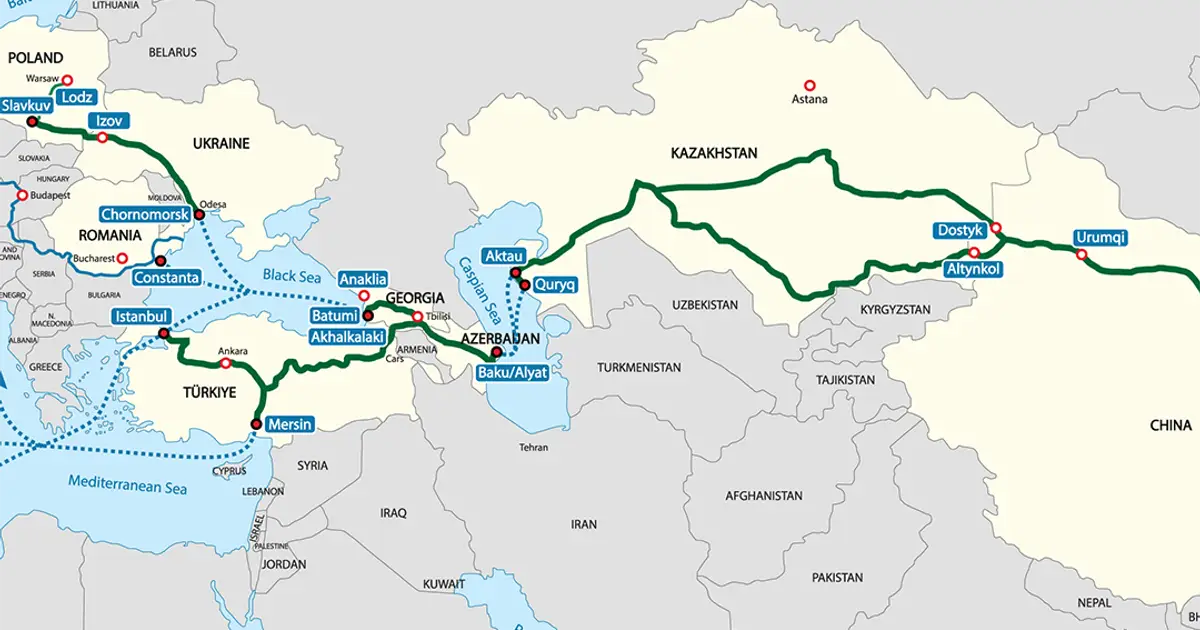
The Middle Corridor, formally the Trans-Caspian International Transport Route, is moving from geopolitical alternative to serious commercial infrastructure. Freight still remains far below the volumes carried by maritime routes or the Russian Northern Corridor, but investment is now being made at almost every major bottleneck.
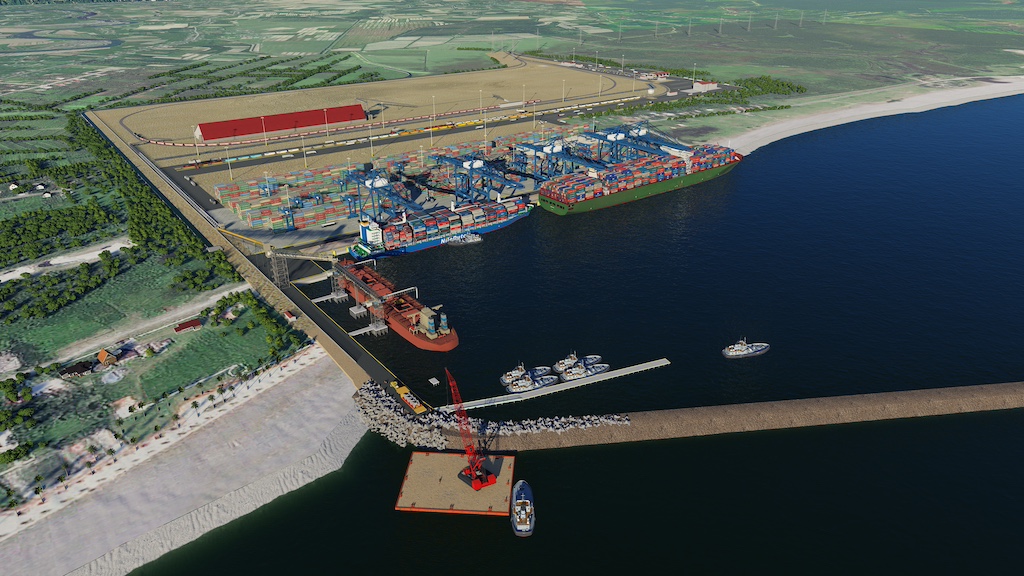
In the first 11 months of 2024 the route carried 50,000 TEU on 328 container trains, including 304 originating in China. Kazakhstan is now expanding its Caspian gateways aggressively. The first stage of the Aktau container hub provides capacity of around 140,000 TEU annually, with expansion to 240,000 TEU planned for 2027–28. The EBRD is also providing €35 million, potentially supplemented by a €10 million EU grant, for a €55 million modernization programme intended to extend berths, install ship-to-shore cranes and reduce container handling time from about four minutes to 2½ minutes.
The Sarzha complex includes general, universal and liquid-cargo terminals, while a Chinese-backed project announced in July 2026 envisages 470 billion tenge of investment and first-stage capacity of up to 15 million tonnes annually.
“Nearby Kuryk is developing as a second gateway.”
EuroAsia.News
Across the Caspian, Baku's Alat port handled 8.2 million tonnes and 107,000 TEU in 2025. During January–July 2026 container traffic reached 72,370 TEU, up 20%, while dry cargo increased 82% to 1.4 million tonnes. Capacity has risen from 100,000 to 150,000 TEU, with Azerbaijan ultimately targeting 500,000 TEU and 25 million tonnes. Two new shallow-draft ships capable of carrying 780 TEU each are expected in 2027, addressing one of the corridor's most serious constraints: insufficient Caspian shipping capacity.
The western railway link is also changing. Modernisation of the Baku–Tbilisi–Kars railway raised annual freight capacity from 1 million to 5 million tonnes, strengthening the route through Türkiye.
Yet speed and price remain problematic. In June 2026, Xi'an–Alat shipments averaged roughly 14–18 days, while reaching Turkish gateways generally required 18–25 days. A 40-foot container cost around $6,450–$6,900 to Alat, $6,800–$7,100 to Tbilisi and $7,100–$7,900 to Turkish ports. By comparison, the Northern Corridor through Russia and Belarus can take 12–15 days and cost roughly $4,000–$6,000, while Shanghai–Rotterdam maritime freight was recently around $4,425 per 40-foot container, albeit with journeys generally lasting 30–40 days or more.
The Middle Corridor's complexity explains much of the premium. Chinese trains use 1,435-mm gauge, requiring transfer to Kazakhstan's 1,520-mm network; cargo must then cross the Caspian, re-enter rail in Azerbaijan and change gauge again at Akhalkalaki before entering Türkiye.
Governments are therefore focusing increasingly on digital rather than concrete infrastructure. Kazakhstan says its TezCustoms platform has cut some China-border clearance from eight hours to 30 minutes. Azerbaijan is introducing e-TIR, e-CMR, electronic permits and a Single Window logistics platform. In April 2026 TITR members also agreed on new Caspian container-service and multimodal digitalisation arrangements.
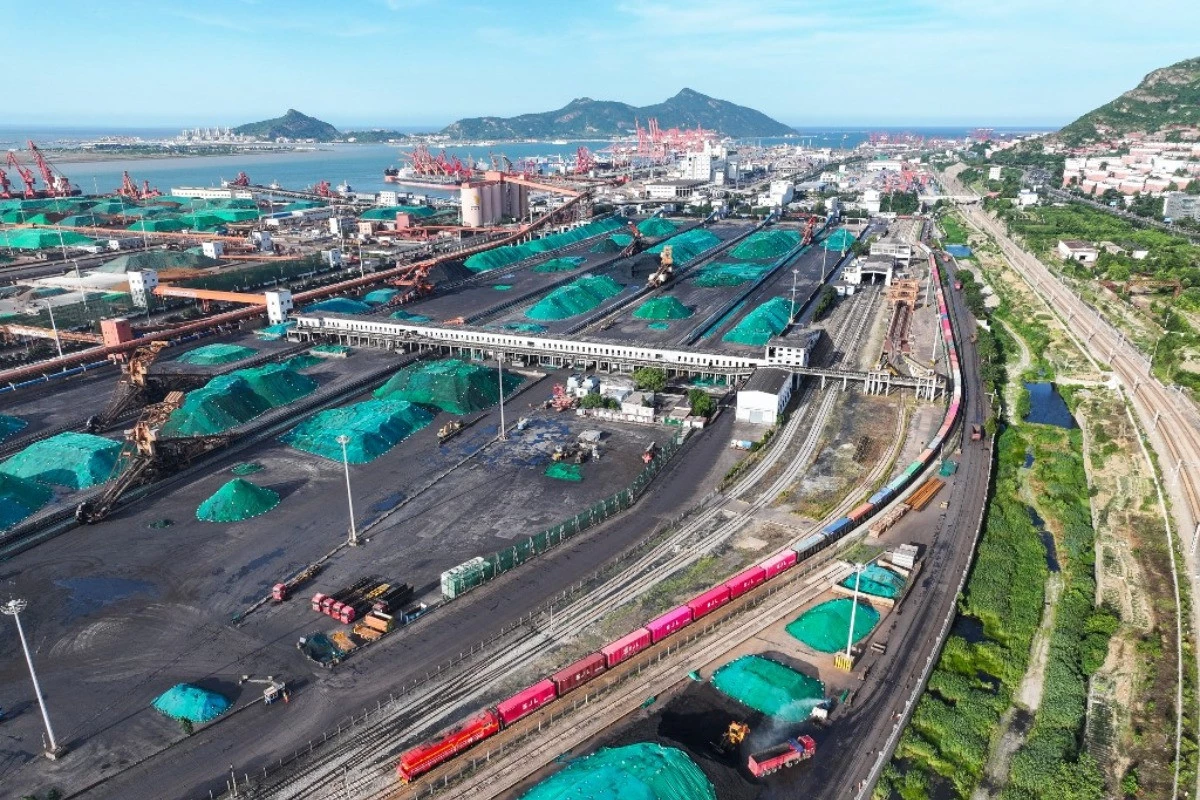
China itself has now become part of the operating structure. China Railway Container Transport joined Middle Corridor Multimodal Ltd. in 2025, alongside Azerbaijan, Kazakhstan and Georgia — turning Beijing from customer into institutional participant.
Europe is investing heavily as well. Around €10 billion was mobilised for Central Asian transport connectivity following the 2024 investors forum, while the 2025 EU–Central Asia summit announced a broader €12 billion Global Gateway package, including €3 billion for transport.
Kazakhstan wants Middle Corridor container volumes to rise from roughly 80,000 to 300,000 TEU by 2029 and transit times to approach ten days. The World Bank estimates that, with infrastructure and operational reforms, Caspian freight could exceed 11 million tonnes by 2030; without them, potential demand could be around 35% lower.
The Middle Corridor is therefore unlikely to replace either Suez or Russia's rail network. Its importance is different: it is becoming a third Eurasian artery — faster than sea, politically diversified from Russia, but still more complex and expensive than a single railway.
Its future will depend less on new maps and investment announcements than on one practical question: can a container cross several countries, two rail gauges, the Caspian Sea and multiple customs systems with the reliability of one railway?