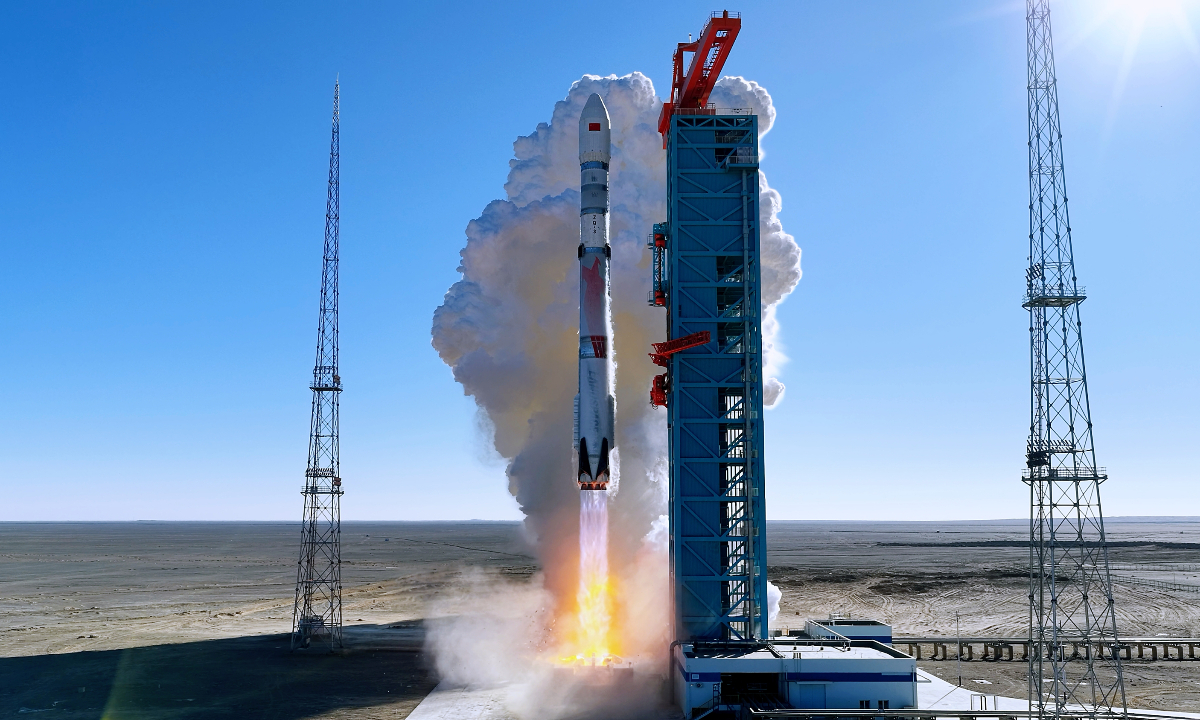
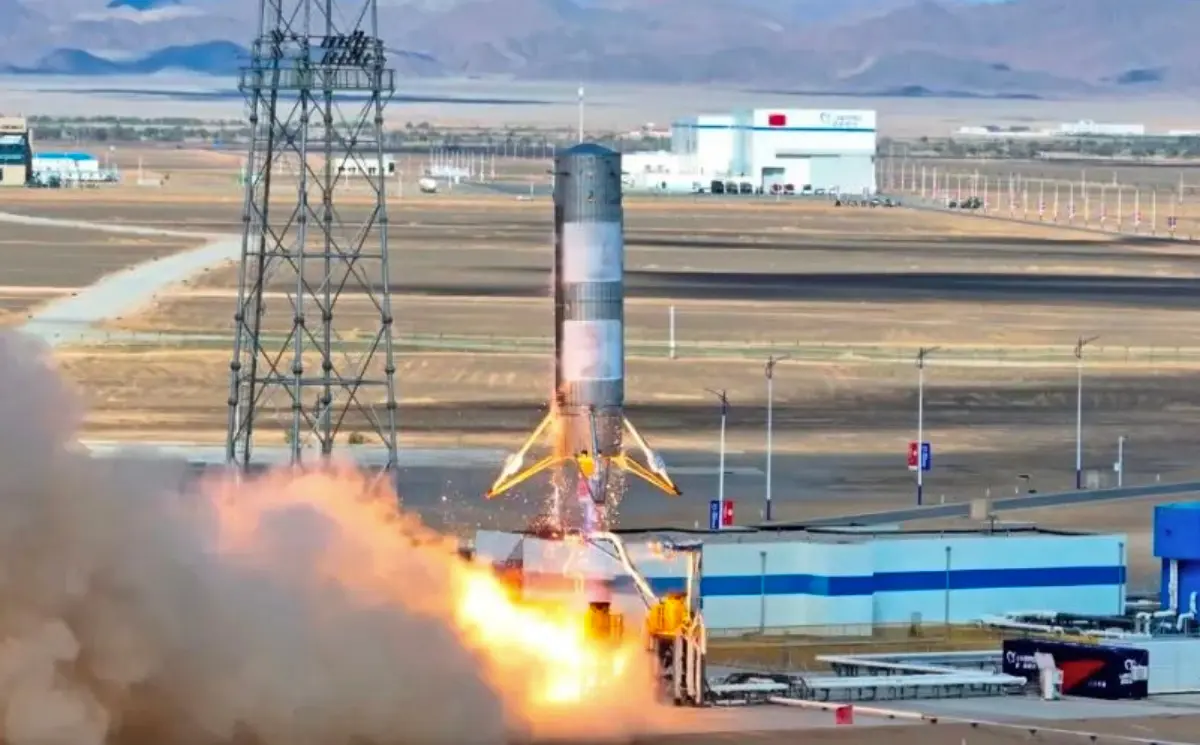
China has crossed an important threshold in reusable spaceflight. On 18 August 2026, private aerospace company LandSpace successfully landed the first stage of its Zhuque-3 rocket after launch from northwestern China. The stainless-steel booster descended back through the atmosphere, reignited its engines and touched down vertically on landing legs at a recovery site roughly 390 kilometres downrange in Gansu Province.
The achievement is more important than simply recovering an expensive piece of hardware. Until now, China had succeeded in retrieving an orbital-class booster through a very different system: on 10 July, the state-developed Long March-10B descended onto an offshore platform and was captured by a large arresting net. Zhuque-3 instead follows the architecture pioneered commercially by SpaceX — the rocket itself performs a controlled powered descent and lands upright.
After stage separation, a reusable booster must survive atmospheric re-entry, orient itself correctly, steer towards a target hundreds of kilometres away and restart engines that have already operated during launch. Zhuque-3 uses a reaction-control system, four deployable grid fins and landing legs to manage this sequence. Grid fins provide aerodynamic steering as the booster falls through the atmosphere, while engine thrust is progressively controlled during the final approach.
“That manoeuvre is extraordinarily difficult.”
EuroAsia.News
LandSpace had rehearsed the technology for years. During a 2024 test, a smaller Zhuque-3 demonstrator climbed to 10,002 metres, shut down its engine, coasted for about 40 seconds and restarted at an altitude of 4.64 kilometres while travelling around Mach 0.8. It eventually landed only 1.7 metres from the centre of its target, descending vertically at approximately 1.65 metres per second. Engineers even had to compensate for high-altitude crosswinds of about 36 m/s.
The first full orbital attempt in December 2025 was far less successful. Zhuque-3's second stage reached orbit, but an abnormal combustion event occurred during the first stage's landing sequence and the booster failed to make a soft touchdown. Rather than abandoning the design, LandSpace modified the landing procedure, conducted another major static-fire campaign in June and returned for the August attempt.
Why methane matters
Zhuque-3 is powered by liquid methane and liquid oxygen, or methalox. Methane burns with considerably less soot than kerosene, an important advantage when an engine is expected to fly repeatedly. Cleaner combustion can reduce inspection and refurbishment requirements between launches.
The rocket also makes extensive use of stainless steel. It is heavier than some aerospace composites but comparatively inexpensive, strong and tolerant of the intense heating associated with atmospheric return. LandSpace says the first stage is designed for at least 20 flights. Its full Zhuque-3 configuration is planned to stand 76.6 metres tall, weigh about 660 tonnes at liftoff and use nine TQ-12B methane engines producing roughly 900 tonnes of combined liftoff thrust. The company targets up to 18.3 tonnes to low Earth orbit when recovering the booster, or 21.3 tonnes when flown expendably.
The next milestone is even more consequential: flying the recovered booster again. LandSpace has previously said a successful recovery would be followed by refurbishment and a reflight attempt, while Reuters reports that the recovered stage is expected to be prepared for reuse within about six months.
China needs that capability for more than prestige. Its planned satellite-internet constellations will require thousands of spacecraft and far more launches than traditional disposable rockets can economically provide. Reusable boosters could dramatically increase launch frequency while reducing the amount of new hardware required for every mission.
SpaceX has already demonstrated that landing a rocket is only the beginning; the real economic breakthrough comes when boosters can be inspected quickly and flown repeatedly.
Zhuque-3 has now completed the spectacular part — returning from space and standing upright again. China's next challenge is to prove that the same rocket can go back up.