Russia dominates the infrastructure and icebreaker fleet, China is expanding commercial operations, and the European Union has just announced a fundamental shift in its Arctic strategy.
For more than 150 years, the Suez Canal has been one of the principal connections between Asia and Europe. But climate change, geopolitical conflicts and technological developments are increasing interest in a competing corridor along Russia’s Arctic coastline: the Northern Sea Route (NSR).
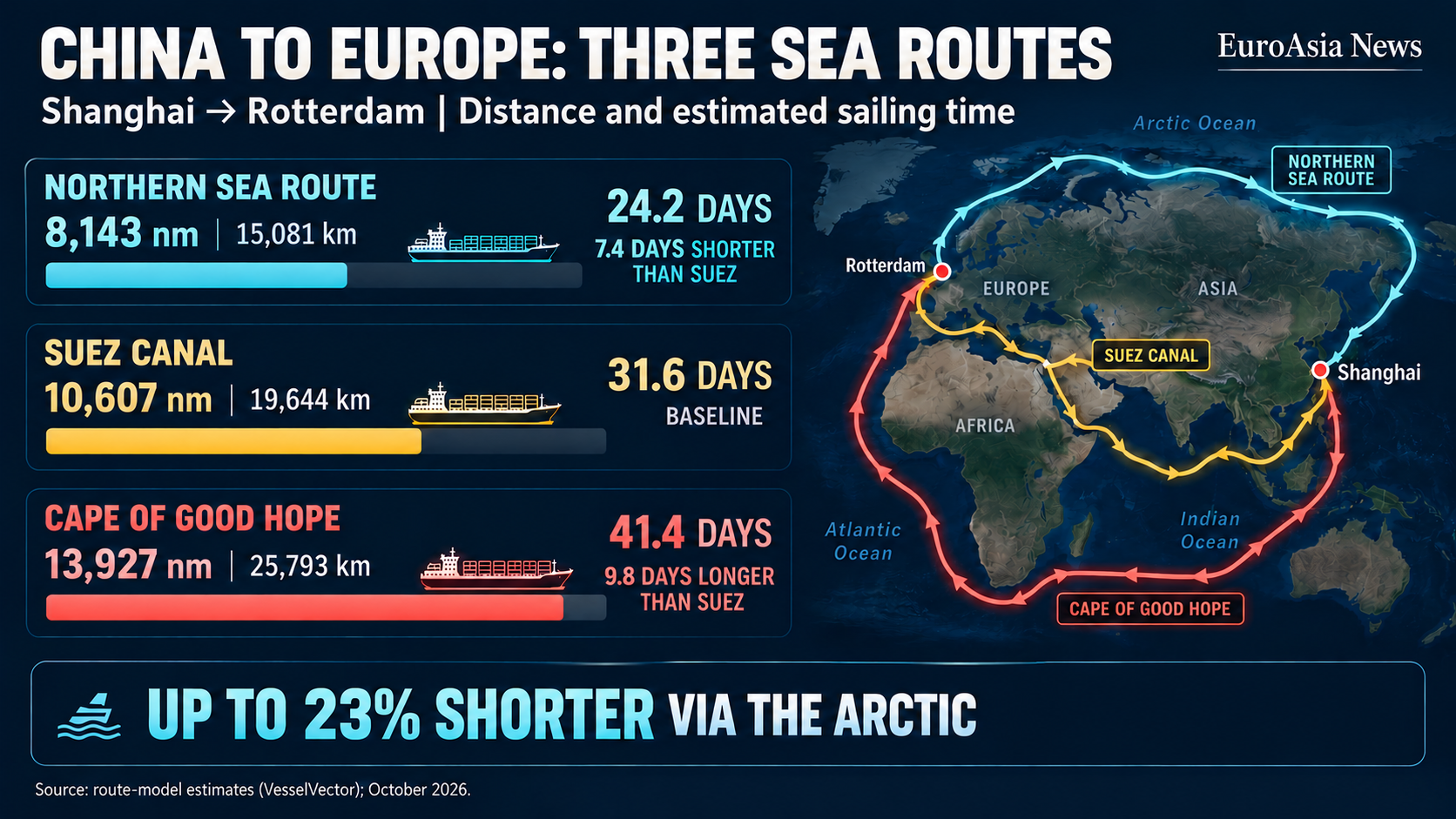
The economic differences are substantial. For a voyage between Shanghai and Rotterdam, the route through Suez covers approximately 19,644 kilometres, compared with 15,081 kilometres through the Arctic — a reduction of 4,563 kilometres, or 23%.
The third alternative, around South Africa’s Cape of Good Hope, stretches approximately 25,793 kilometres, making it 31% longer than Suez and 71% longer than the Arctic route.
At a constant sailing speed of 14 knots, these distances translate into 24.2 days via the Arctic, 31.6 days through Suez and 41.4 days around Africa. These theoretical figures exclude canal waiting times, port calls and reduced speeds in Arctic ice.
The Suez Canal: Expensive but established
Egypt’s 193.3-kilometre canal operates throughout the year, with individual transits normally requiring 12–16 hours.
Passage is expensive. Large fully loaded container vessels may pay approximately $700,000–$1.2 million per transit, depending on their size and applicable discounts. Egypt currently offers qualifying large container ships a 15% toll reduction.
Nevertheless, Suez has a decisive advantage: established infrastructure, regular services, predictable access and connections to major international ports.
Its principal weakness is geopolitical. Shipping through the Red Sea and Bab el-Mandeb Strait is exposed to regional conflicts and attacks on commercial vessels. Avoiding these risks by sailing around South Africa adds approximately ten days to a typical Shanghai–Rotterdam voyage.
Russia controls the Arctic corridor
The Northern Sea Route extends approximately 5,600 kilometres along Russia’s northern coastline, connecting the Kara Sea with the Bering Strait.
Important supporting ports and terminals include Murmansk, Arkhangelsk, Sabetta, Dudinka, Dikson, Tiksi and Pevek, although the first two lie outside the formally defined NSR.
The route passes through waters under differing Russian maritime jurisdictions. Russia controls navigation permits and provides icebreaker escort services, while aspects of its regulatory authority remain internationally disputed.
Cargo volumes demonstrate growing commercial interest. Approximately 37 million tonnes moved along the NSR in 2025, but only around 3.2 million tonnes represented full-route transit traffic.
Independent researchers recorded 103 complete transits during 2025. By the end of September 2026, the figure had already reached 104 voyages, carrying an estimated 3.7 million tonnes.
However, the majority of Arctic shipping continues to serve Russian oil, gas and other resource developments rather than conventional Europe–Asia container trade.
The icebreaker advantage: Russia far ahead
The ability to operate in ice is becoming a strategic economic asset.
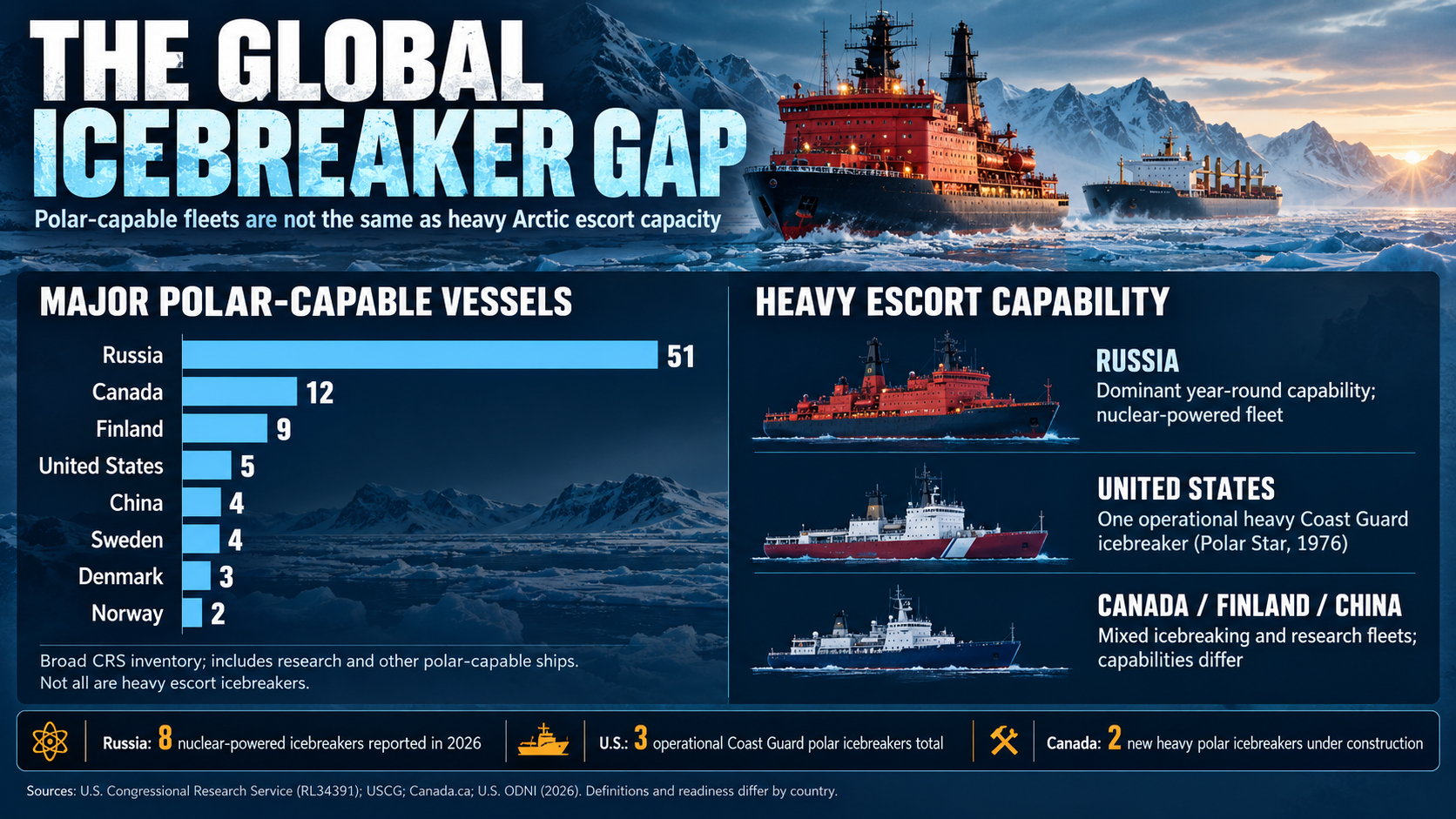
An inventory cited by the US Congressional Research Service identifies 51 major Russian polar-capable vessels, compared with 12 for Canada, nine for Finland, five for the United States and four for China.
These figures include different classes of icebreakers and research vessels; they do not represent equal heavy-ice escort capacity.
Russia also operates the world's only nuclear-powered icebreaker fleet, with eight nuclear vessels reported in early 2026. Modern nuclear icebreakers provide Moscow with a capability no other country currently matches.
The United States has only three operational Coast Guard polar icebreakers, including the heavy icebreaker Polar Star, commissioned in 1976. Washington is accelerating procurement, with contracts covering up to 11 Arctic Security Cutters.
Canada has commissioned construction of two powerful new polar icebreakers under contracts worth approximately C$6.4 billion, with deliveries planned for the early 2030s.
Finland possesses substantial icebreaking expertise but operates several ageing vessels dating from the 1970s and 1980s. China, meanwhile, is expanding its modern polar research fleet while relying on cooperation with Russia for extensive commercial Arctic operations.
Europe’s Arctic strategy takes a geopolitical turn
The Arctic has now moved considerably higher on the European Union’s security agenda.
At the European Arctic Summit in Rovaniemi, Finland, on 13–14 September 2026, leaders from more than ten EU countries called for a stronger European role in the northern region.
A month later, on 20 October, the European Commission and EU foreign policy chief Kaja Kallas presented a new strategy entitled Europe’s Northern Neighbourhood: A New Strategy for the Arctic.
Compared with the EU's 2021 approach, which strongly emphasised climate protection, international cooperation and sustainable development, the new strategy puts strategic influence much closer to the centre of European policy.
The measures include an Arctic Cable Hub to monitor and protect submarine communications cables, a broader Maritime Security Hub, expanded satellite surveillance, improved military mobility and potential joint procurement of icebreakers.
The EU is also investing €260 million through its European Defence Fund in technologies relevant to extreme environments, including specialised aircraft, sensors and equipment. However, the new strategy is clearly based on a Dual-Use (civil and military), and aligns as EuroAsia.News reported earlier with NATO's rapidly expanding military posture in the Arctic.
Environmental objectives became also not so important anymore, although climate research and sustainability remain priorities. But, the new strategy no longer repeats the EU's previous ambition to negotiate a binding international prohibition on further Arctic oil and gas development.
That distinction is significant: Brussels is not formally abandoning environmental protection, but it is increasingly treating the Arctic as an area of strategic competition.
A new commercial and geopolitical balance
The Northern Sea Route offers a potentially transformative advantage in distance, particularly for trade between northeastern Asia and northern Europe.
Yet serious obstacles remain: seasonal ice, expensive specialist vessels, uncertain sailing schedules, limited emergency infrastructure, insurance costs and geopolitical restrictions.
For conventional container shipping, Suez remains the established year-round corridor. The Cape of Good Hope offers a longer but strategically important alternative when Red Sea risks become unacceptable.
Russia, however, possesses something increasingly valuable: physical access, ports, nuclear icebreakers and operational experience along the Arctic corridor.
China recognises that advantage and is expanding commercial cooperation. Europe and North America are now responding with new investments in security, infrastructure and specialised vessels.
The Arctic is no longer simply an environmental frontier. It is emerging as a new arena of competition over international trade, strategic infrastructure and economic influence.