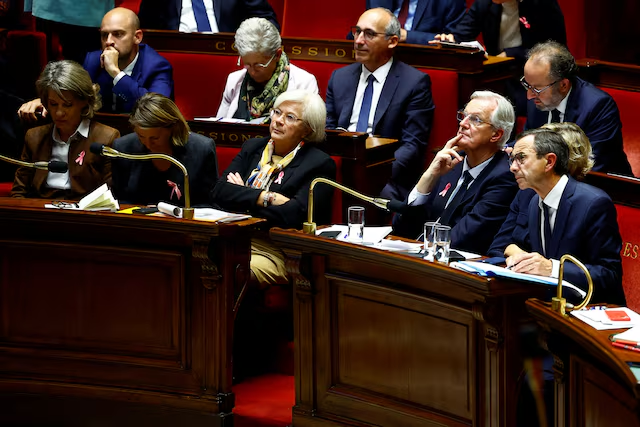
Political leaders promise fiscal consolidation but struggle to pass budgets. Markets begin asking whether the country's debt trajectory is sustainable.
During the euro crisis, the names were Greece, Portugal, Ireland, Spain and eventually Italy.
In 2026, the country making markets nervous is France.
The euro fell below $1.12 on October 5, its weakest level in 17 months, as investors sold French government bonds. France's ten-year yield approached 5%, its highest level since 2002, while the spread over equivalent German debt recently reached its widest point in approximately 15 years.
Those numbers matter because France is not Greece.
It is the euro area's second-largest economy, a nuclear power, a permanent member of the UN Security Council and one of the political foundations of the European Union.
The European Commission expects 118.1% this year and approximately 120.2% in 2027.
The budget deficit is forecast at 5.1% of GDP this year and 5.7% next year — almost twice the EU's traditional 3% ceiling.
The direction is particularly striking when compared with Europe's former crisis countries.
Greece, once synonymous with unsustainable euro-area debt, has been reducing its debt ratio dramatically. Spain has also lowered its ratio from its pandemic peak.
“Its debt problem is correspondingly enormous. France ended 2025 with public debt around 115.6% of GDP.”
EuroAsia.News, reporting from Paris
France is moving in the opposite direction.
Its debt already exceeds €3.5 trillion. Interest payments reached approximately €66 billion in 2025 and could approach €100 billion by 2029. Debt servicing is on course to compete with — and potentially exceed — some of the French state's largest traditional spending categories.
That creates the dangerous mechanism economists call a debt snowball.
When the interest rate a government pays persistently exceeds economic growth, simply stabilising debt becomes progressively harder. More tax revenue must service old borrowing, leaving less for infrastructure, schools, defence, healthcare and tax reductions.
France's growth outlook provides little comfort.
The European Commission expects GDP growth of only 0.8% in 2026 and 1.1% in 2027. Unemployment is projected to rise from 7.7% in 2025 to 8.7% next year.
Paris is attempting to respond.
The proposed 2027 budget contains tax increases, restrictions on pension increases, healthcare savings and reductions in tax advantages. But every significant consolidation measure creates political opposition.
That is the second half of France's problem.
Fiscal mathematics says the government must either cut spending, raise taxes or generate much stronger growth.
French politics makes all three extraordinarily difficult.
President Emmanuel Macron's era is approaching its conclusion, the parliament is fragmented and the 2027 presidential election is already shaping political behaviour. Few parties want to enter an election promising voters years of austerity.
France therefore faces something Greece did not possess during the worst of its crisis: enormous political weight inside the European system.
Greece could be subjected to bailout conditions by larger creditors.
Who disciplines France?
That question reaches directly to the European Central Bank.
The ECB was able to stabilise the previous euro crisis after Mario Draghi's famous 2012 promise to do “whatever it takes” to preserve the currency. Since then, Europe has created mechanisms designed to prevent self-reinforcing sovereign-debt crises.
But supporting French bonds too aggressively could create another problem: why should the ECB suppress borrowing costs if Paris repeatedly fails to control its deficit?
France is nowhere near a Greek-style default crisis today. Its economy is diversified, its institutions are strong and it retains enormous capacity to raise revenue.
That distinction matters.
But markets rarely wait until a crisis has formally arrived.
They price risk beforehand.
France's ten-year borrowing cost approaching 5%, the widening German spread and a euro at a 17-month low are therefore warning lights rather than proof of catastrophe.
The uncomfortable historical comparison is that European debt crises rarely begin with governments announcing they cannot pay.
They begin when investors slowly stop believing that existing fiscal policy can continue indefinitely.
For years Europe worried about Italian debt.
Today the more politically consequential question may be different:
What happens to the euro if the country markets begin doubting is France?