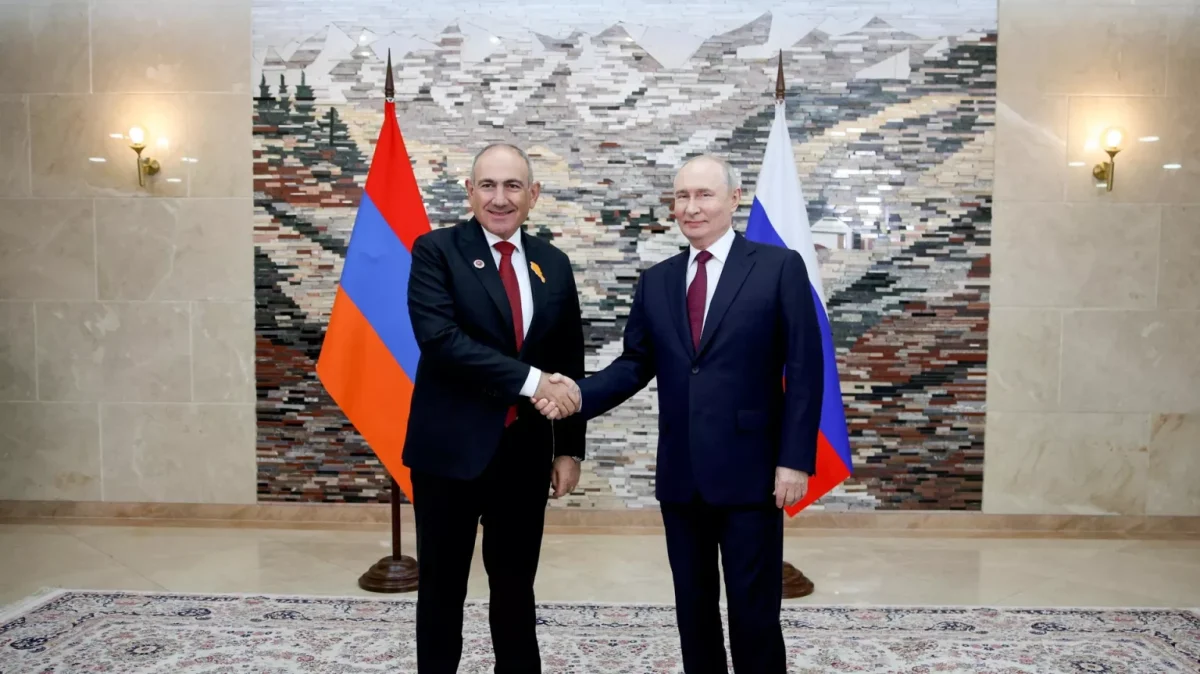
Armenian Prime Minister Nikol Pashinyan's meeting with Russian President Vladimir Putin in Bishkek on September 1 came with an unusually large economic delegation on the Russian side, including Foreign Minister Sergei Lavrov, Deputy Prime Minister Alexey Overchuk and the heads of Russian Railways, Rosatom and other major institutions. The message was difficult to miss: relations with Armenia are no longer merely diplomatic.
The economic future of the relationship is now on the table.
Earlier in the day, Pashinyan delivered an elaborate explanation of what he calls Armenia's “balanced and balancing foreign policy.” Armenia, he said, develops relations with different geopolitical poles in order to preserve its sovereignty. He simultaneously highlighted strategic relations with the EU and several Western states while announcing that he would discuss with Putin “the strategy for the further development” of Russian-Armenian relations.
The difficulty is that economic integration is not a diplomatic reception where everybody can be invited to the same table.
EU and EAEU Membership Cannot Simply Be Combined
Armenia's parliament already adopted the law “On the Launch of the Process of the Republic of Armenia's Accession to the European Union” in March 2025. Pashinyan himself told the European Parliament in 2026 that the law represented the political crystallisation of Armenia's European direction.
“It sounds attractive.”
EuroAsia.News
Yet when speaking inside the Eurasian framework, Pashinyan stresses that the legislation does not mean Armenia is already joining the EU. In August he acknowledged the central fact himself: simultaneous membership of the EU and the EAEU is impossible. He argued that Armenia can remain inside the EAEU until it is actually ready and invited to enter the European Union.
Legally, that distinction exists. Politically, however, it begins to look like an attempt to prolong the benefits of both directions for as long as possible.
Moscow has made its position equally clear. The EAEU is a customs and economic union based on common external tariffs and the free movement of goods, services, capital and labour. EU membership requires participation in another customs and regulatory system. Russia therefore argues that eventually Armenia must choose.
Who Pays for the Transition?
For Armenia this is not an abstract geopolitical debate.
Russia remains one of its largest economic partners and accounted for roughly 35% of Armenian foreign trade last year. Armenia benefits from access to the EAEU market, Russian energy supplies, employment opportunities for Armenians in Russia and established transport and commercial networks. Recent Russian restrictions on Armenian exports have already demonstrated how quickly political tensions can become economic problems.
The EU, meanwhile, is offering substantial incentives for diversification. Its €270 million Resilience and Growth Plan for 2024–2027 includes €200 million in grants and €70 million intended to mobilise investments. Under Global Gateway, EU-supported investments in Armenia are expected eventually to reach €2.5 billion.
That money is real, but it should not be confused with free prosperity.
Changing economic blocs means changing standards, supply chains, customs arrangements, export markets and potentially energy relationships. Russian Deputy Prime Minister Overchuk has warned that leaving the EAEU could mean higher energy and food prices and a severe reduction in Armenian exports to existing markets. Those are Russian estimates and should be treated as such, but the underlying issue is undeniable: economic realignment carries a cost.
And ultimately governments do not pay that cost. Citizens do.
Businesses lose markets or find new ones. Consumers pay different prices. Workers discover whether promised investment actually produces jobs. Politicians can announce “European integration” today while the economic consequences emerge years later.
Two Chairs Cannot Remain Together Forever
There is nothing inherently illegitimate about Armenia seeking closer relations with Europe. Nor is Armenia obliged to remain indefinitely inside a Russian-centred economic system.
But voters deserve clarity about the price and consequences of either decision.
Pashinyan's increasingly sophisticated explanation — Armenia is heading toward Europe but has not joined Europe; Armenia accepts that the EU and EAEU are incompatible but intends to remain in the EAEU; Armenia is building strategic relations with the West while promising Russia that bilateral relations should continue developing — may postpone the decision.
It cannot eliminate it.
The real question is therefore not whether Pashinyan can persuade Putin with another carefully constructed explanation. It is whether Armenian citizens understand that eventually one of the two chairs will be removed — and they, rather than the politicians delivering today's speeches, will live with the economic consequences.