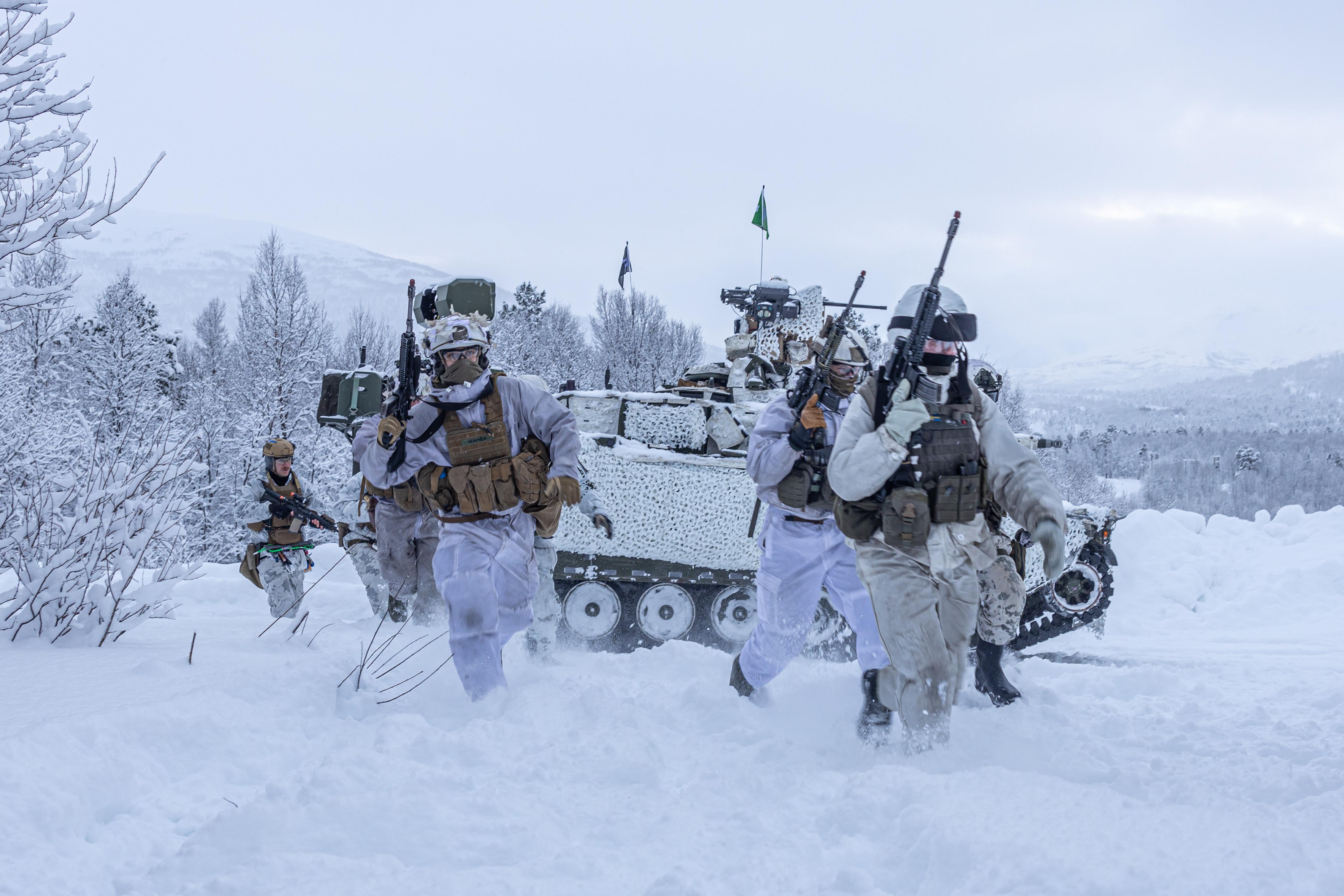
The transformation is already underway. In February 2026 NATO launched Arctic Sentry, bringing military exercises and operations across the High North under a more coordinated command structure. In June, the alliance established Forward Land Forces Finland, placing a multinational NATO presence close to Russia's northwestern frontier. Exercises including Cold Response are now training tens of thousands of Allied personnel for warfare under Arctic conditions.
The strategic geography changed fundamentally when Finland and Sweden entered NATO. Seven of the world's eight Arctic states are now members of the alliance; Russia is the only exception. What was once a region with several non-aligned states has effectively become a vast NATO–Russia frontier stretching from Finland and Norway through the North Atlantic to Canada and Alaska.
It points to Russia's Arctic military bases, Northern Fleet, nuclear submarines, missile systems and increasingly close cooperation with China. The Arctic also protects the sea routes linking North America with Europe and contains enormous reserves of hydrocarbons and critical minerals. Melting sea ice is simultaneously making the Northern Sea Route increasingly accessible. (NATO)
“NATO argues that the expansion is defensive.”
EuroAsia.News
Yet there is an important contradiction in the threat narrative.
On August 30, a NATO official said the alliance sees no imminent threat of a Russian attack on NATO territory. Finnish President Alexander Stubb similarly argued that Russia would be unlikely to risk attacking NATO and currently lacks the capacity to open another major military front. (Reuters)
Nevertheless, military preparations continue to move north.
Is NATO Moving Beyond Ukraine?
Ukraine has certainly not been formally abandoned. At its July 2026 summit NATO members committed another €70 billion in military assistance for Kyiv, while Ukraine remains heavily dependent on Western funding, weapons and air defence. Its new defence leadership is seeking further financing as the war continues.
But strategically, the alliance is clearly preparing for a confrontation with Russia that extends far beyond Ukraine.
After years of war, sanctions and enormous military expenditure have failed to produce a decisive defeat of Russia. Moscow still controls substantial Ukrainian territory, Russia's military-industrial production has expanded, and there is no obvious military path to a quick Western victory.
The Arctic therefore risks becoming the next arena in a much broader confrontation.
Russia's Foreign Minister Sergei Lavrov said on August 31 that NATO's expanding Arctic presence represented a "direct threat" to Russia. Moscow argues that NATO exercises, bases and forces near its northern territory increase rather than reduce the possibility of an accidental confrontation. NATO, in turn, says it is responding to Russian militarisation.
This is the familiar security dilemma: each side describes its own forces as defensive and the other's as aggressive. Each new deployment then becomes the justification for another.
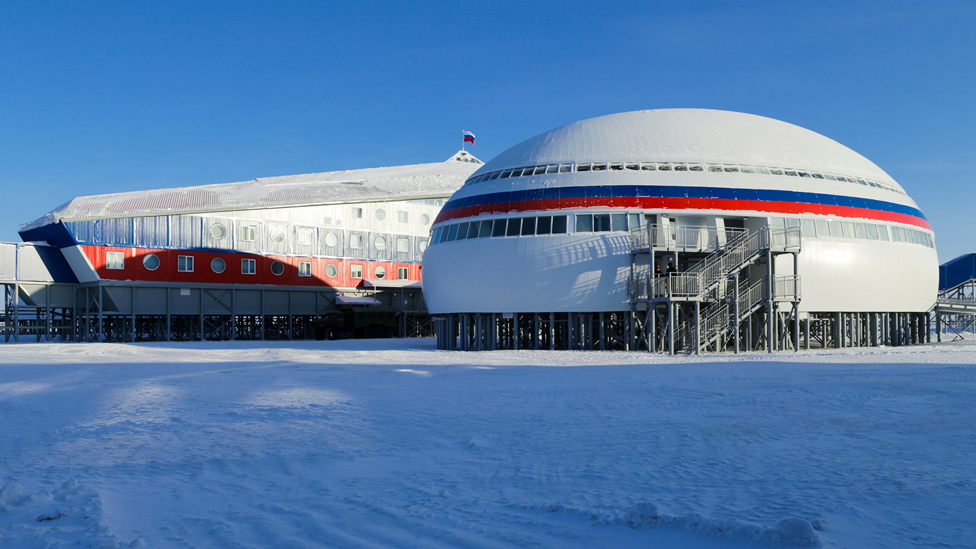
From a Zone of Cooperation to a Military Frontier
What makes this development particularly striking is that the Arctic once demonstrated that Russia and Western countries could cooperate even when they disagreed elsewhere.
The Arctic Council, created in 1996, brought Russia, the United States, Canada and the Nordic countries together on environmental protection, scientific research, maritime safety and Indigenous issues. Its members negotiated agreements covering Arctic search and rescue, oil-spill response and scientific cooperation.
That system largely froze after 2022. Political-level meetings remain suspended, although limited scientific and working-level cooperation has gradually resumed. Even in 2026, the Arctic Council says diplomatic channels remain open and acknowledges that cooperation is still necessary.
There is another possible future for the High North.
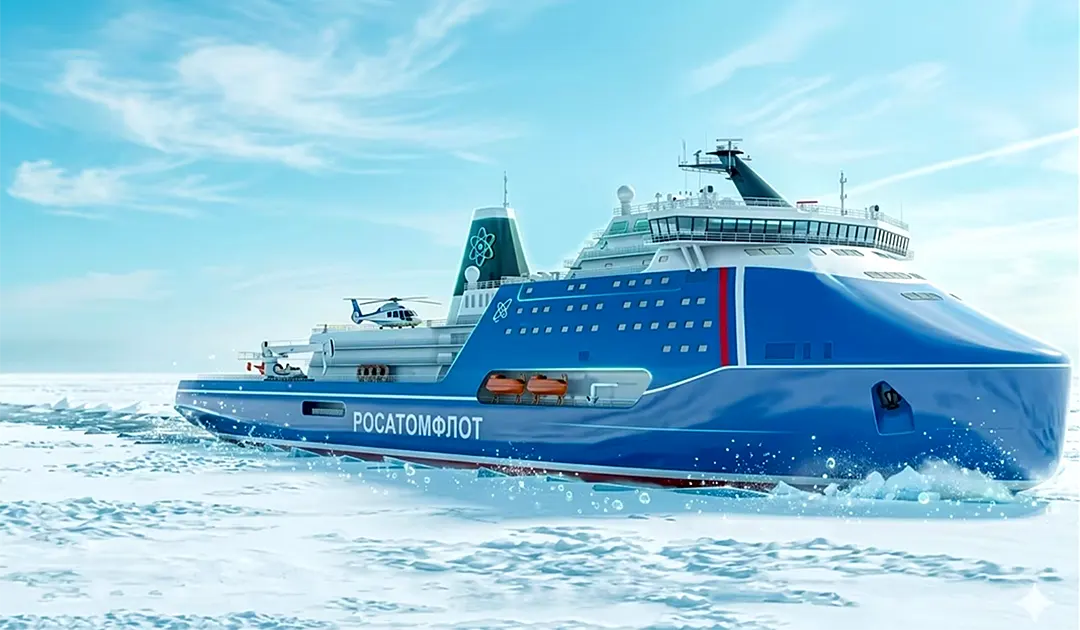
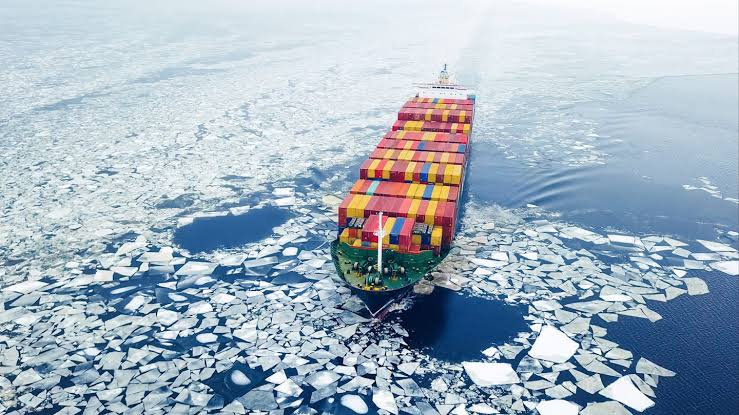
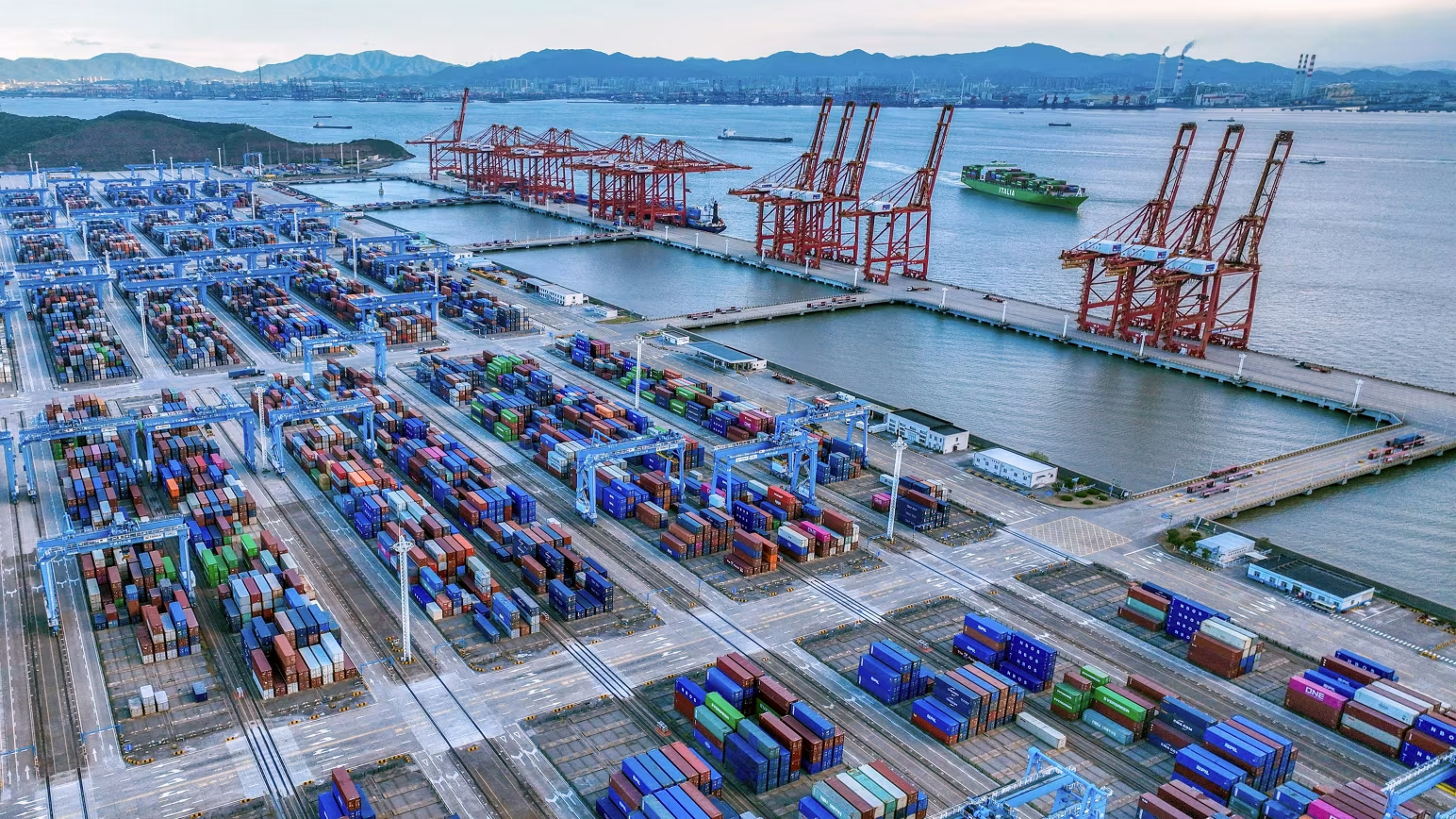
Instead of becoming NATO's next military frontier, the Arctic could form part of a wider Eurasian economic and transport space: European ports connected through Russia's Northern Sea Route to China, Japan and Korea; joint search-and-rescue systems; scientific cooperation; energy projects and shared environmental monitoring.
The choice matters because the Arctic is becoming economically more important precisely as its military geography becomes more dangerous.
Europe and Russia share a continent. Russia cannot be removed from the geography of Eurasia, just as European NATO states cannot be removed from the Arctic. Permanent confrontation therefore produces an uncomfortable logic: when one battlefield reaches stalemate, attention shifts to another frontier.
Ukraine should have demonstrated the extraordinary costs of allowing political disputes to become military ones.
If the lesson instead becomes that confrontation with Russia must simply move from the Black Sea to the Barents Sea, the Arctic may cease to be one of the world's last great zones of international cooperation and become its next heavily armed dividing line.