Their alternative route could save thousands of kilometer’s, but limited capacity, expensive transfers and an estimated $55 billion investment requirement remain formidable obstacles.
When the foreign ministers of Kazakhstan, Uzbekistan, Kyrgyzstan, Tajikistan and Turkmenistan met their Georgian counterpart in Batumi on 23 October, transport infrastructure was high on the agenda.
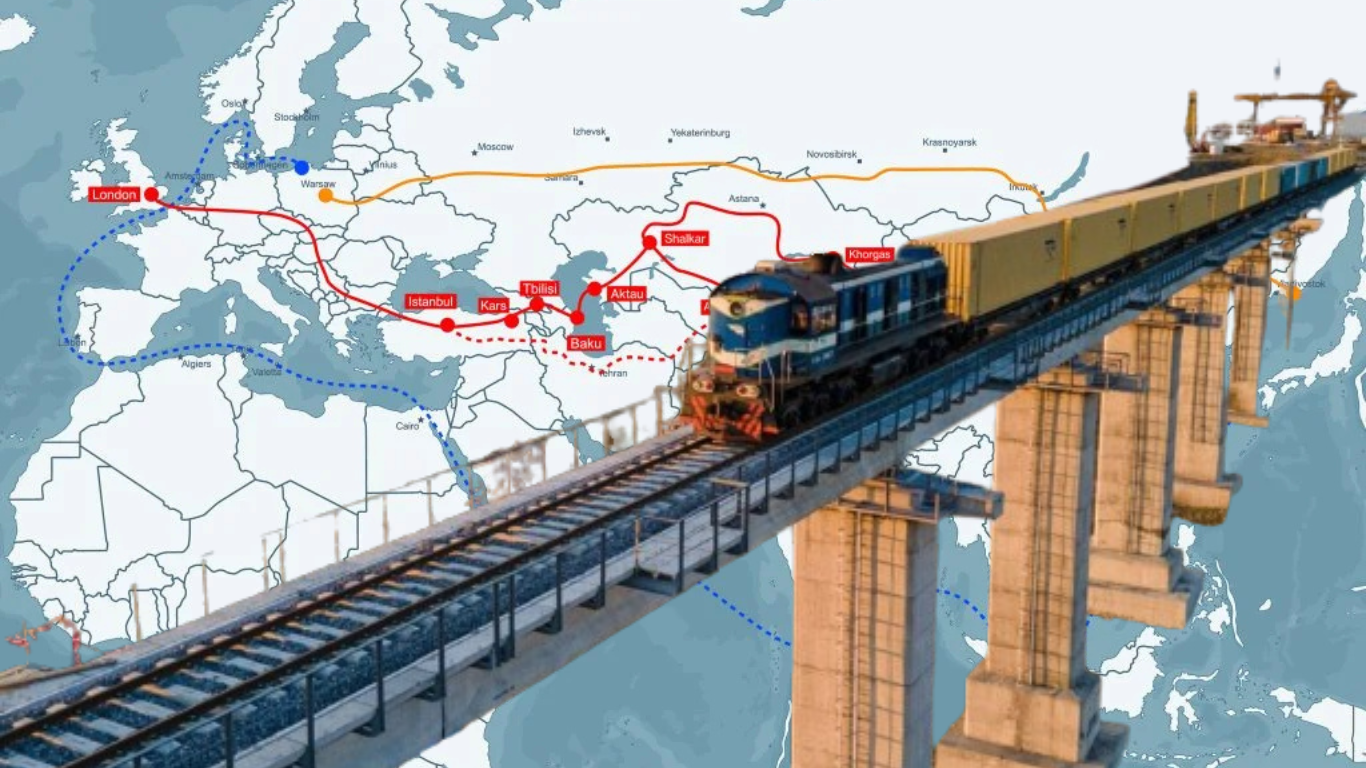
Their principal ambition is to expand the Middle Corridor, connecting China with Europe through Kazakhstan, the Caspian Sea, Azerbaijan, Georgia and Türkiye.
But can the route genuinely compete with Russia's northern railway corridor and the world's cheapest large-scale option, maritime shipping?
“7,000 kilometer’s versus 10,000 and 20,000 A frequently cited China–Europe comparison puts the Middle Corridor at approximately 7,000 kilometer’s, compared with 10,000 kilometer’s for the railway route through Russia and 20,000 kilometer’s for maritime shipping via Suez.”
EuroAsia.News, reporting from Tblisi
The actual distance depends on the departure and destination ports.
Despite being approximately 30% shorter than the northern railway in this comparison, the Middle Corridor is not necessarily faster.
Historical OECD benchmarks give China–Europe delivery times of 16–20 days via the Middle Corridor, 14–18 days through Russia and 28–40 days by sea.
The reason is simple: distance is only one factor. The Middle Corridor requires transferring cargo between trains and ships, crossing the Caspian Sea, and navigating different railway systems and border procedures.
The shortest route is not the cheapest
OECD comparisons, based on 2020 freight conditions, offer an instructive illustration.
Transporting a 40-foot container from Chengdu to Europe cost approximately:
Middle Corridor: $3,500–4,500.
Northern railway: $2,800–3,200.
Maritime route: $1,500–2,000.
At the midpoint of those historical ranges, the Middle Corridor was approximately 43% more expensive than the northern railway and 129% more expensive than maritime shipping.
These figures are benchmarks, not current freight quotations. Nevertheless, they illustrate the difficult economics of a route involving numerous transfers and transport operators.
A major capacity disadvantage
The Middle Corridor transported approximately 4.48 million tons in 2024 and 4.12 million tons in 2025, according to Kazakhstan's transport ministry.
That represents a decline of around 8% despite years of expansion.
Container volumes performed better, reaching approximately 77,000 TEU in 2025, with a target of 300,000 TEU by 2029 — almost four times the current level.
The OECD records 177.7 million tons across the much broader Northern Eurasian Corridor in 2023, including 2.6 million TEU.
These figures cover different geographic networks and years, so they cannot be treated as a perfectly like-for-like market-share comparison. They nevertheless demonstrate the enormous difference in operating scale.
Another structural problem is the lack of return freight. During January–August 2026, ADY Express reported 53,574 TEU on the Middle Corridor, including 42,642 westbound but only 10,932 eastbound.
Nearly four containers moved west for every one moving east.
That imbalance raises costs because trains, ships and containers frequently must return with unused capacity.
The Caspian Sea problem
Cargo arriving at Kazakhstan's Aktau or Kuryk ports must cross the Caspian Sea to Azerbaijan before continuing west.
Port handling, ferry availability and scheduling create substantial delays. Freight can move rapidly across Kazakhstan, only to lose time waiting for a vessel.
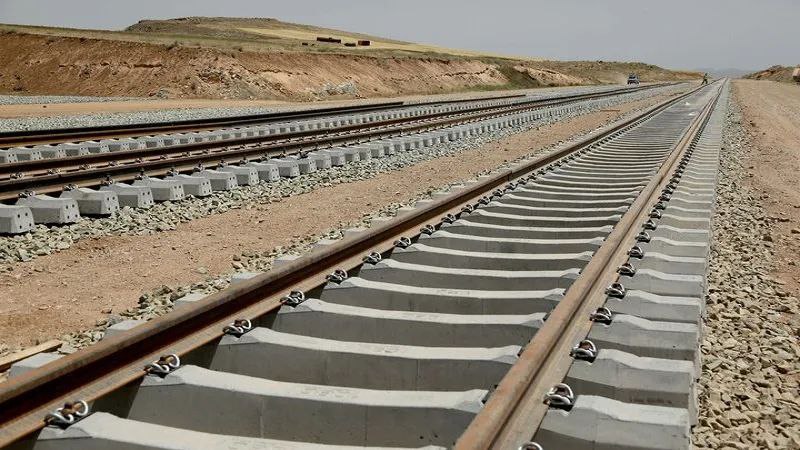
The Baku–Tbilisi–Kars railway provides an alternative connection towards Türkiye. Its approximately 826-kilometre line crosses Azerbaijan, Georgia and Türkiye.
Following modernisation completed in 2024, its annual freight capacity increased from approximately one million to five million tons.
However, the corridor still needs stronger port infrastructure, better customs coordination, digital documentation and more reliable shipping services.
$55 billion to become competitive?
A new World Bank assessment published in September 2026 estimates that countries along the Trans-Caspian Corridor require at least $25 billion in core infrastructure investment through 2040.
Another $30 billion is estimated for connecting infrastructure, logistics hubs, roads and inland terminals.
The combined requirement is approximately $55 billion.
The World Bank projects that coordinated investment and policy reforms could more than triple corridor trade volumes, halve travel times, boost GDP by 3.3% and help create two million additional jobs by 2040.
The European Union and its partners have already announced more than €10 billion in connectivity commitments under the Global Gateway framework. These commitments are not equivalent to completed construction expenditure.
In February 2026, the World Bank also approved an $846 million guarantee intended to mobilise $1.41 billion for Kazakhstan's railway connectivity.
More than another route to Europe
The Middle Corridor's economic significance extends beyond transporting Chinese products to European consumers.
For Kazakhstan and Uzbekistan, it creates access to additional export destinations. Azerbaijan can strengthen its position as a Caspian logistics hub, while Georgia gains opportunities through its railways, Black Sea ports and planned Anaklia deep-sea port.
The World Bank expects improved connectivity to stimulate regional trade, not merely long-distance transit.
That distinction matters. A corridor carrying only China–Europe freight may struggle to compete with established transport networks. A corridor also handling growing regional trade could become much more commercially sustainable.
Can the Middle Corridor win?
The current competition has three distinct leaders.
The Middle Corridor offers a relatively short geographic connection and avoids Russian territory.
The northern railway retains a major advantage in existing infrastructure, capacity and historically competitive freight prices.
Maritime shipping remains the cheapest option for most large-volume, less time-sensitive goods.
The Middle Corridor's future therefore depends less on achieving the shortest distance than on reducing delays, increasing volumes and eliminating inefficient transfers.
The decisive question is whether governments can turn a strategically attractive 7,000-kilometre route into a transport service that businesses can afford to use regularly.