The figures are devastating for the CDU. The AfD won roughly 44% of the vote in Saxony-Anhalt, more than doubling its 20.8% result from 2021. Merz’s CDU, which had dominated the state for decades, collapsed to below 20%. Even more damaging for Berlin, surveys showed that 87% of voters in the state were dissatisfied with the federal government. This was not a narrow protest at a local administration. It was a rejection with national implications.
Merz therefore has little reason to look for convenient scapegoats. Since taking office, his government has pushed Germany deeper into confrontation with Russia, expanded military spending and continued large-scale weapons support for Ukraine. Berlin has moved towards acquiring American Tomahawk long-range missiles while expanding German-Ukrainian cooperation on drones, missiles and other weapons.
Then actually Germany and personally now president Steinmeier, in 2014 Germanies foreign minister, is one of the main reasons of todays problems. Steinmeier, in 2014 convinced in Kiev personally then president Janukovich to withdraw police from the streets and promised street fights would stop. The day after police withdrawal rioters stormed government buildings and Janukovich was forced to flee the country. Obviously Steinmeier was afterwards rewarded for his European actions with the post of becoming Germany's president. Now politically, especially in eastern Germany, the strategy is producing increasingly visible resistance.
“The government presents this as necessary deterrence following Russia’s invasion of Ukraine and subsequent security threats against Europe.”
EuroAsia.News, reporting from Berlin
Saxony-Anhalt demonstrates just how large that gap has become. According to Infratest dimap polling, 57% of voters supported ending German weapons deliveries to Ukraine. Among AfD voters, the figure reached an extraordinary 92%. Asked which party they trusted most to secure peace in Europe, the AfD led its competitors in the state. The party’s demand for renewed economic and political contacts with Moscow therefore addresses an issue that the federal government cannot simply dismiss as fringe sentiment.
There is an economic dimension that Berlin also risks misunderstanding. Germany built much of its post-Cold War industrial competitiveness around a combination of advanced manufacturing, exports and relatively inexpensive energy. The rupture with Russia removed a major component of that model. Whatever one thinks about the political necessity of sanctions, the economic consequences cannot be wished away.
German industry remains under pressure. Industrial production fell 1.1% in July 2026 and was 1.6% lower than a year earlier, with automobile production particularly weak. DIW now expects Germany to grow by around 1.2% this year, but estimates that roughly 70% of that growth will come from public expenditure, including the €500 billion infrastructure programme and rapidly rising defence investment. That raises an uncomfortable question: is Germany rebuilding the productive foundations of its civilian economy, or increasingly substituting state-funded military demand for the industrial model that once made it Europe’s economic powerhouse?
This is where Merz’s political weakness becomes most obvious. Germany needs an industrial strategy, competitive energy, investment, functioning infrastructure and a realistic foreign policy capable of protecting national interests without permanently eliminating diplomacy. Instead, many voters see enormous sums available for weapons while municipalities, households and companies are confronted with higher costs and economic uncertainty.
Supporters of Merz will argue that Germany cannot base foreign policy on cheap energy when Russia continues its war against Ukraine and when German authorities accuse Moscow of hybrid attacks against German infrastructure. That security argument cannot simply be ignored. Russia denies several of Berlin’s allegations, but the deterioration in relations is nevertheless real.
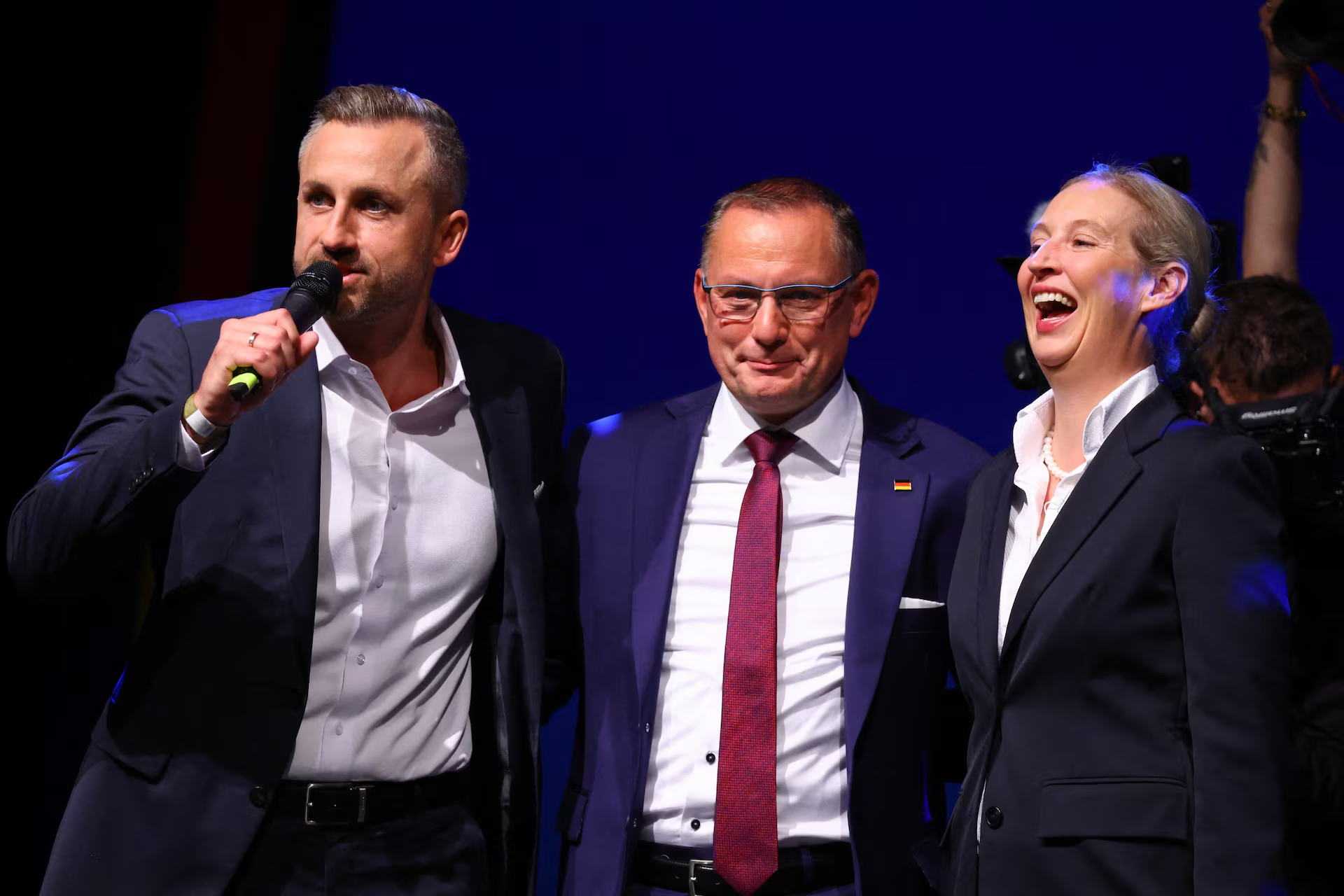
But elections are ultimately judgments on political results, not government explanations. In Saxony-Anhalt, voters delivered one of the clearest judgments imaginable.
The AfD did not reach 44% because millions of Germans suddenly changed their worldview overnight. It benefited from accumulated frustration over migration, living costs, economic insecurity, distrust of Berlin and — particularly in eastern Germany — opposition to an increasingly militarised relationship with Russia.
Merz can continue calling the AfD the problem. But after Saxony-Anhalt, that is no longer enough. When a governing party falls from 37% to below 20% while its principal opponent more than doubles its vote, the Chancellor must eventually examine his own policies.
Saxony-Anhalt may therefore be remembered not merely as the AfD’s biggest regional breakthrough, but as the moment when Germany’s post-2022 political consensus began visibly breaking apart.