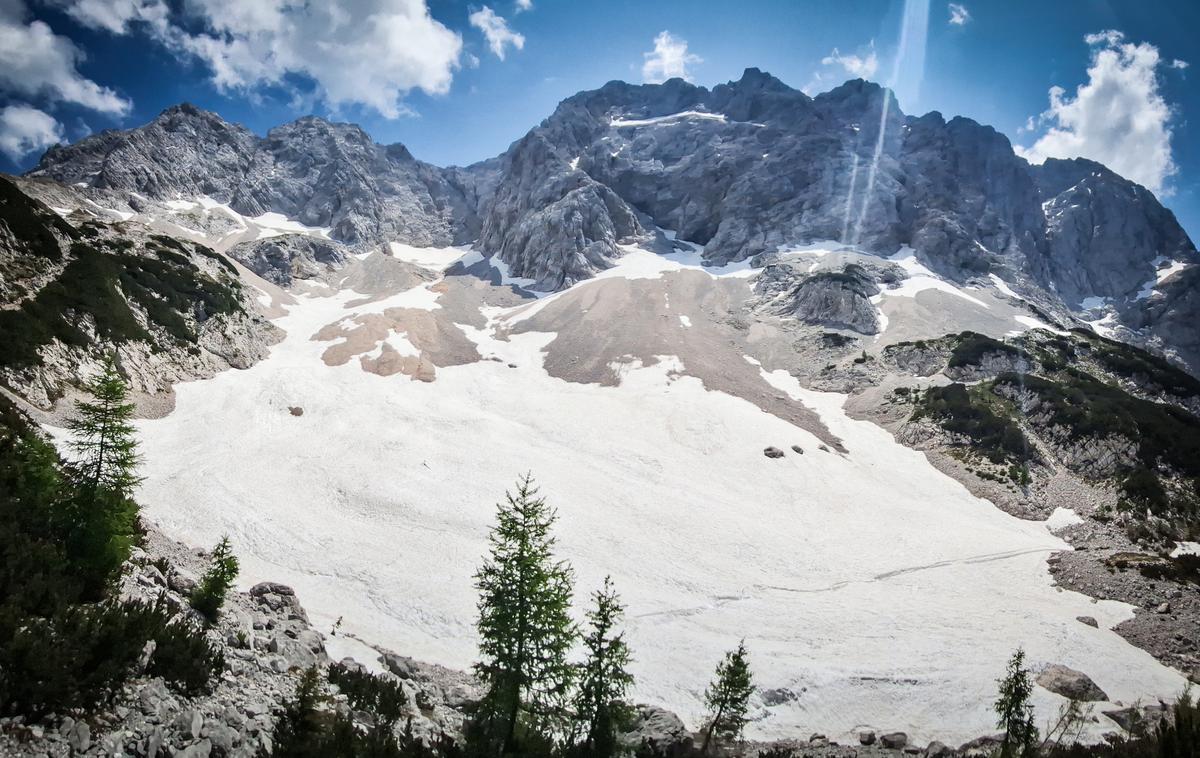
Slovenia is witnessing the disappearance of its glaciers. After 80 years of scientific monitoring, researchers have confirmed that the once-famous Triglav Glacier has effectively vanished. Only one significant ice remnant remains beneath Mount Skuta, where a layer of gravel now offers limited protection against further melting.
The consequences extend beyond disappearing mountain scenery. Scientists warn that the loss of Alpine ice threatens summer river flows, groundwater reserves, drinking water supplies and agriculture across Central Europe.
By 2024, just 0.2 hectares remained, a reduction of approximately 98.6%.
The glacier's thickness tells an equally dramatic story. Measurements in 2022 found an average ice thickness of just 1.4 metres, with a remaining volume of around 2,455 cubic meters.
“From 14 Hectares to Almost Nothing When systematic measurements began in 1946, the Triglav Glacier covered approximately 14 hectares — roughly 20 football pitches.”
EuroAsia.News, reporting from Vienna
That is less water than a single Olympic swimming pool, which holds approximately 2,500 cubic metres.
Following an unusually snow-poor winter and the exceptionally hot summer of 2026, researchers reported that the remaining ice had disappeared.
Slovenia's Final Glacier Protected by Stones
The Skuta Glacier, in the Kamnik-Savinja Alps, has survived longer because of its shaded location.
In 1946, it covered approximately three hectares. Today, only around 1.5 hectares remain, with its ice thickness reduced from several tens of metres to just a few metres.
Researchers report that 80–90% of its surface is now covered by gravel and rock debris, which shields the ice from direct sunlight.
However, this is primarily natural debris cover rather than a newly installed engineering system. It provides limited insulation, while the glacier continues melting from its sides and underneath.
Inside cavities beneath the ice, water continues dripping from the ceiling. Scientists believe Skuta is following the same path as Triglav.
The Bigger Danger: Europe's Rivers
Glaciers function as natural freshwater reservoirs. Snow accumulates during winter and releases water during warmer months, supporting rivers when rainfall becomes scarce.
As glaciers shrink, the seasonal balance changes. Melting can initially increase runoff, but once stored ice disappears, that additional summer supply is lost.
The Drava and Mura river systems, which connect Austria, Slovenia, Croatia and Hungary, depend partly on Alpine snow and ice reserves.
Reduced summer flows could affect irrigation, groundwater recharge, drinking-water wells and hydropower generation.
However, Slovenia's tiny remaining glaciers contribute only a small fraction of national river discharge. The larger regional danger comes from the disappearance of Austria's much more extensive Alpine glaciers, combined with declining snow cover and changing rainfall patterns.
Austria: 94 of 96 Glaciers Retreating
The problem extends throughout the Alps.
According to the Austrian Alpine Club's March 2026 report, 94 of the 96 monitored Austrian glaciers retreated during the 2024–2025 measurement period.
Among the 79 glaciers measured in consecutive years, the average retreat reached 20.3 metres.
Some experienced substantially larger losses:
• Alpeiner Ferner, Tyrol: 114.3 meters
• Sonnblickkees, Salzburg: 103.9 meters
• Krimmler Kees: 90.3 meters
• Pasterze, Austria's largest glacier: 54 meters
Researchers warn that many lower-altitude Alpine glaciers could disappear within the coming decades.
Switzerland Loses One-Fifth of Its Ice in Five Years
Switzerland provides another striking comparison.
According to ETH Zurich and the Swiss Glacier Monitoring Network, the country's glaciers lost more than 5% of their total ice volume during 2026 alone.
Since 2021, Switzerland has lost almost 20% of its remaining glacier ice.
Some glacier surfaces thinned by 2.5–4 metres in a single year, while certain glacier tongues lost as much as 10 metres.
That is equivalent to the height of a three-storey building disappearing from the ice surface in just one summer.
Disappearing Ecosystems and Growing Economic Costs
Melting ice exposes unstable rock, changes mountain habitats and increases risks from rockfalls and sudden water releases.
Alpine tourism must also adapt. Traditional glacier hiking routes are changing, mountain refuges face new water-supply challenges and previously frozen terrain becomes less stable.
For farmers downstream, increasingly irregular river flows may require expanded irrigation storage, water-saving technologies and changes in crop selection.
Glacier loss does not mean Central Europe will simply run out of water. But it can mean less water arriving when agriculture, industry and households need it most.
Can Europe's Glaciers Still Be Saved?
Slovenia's experience illustrates the limits of local protection.
Gravel and insulating coverings can temporarily slow melting in specific locations, but cannot reverse regional warming or rebuild entire glaciers.
The difference between 14 hectares of ice and a bare mountainside is now visible within one human lifetime.
For Slovenia, the disappearance of Triglav marks the loss of a national natural landmark. For Austria, Switzerland and neighbouring countries, it represents a broader warning about changing freshwater availability.
Europe's glaciers are not simply disappearing from the mountains. The natural water-storage systems that have supported Alpine rivers for centuries are changing with them.