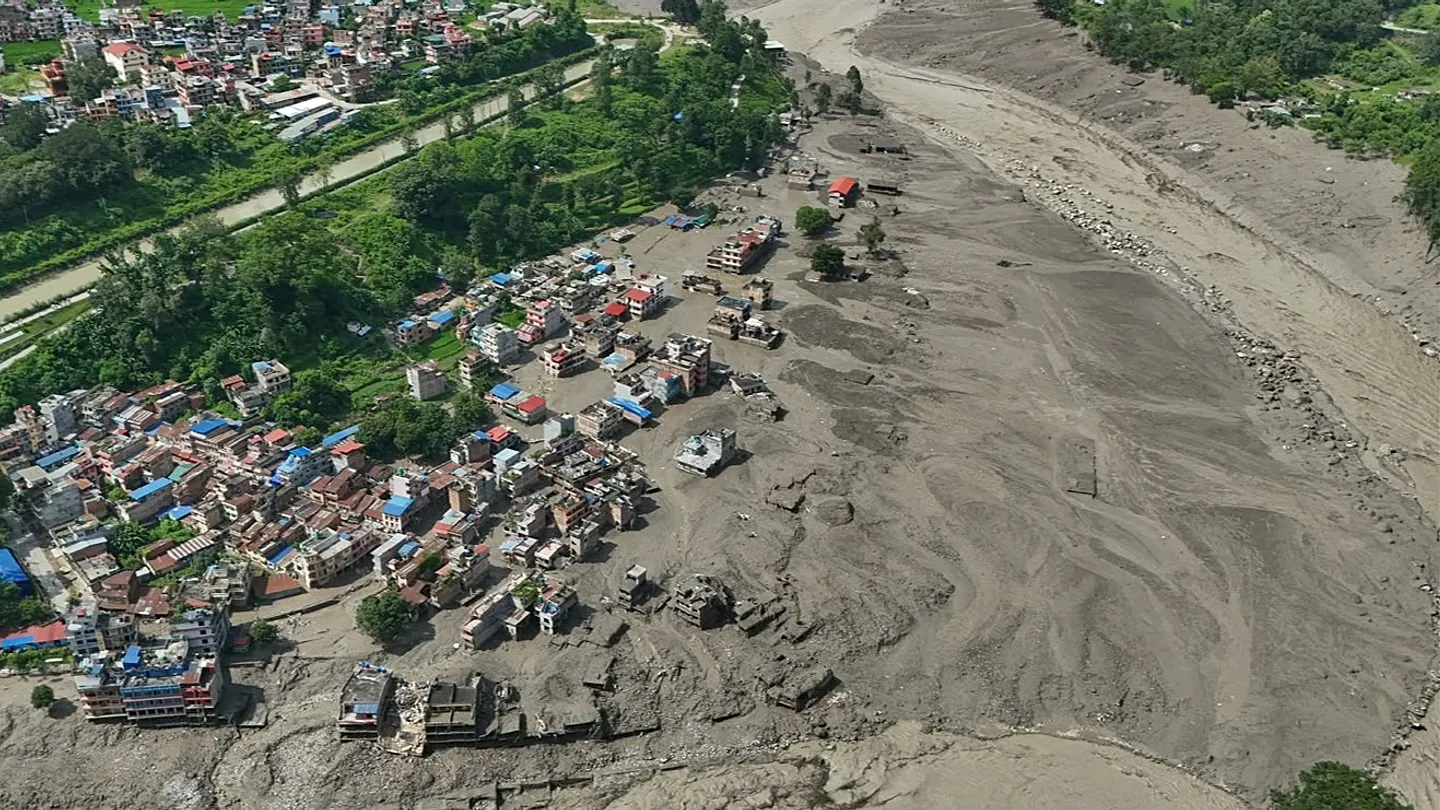
The disaster that struck northern Nepal on 26 August 2026 began high in the Himalayas near the Tibetan border. A huge mass of glacier ice and rock broke away at roughly 5,200 metres altitude and plunged about 1,200 metres into the valley below. The impact generated an avalanche and debris flow that entered the Lhende Khola river system and surged downstream into the Bhote Koshi and Trishuli rivers.
Water levels reportedly rose by as much as nine metres in just 30 minutes, destroying villages, roads, bridges and energy infrastructure. By August 30, Nepal had reported more than 730 deaths and around 2,500 people missing, while additional casualties were recorded across the border in Tibet.
Scientists are still investigating precisely why the slope failed, and it would be premature to attribute one individual event entirely to global warming. But the broader trend is much clearer.
“What initially appeared to be an earthquake was subsequently identified as seismic energy generated by the enormous glacier and rock collapse itself.”
EuroAsia.News
A Mountain System Losing Its Ice
The Hindu Kush Himalaya is warming rapidly. ICIMOD reported in March 2026 that glacier ice loss across the region has roughly doubled in rate since 2000. Between 1990 and 2020, glacier area declined by about 12 percent, while earlier research found glacier disappearance accelerated by around 65 percent during 2011–2020 compared with the preceding decade.
As glaciers retreat, they remove ice that has effectively supported mountain slopes for centuries. At the same time, permafrost — permanently frozen ground and ice inside cracks in the rock — begins to thaw. Water can penetrate deeper into fractured mountains, while repeated freezing and thawing further weakens the rock.
The result is a potentially dangerous combination: less stable glaciers, weaker rock faces, new glacial lakes and greater quantities of loose material available for landslides and debris flows.
Nepal is an extreme example, but it is not an isolated phenomenon.
The Same Warning Signs in the Alps
Europe's Alps are experiencing many of the same physical processes.
During the extreme storms of June 2024, parts of Switzerland's Valais and Ticino were hit by severe flooding, mudslides and landslides. Around 200 litres of rain per square metre fell within 24 hours in parts of the Maggia Valley. Rivers including the Rhône, Matter Vispa and Maggia reached exceptional levels, with several monitoring stations recording flows associated with events expected only once every 100 years or more.
Roads and bridges were destroyed, Alpine valleys became temporarily isolated and tourist infrastructure was affected. Flood erosion reached infrastructure around the Mörel–Riederalp cable-car area, illustrating how mountain transport systems can be exposed even when the lift itself is situated above the river.
Then came an even more dramatic warning.
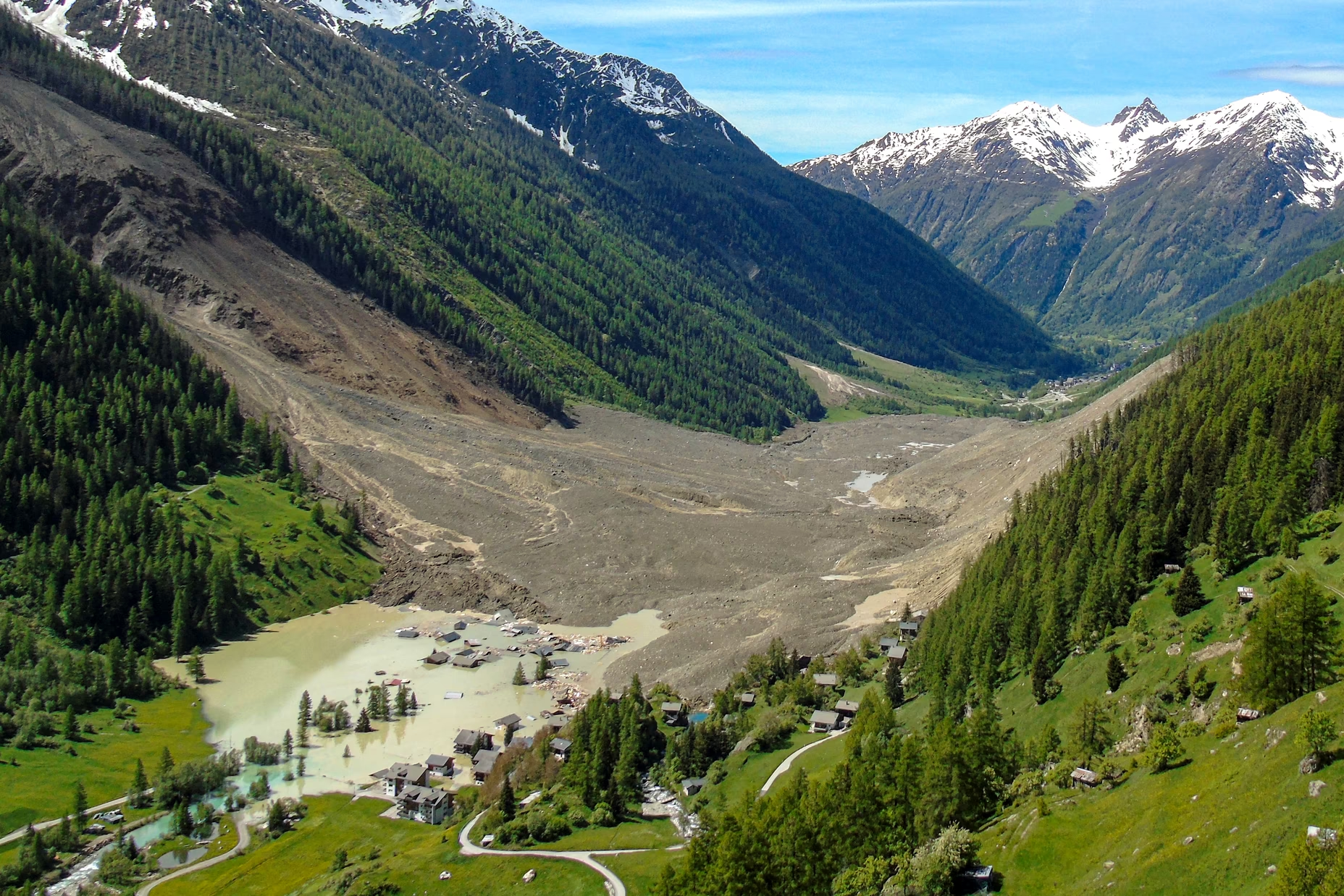
In May 2025, a massive rock collapse above Blatten in Switzerland's Lötschental fell onto the Birch Glacier. The overloaded glacier subsequently collapsed, sending rock and ice into the valley, burying most of the village and damming the Lonza River.
University of Zurich researchers concluded that geology remained fundamental to the event, but identified three climate-related contributors: glacier retreat, warming permafrost and declining snow and ice cover. Glaciologist Christian Huggel said that without climate warming, the collapse might not have occurred at all — or could have happened centuries later.
Ski Lifts Are Built on a Changing Mountain
For Alpine tourism, the danger goes beyond having less snow.
Much of the high-altitude infrastructure supporting skiing was constructed when engineers could assume that frozen mountain ground was relatively stable. Cable-car stations, lift pylons, restaurants, avalanche barriers and mountain huts are often anchored directly into rock or soil containing permafrost.
That assumption is changing.
Swiss researchers estimate Alpine permafrost is warming by around one degree Celsius per decade. Thawing ground can move, settle or fracture, threatening foundations. Mountain railways, lift towers and cable-car stations are among the infrastructure specifically identified as vulnerable.
The problem is already visible. Research on Alpine tourism has documented instability affecting infrastructure including the Eggishorn cable-car station and the Moosfluh cable-car system near the Aletsch Glacier, where glacier retreat and ground movement have required extensive monitoring and adaptation.
At the same time, lower-altitude resorts face another challenge: less reliable snow. European snow cover has generally declined, snow seasons are becoming shorter, and future snowfall is expected to decrease particularly strongly at lower elevations in the central and southern European mountains.
The Future Ski Resort May Need More Than Snow Cannons
For decades, the principal climate strategy of ski resorts was straightforward: when natural snowfall became unreliable, make artificial snow.
That may no longer be sufficient.
A resort of the future may need to spend increasing amounts not just on snowmaking but on reinforcing lift foundations, monitoring permafrost, stabilising slopes, rebuilding access roads, enlarging drainage systems and protecting stations from floods and debris flows.
Some lift infrastructure may eventually have to be moved entirely as glaciers retreat or formerly frozen ground becomes unstable.
This makes the lesson from Nepal relevant far beyond the Himalayas. Climate change is not simply melting glaciers and shortening ski seasons. It is changing the physical structure of the mountains themselves.
Nepal has demonstrated the most violent end of that process. In the Alps, sophisticated monitoring, engineering and early-warning systems can reduce the danger considerably. But they cannot stop glaciers from retreating or frozen rock from warming.
For Europe's mountain tourism industry, the coming decades may therefore bring a difficult paradox: the highest resorts will retain snow longest, yet the high-altitude terrain on which their lifts, stations and access infrastructure depend may itself become increasingly unstable.