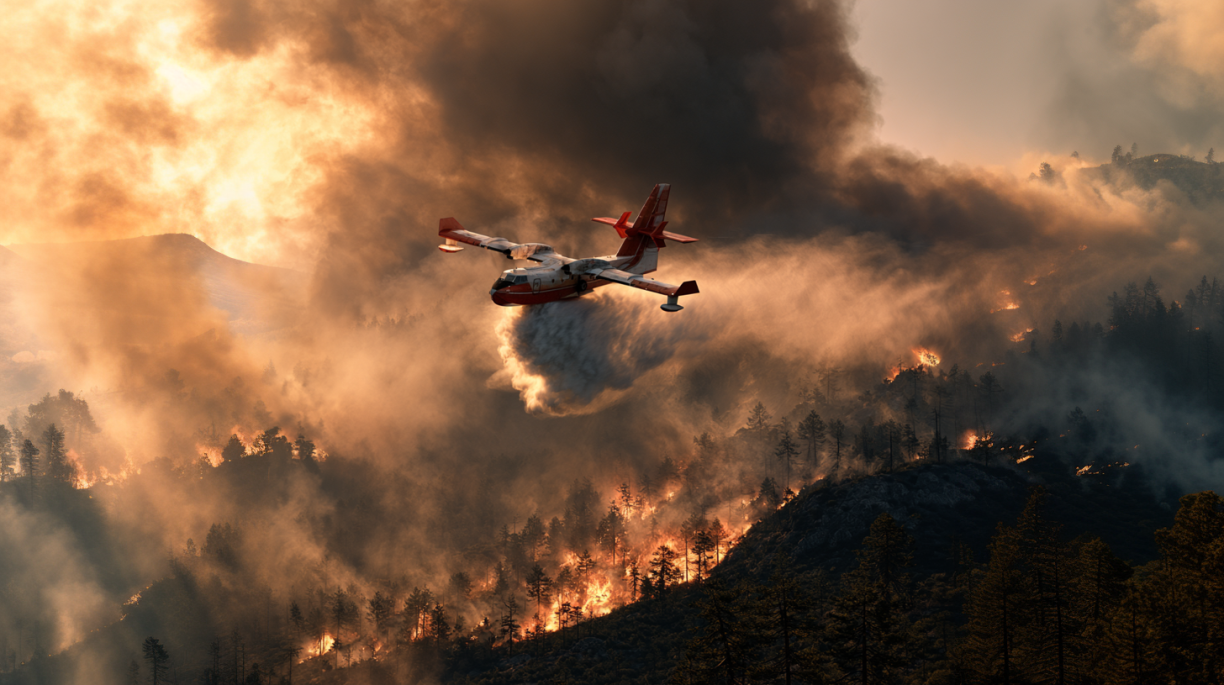
As wildfires intensify across southern Europe, France continues to depend on only 12 Canadair water bombers, averaging around 30 years of age. Maintenance problems regularly reduce the number available for missions; during parts of summer 2024, none of the aircraft could fly. Yet the first replacements are not expected before 2028, while the fleet may reach only 14 aircraft by 2033. President Emmanuel Macron’s 2022 promise to acquire 16 new Canadairs was never implemented. Budget cuts even led to the cancellation of two planned aircraft. Le Monde
Europe has another possible short-term resource: Russia’s Beriev Be-200. This amphibious jet can scoop water directly from lakes or the sea and carry up to 12 tonnes per flight. Russian aircraft and specialist crews previously supported firefighting operations in Portugal, Greece, Italy and Turkey. Portugal employed Be-200s during several severe fire seasons, while Turkey received Russian aircraft again in 2026.
EU sanctions prohibit Russian air carriers and aircraft from entering European airspace and restrict aviation-related services. Although emergency exemptions could theoretically be considered, normal contracts involving Russian aircraft, maintenance and crews are effectively blocked. Irish Aviation Authority
“Such cooperation has now become extremely difficult.”
EuroAsia.News Editorial, reporting from Paris
The political contrast is difficult to ignore. France postponed or reduced civil-protection investments worth hundreds of millions of euros, while the EU and its member states have mobilised more than $226 billion in financial, military, humanitarian and refugee support for Ukraine since 2022. A further $104 billion package was agreed for 2026–2027, including nearly $70 billion for military assistance. These are different budgets and responsibilities, but taxpayers may reasonably ask why funding can be found rapidly for geopolitical priorities while equipment protecting European lives, forests, homes and businesses takes years to arrive. EU External Action Service
Europe needs a permanent modern firefighting fleet. Until it exists, however, ideology should not prevent narrowly defined humanitarian cooperation. When communities are burning, operational capability—not the nationality of an aircraft—should be the decisive consideration.