Across Central Asia, a remarkable urban race is taking shape. Kazakhstan is promoting Alatau as a new international hub near Almaty. Uzbekistan is building New Tashkent as an expansion of its capital. Kyrgyzstan has revived plans for Asman, an eco-city on the shores of Lake Issyk-Kul. Turkmenistan has already inaugurated Arkadag, a highly controlled “smart city” near Ashgabat.
These projects are not small satellite towns. They are presented as national symbols: cities for the future, designed to solve population growth, attract investment, modernize infrastructure and give each country a new architectural image. But behind the optimistic language of “smart,” “green,” “sustainable” and “international” cities lies a difficult question: will these places become real living cities, or will they remain monumental political projects — impressive on renderings, but disconnected from everyday life?
Samarkand, Bukhara, Khiva, Merv, Taraz and Kashgar were not only architectural treasures, but also living nodes of trade, learning and cultural exchange. Today’s new-city projects borrow some of that ambition. They aim to place Central Asia again on the map of global movement: logistics, tourism, finance, education, technology and cultural branding. Yet the comparison with the Silk Road also raises the key challenge. Historic cities grew through trade, water, craft, migration and social life. New cities, by contrast, are often planned first as state visions. Their success depends on whether real communities, businesses and institutions will follow.
“Central Asia has always been a region of cities and routes.”
EuroAsia.News Editorial
Alatau: Kazakhstan’s new investment gateway
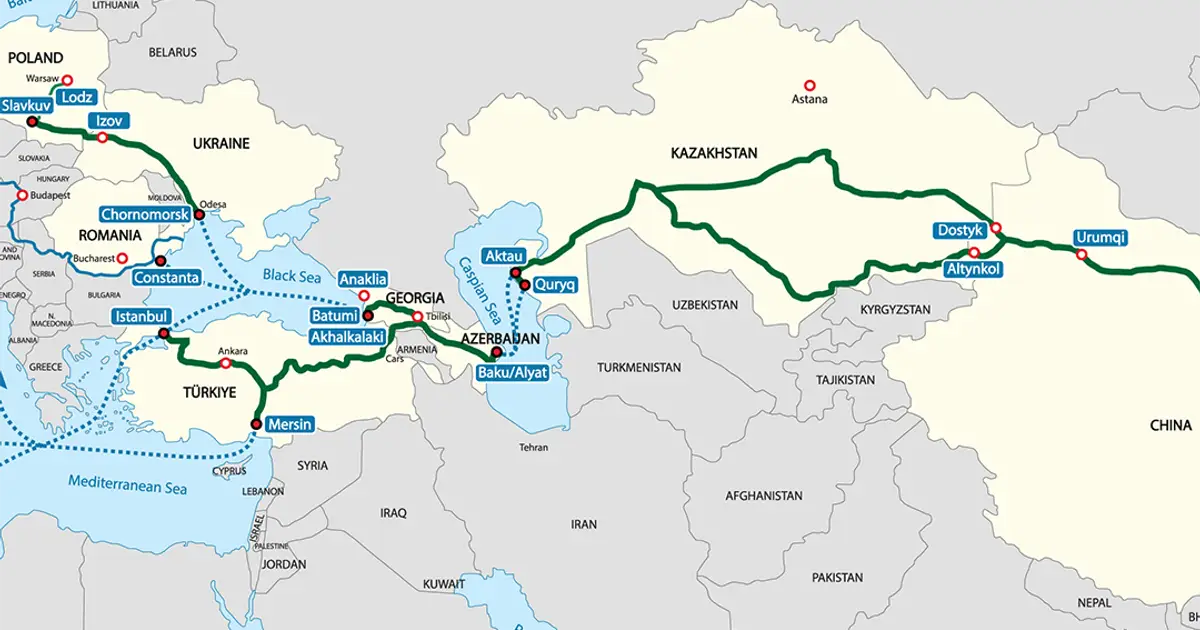
Kazakhstan’s Alatau is perhaps the most internationally visible of the current projects. Located along the Almaty–Qonaev highway, it is promoted as a strategic city and future Central Asian international hub. The official Alatau City platform describes the project as covering 88,000 hectares and positioned along a key corridor connected to the Western Europe–Western China transport route.
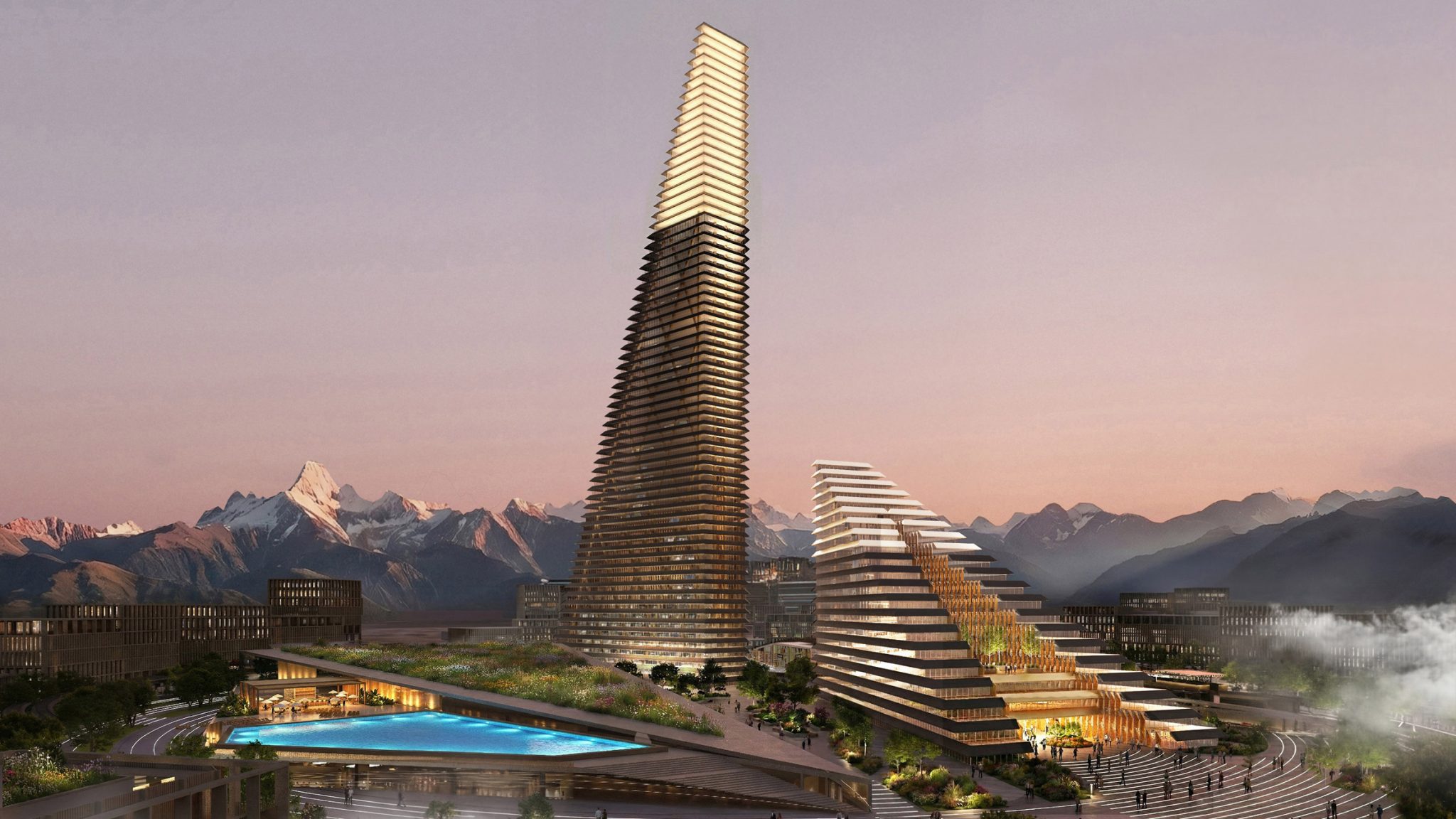
The most striking recent architectural image is SOM’s Alatau Iconic Complex and Gateway District, revealed in 2026. SOM describes the project as the future economic and administrative nucleus of Alatau, using a transit-oriented and site-specific approach. ArchDaily reports that the wider master plan extends to 2050, with the first phase of major infrastructure scheduled for completion by 2030.
Architecturally, Alatau is trying to create a new skyline language for Kazakhstan. The SOM towers are described as inspired by the Trans-Ili Alatau mountain landscape, translating geological layers and mountain forms into a vertical urban composition. This is important because it shows how the new city is not only about real estate, but also about identity. Kazakhstan wants Alatau to look global, but not anonymous. It must signal investment, technology and modern governance, while still referring to the surrounding landscape.
The strongest argument in favor of Alatau is its location. It is not being imagined in total isolation. It sits near Almaty, Kazakhstan’s largest city and economic centre, and along an existing development corridor. That gives it a better chance than more remote utopian cities. If Alatau can connect transport, housing, offices, education, public services and private investment, it may become a genuine extension of the Almaty region rather than a symbolic showpiece.
But the risk is also clear. New financial districts often succeed on paper before they succeed socially. A city needs more than towers, ministries and investment forums. It needs schools, clinics, affordable housing, parks, markets, cultural venues, small businesses and public transport that people actually use. Alatau’s success will depend on whether it becomes a mixed, accessible urban environment, not only a prestigious address.
New Tashkent: expansion, memory and pressure.
Uzbekistan’s New Tashkent is another major project, but with a slightly different character. It is planned as an expansion of the existing capital rather than a completely separate urban fantasy. The master plan by Cross Works covers around 25,000 hectares east of Tashkent, between the Chirchiq and Karasu rivers, and is designed to accommodate an estimated 2.5 million people over the coming decades. Buro Happold states that the first phase is planned for 600,000 residents, with the city’s population eventually rising by 2.5 million.
New Tashkent is presented as a response to very real pressures. The existing capital is growing, traffic and infrastructure are under strain, and Uzbekistan is trying to position itself as a more open, investment-friendly country. New government buildings, residential districts, educational institutions, transport networks and cultural facilities are expected to shift part of the capital’s future growth eastward.
The architectural challenge in New Tashkent is especially sensitive because Tashkent already has a rich and complicated urban identity. The old city, Soviet modernist avenues, metro stations, bazaars and post-independence monumental spaces all coexist. Recent international attention to Tashkent’s modernist architecture has shown how valuable the city’s twentieth-century heritage has become. The Guardian, for example, described Tashkent’s Soviet modernist legacy as a distinctive fusion of modern construction and Uzbek ornamental traditions, while also noting that preservation concerns increased after major demolitions.
This gives New Tashkent a difficult task. It must not become a generic “future city” of glass blocks and empty boulevards. It should learn from the existing city’s best qualities: shaded public spaces, strong cultural institutions, markets, craft traditions, ornament, metro culture and the relationship between modernism and local identity. If New Tashkent becomes only an administrative district with luxury housing and wide roads, it will miss the opportunity to create a new urban model rooted in Uzbek culture.
At the same time, New Tashkent may be the most realistic of the region’s new-city projects because it is tied to an existing metropolis. It can absorb real population growth and institutional expansion. The question is whether planning will be people-centred. A successful New Tashkent would not only provide buildings; it would create urban life.
Asman: eco-city dream on Issyk-Kul
Kyrgyzstan’s Asman is the most poetic and perhaps the most uncertain of the projects. Planned near Lake Issyk-Kul, one of Central Asia’s most beautiful landscapes, Asman has been described as an eco-city and tourism-oriented development. The project has been discussed for several years, with a proposed population often given between 500,000 and 700,000 people and an estimated cost around $20 billion.
Kyrgyz officials have presented Asman as a way to stimulate the economy, attract tourism and create a modern national symbol. VOA reported that Kyrgyz authorities first unveiled plans for the city in 2022, saying it would support the local economy, attract foreign tourists and help unify the country.
The Times of Central Asia reported in 2024 that President Sadyr Japarov signed a decree to construct the eco-city near Toru-Aigyr on the northern shore of Lake Issyk-Kul.
Asman’s appeal lies in its setting. Issyk-Kul is not just a lake; it is a national landscape, a tourism asset and a cultural symbol. A carefully planned, environmentally sensitive city could help Kyrgyzstan develop tourism, education and services beyond Bishkek. It could also create a model for mountain-region urbanism, where architecture respects water, climate, seismic risk and landscape.
But Asman also carries the greatest environmental and financial questions. Building a city for hundreds of thousands of people near Issyk-Kul is not a neutral act. It would require roads, water systems, sewage treatment, energy, waste management, housing, hotels and long-term maintenance. If executed badly, an “eco-city” could damage the very landscape that makes it attractive.
The financial scale is also difficult. For a smaller economy such as Kyrgyzstan, a $20 billion megaproject is enormous. The danger is that Asman becomes a recurring announcement rather than a functioning city: a vision revived in speeches, redesigned in master plans, but slow to become real. Its success will depend on credible financing, transparent environmental safeguards and phased development that begins with useful infrastructure rather than spectacular imagery.
Arkadag: the completed symbol
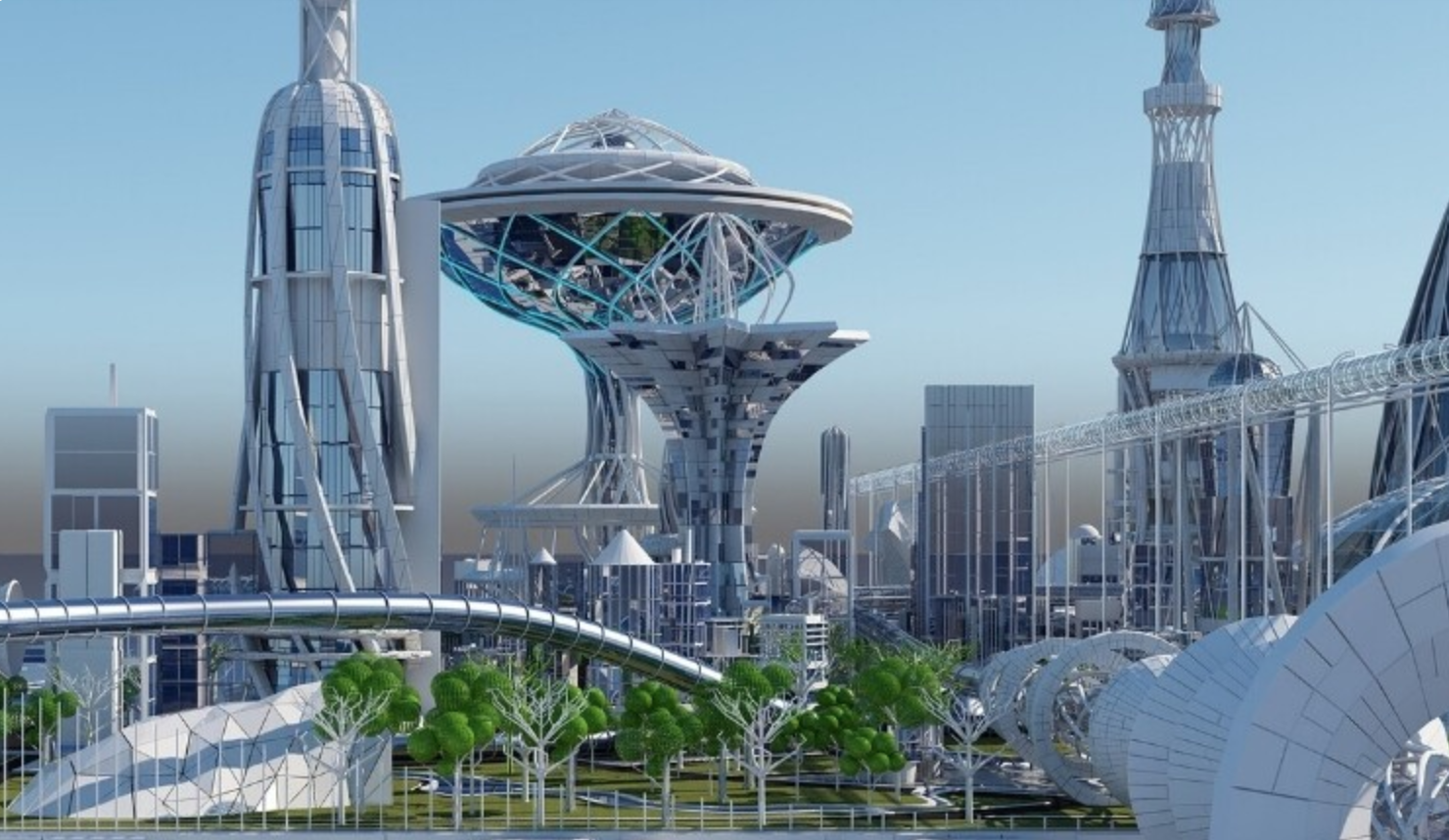
Turkmenistan’s Arkadag is different from the other examples because it has already opened. In June 2023, Turkmenistan inaugurated the new city near Ashgabat, named after the honorary title of former president Gurbanguly Berdimuhamedov. Reuters described it as a futuristic “smart” city dedicated to the former leader. Eurasianet reported that the city cost more than $5 billion and was promoted as a place governed by digital and green technologies.
Arkadag is perhaps the clearest case of architecture as political symbolism. It is not only a city; it is a monument to state power, continuity and controlled modernization. The architecture, infrastructure, public ceremonies and naming all communicate authority. In this sense, Arkadag belongs to a long tradition of planned capitals and prestige cities, from Brasília to Astana, but with a more closed political atmosphere.
The official image is one of order, cleanliness, technology and national achievement. The city includes hospitals, administrative buildings, housing, public facilities and ceremonial spaces. But the question is whether it can develop the messy, spontaneous, unpredictable qualities that make cities alive. A city cannot be only managed; it must also be inhabited. Streets need informal encounters, businesses, cafés, families, students, workers, cultural scenes and public memory. Without these, a city can look complete but feel staged.
Arkadag therefore represents both the promise and the warning of Central Asia’s new-city race. It shows that governments in the region can mobilize huge resources to build quickly. But it also shows the risk of urbanism becoming theatre — a built image of progress rather than an open framework for civic life.
Why Central Asia is building new cities
The new-city wave is not accidental. Several forces are converging.
First, Central Asian capitals and major cities face population growth and infrastructure pressure. Tashkent, Almaty and Bishkek were not designed for today’s mobility, investment flows and demographic demands. New districts and satellite cities promise relief.
Second, governments want to attract foreign capital. A new city is easier to market than a complex reform process. Renderings of towers, smart mobility, green parks and international business districts create a simple investment story.
Third, these projects are tools of national branding. They show that Central Asia is no longer only a region of post-Soviet transition or Silk Road memory. It wants to be seen as future-facing: connected to China, the Gulf, Turkey, Europe and global finance.
Fourth, there is a political dimension. Planned cities allow governments to shape space, symbolism and institutions. They can relocate ministries, create new administrative centres, reward construction interests and display state capacity.
Finally, there is a genuine architectural opportunity. Central Asia has the chance to develop a new urban language that combines climate adaptation, Islamic and nomadic heritage, Soviet modernist lessons, landscape sensitivity and contemporary technology.
Visionary planning or political architecture?
The answer is: both.
These cities are visionary because Central Asia does need new infrastructure, better planning and stronger regional hubs. Alatau could help Kazakhstan develop a new economic corridor. New Tashkent could relieve pressure on the old capital. Asman could, if carefully designed, bring investment and services to Issyk-Kul. Arkadag shows that a new city can be built quickly when the state decides to act.
But they are also political architecture. They are designed to communicate ambition, authority and national modernization. Their images are meant for investors, citizens and foreign observers. They say: we are building the future.
The deeper question is whether that future will be inclusive. A successful city cannot be judged only by skyline height, master-plan size or opening ceremonies. It must be judged by daily life. Can ordinary families live there? Can young people study and work there? Can small businesses afford space? Is public transport better than private-car dependence? Are parks and public squares truly public? Are old communities respected? Is water use sustainable? Are buildings adapted to heat, cold, dust, earthquakes and local materials?
Central Asia’s historic cities became great because they connected people, goods, ideas and cultures. The new cities of the steppe will succeed only if they do the same. If they become living crossroads, they may define the next chapter of Eurasian urbanism. If they remain symbolic mega-projects, they will stand as monuments to ambition — impressive, expensive and strangely empty.
For now, the race is still open. Alatau, New Tashkent, Asman and Arkadag are not only construction projects. They are tests of what modern Central Asia wants to become: a region of real urban renewal, or a landscape of architectural declarations.