On August 29, 2026, Hungary and much of Central Europe pause to mark the 500th anniversary of one of the most consequential battles in European history. The Battle of Mohács, fought on the marshy plains of south-western Hungary, was not merely a military defeat—it was a civilisational earthquake that shattered the medieval Kingdom of Hungary, redrew the map of Europe, and set in motion centuries of conflict between two of the era's great powers: the Ottoman Empire and the Habsburg dynasty.
The Road to Catastrophe
The first blow fell in 1521 with the Ottoman capture of Belgrade, which opened the path northward into Hungarian territory.
“By the early 16th century, the Ottoman Empire under Sultan Süleyman the Magnificent had become the dominant power in the Balkans, and the kingdom of Hungary stood as the primary obstacle to further expansion into Central Europe.”
EuroAsia.News, reporting from Budapest
Hungary, for its part, was dangerously unprepared. King Louis II was just twenty years old and lacked the authority to unite a fractured nobility, many of whom refused to obey his orders. The Hungarian kingdom had also recently suppressed a peasant uprising, eroding popular support for the crown in the countryside. Despite knowing an Ottoman attack was imminent, Louis could not secure support from other Christian powers—the fragmentation of Christendom in the wake of the Reformation meant Hungary would face the Ottoman onslaught largely alone.
Süleyman's army, numbering between 60,000 and 70,000 men, crossed the Drava River virtually unopposed on a pontoon bridge. King Louis, rather than waiting for reinforcements that would have added some 15,000 soldiers to his ranks, ordered an attack on what appeared to be a modest Turkish detachment. The Hungarian army, numbering only 25,000 to 30,000 troops, was significantly outnumbered and outgunned, with just 50 cannon against the Ottomans' formidable artillery batteries.
The Battle and Its Immediate Aftermath
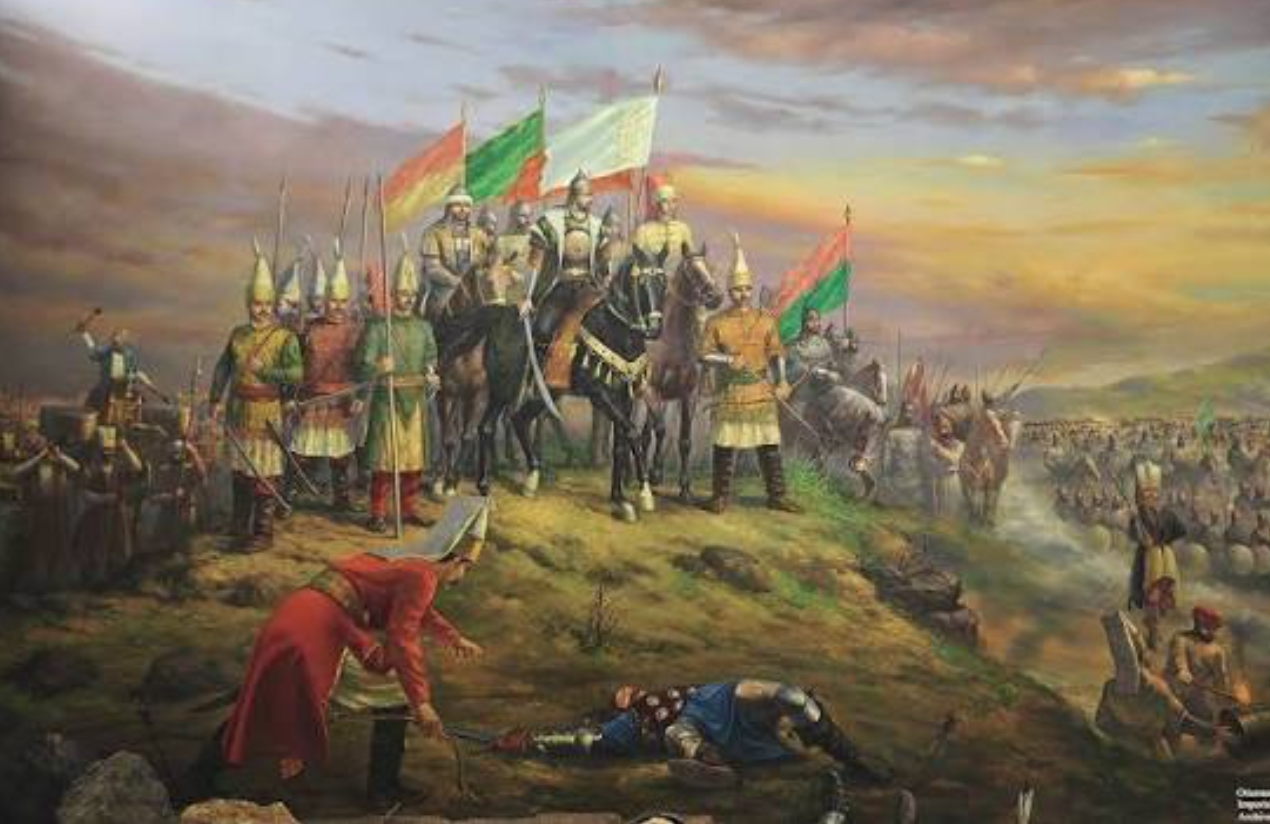
The battle began in the early afternoon of August 29, 1526. The Hungarian heavy cavalry initially caused serious casualties to the Ottoman vanguard, but this success proved short-lived. Süleyman's elite Janissaries, armed with arquebuses, held firm while Ottoman artillery tore apart the Hungarian ranks. As the Hungarians fell back, they were outflanked and encircled by the swift-moving Ottoman light cavalry.
The result was annihilation. King Louis II was thrown from his horse and killed attempting to flee—an alternative account holds that he drowned while trying to cross the Csele River. Along with the young king perished the archbishops of Esztergom and Kalocsa, five bishops, twenty-eight magnates, five hundred nobles, and some 16,000 troops—more than three-quarters of the Hungarian army.
Süleyman entered Buda on September 10, but then withdrew from Hungary, taking more than 100,000 captives with him. The Ottomans had won a devastating victory, but the full implications of Mohács were only beginning to unfold.
The Power Vacuum and Double Kingship
The death of the childless Louis II created a succession crisis with profound consequences. Under treaties concluded between the Jagiellonian and Habsburg dynasties in 1491 and 1515, the crowns of Hungary and Bohemia were claimed by Ferdinand of Habsburg, Archduke of Austria and brother of Holy Roman Emperor Charles V. Ferdinand had married Anna, Louis's sister, while Louis had married Ferdinand's sister Mary.
However, Hungarian law maintained the principle of royal election, and the nobility was deeply divided. Two rival kings were elected: János Szapolyai, Hungary's richest aristocrat and voivode of Transylvania, was chosen by one faction at Székesfehérvár in November 1526, while Ferdinand's supporters held a competing election. The resulting civil war between the two claimants lasted from 1526 to 1538, bleeding a country already devastated by the Ottoman defeat.
Szapolyai, facing defeat by Ferdinand, made a fateful decision: he sought Ottoman support. In early 1528, he dispatched an envoy to Istanbul offering an alliance with the Sultan. The decision was profoundly controversial—it went against Hungary's Christian conscience and centuries of resistance to Ottoman expansion. Yet Szapolyai calculated that of the two powers, the Ottomans were the stronger, and that the Habsburgs could not protect Hungary from them.
Süleyman accepted the alliance, declaring in the autumn of 1528 that he would drive the Habsburgs out of Hungary. In 1529, the Sultan launched an offensive that carried his forces to the gates of Vienna.

The Division of Hungary
The period of chaos and war that followed Mohács ultimately resulted in Hungary's partition. When Szapolyai died in July 1540, Ferdinand attempted to annex his realms, upsetting the balance between the Habsburgs and Ottomans. In response, Süleyman occupied central Hungary and its capital, Buda, on August 29, 1541—exactly fifteen years after the battle.
Buda became the centre of a new Ottoman province, the vilayet of Budin, which remained under Turkish control until its reconquest by the Habsburgs in 1686. The central and southern two-thirds of Hungary were incorporated into the Ottoman Empire, while the northern and western parts came under Habsburg rule. Transylvania and the eastern provinces became an autonomous principality within the Ottoman sphere of influence.
The Human and Cultural Cost
The consequences of Mohács extended far beyond territorial changes. Under Ottoman rule, the administrative and social structures of medieval Hungary were dismantled. Hungarian nobles who remained lost their titles and effectively became peasants, while the land passed to the Ottoman state, which distributed it in fiefs to its own officials and soldiers.
Depopulation was catastrophic. War, slave-raiding, and disease devastated the countryside. In the worst-affected areas, the original population was practically wiped out and only partially replaced by immigration from the Balkans. The Turks, beyond building fortresses, contributed little to Hungarian culture; many churches, schools, and other institutions fell into ruin.
Culturally, however, the catastrophe proved surprisingly generative. The trauma of Mohács gave rise to a new Hungarian vernacular literature, as the nation sought to preserve its identity through language in a period of foreign occupation. The Reformation, which emphasised worship in the vernacular, found fertile ground in the dismembered kingdom, and Hungarian became the language of religious and cultural expression. The image of Hungary as the "bastion of Christianity" was born, alongside the myth of Hungarians as a chosen people punished by God for their sins and destined to be redeemed through faith.
A Legacy of Five Centuries
The Battle of Mohács fundamentally altered the political, military, and cultural balance of East-Central Europe for centuries to come. It brought the Ottomans and Habsburgs into direct confrontation, turning Hungary into the main continental battleground between the two superpowers of the age. The divided kingdom would not be reunited until the Ottoman expulsion in the late seventeenth century, and the scars of Mohács remained embedded in Hungarian national consciousness.
Today, as Hungary marks the 500th anniversary of the battle with commemorations, cultural events, and renewed interest in this pivotal moment, Mohács stands as both a cautionary tale and a testament to the resilience of a people who transformed catastrophe into cultural renewal. The events of August 29, 1526, remind us that a single day can reshape the destiny of nations.