Astronomers spend enormous resources examining planets hundreds or thousands of light-years away. Even the most powerful telescopes normally provide only indirect information about their atmospheres, temperatures or composition.
With 3I/ATLAS, scientists have been given something much rarer: physical material from another planetary system passing through our own cosmic neighbourhood.
The object is only the third confirmed interstellar visitor ever observed, following 1I/'Oumuamua in 2017 and comet 2I/Borisov in 2019.
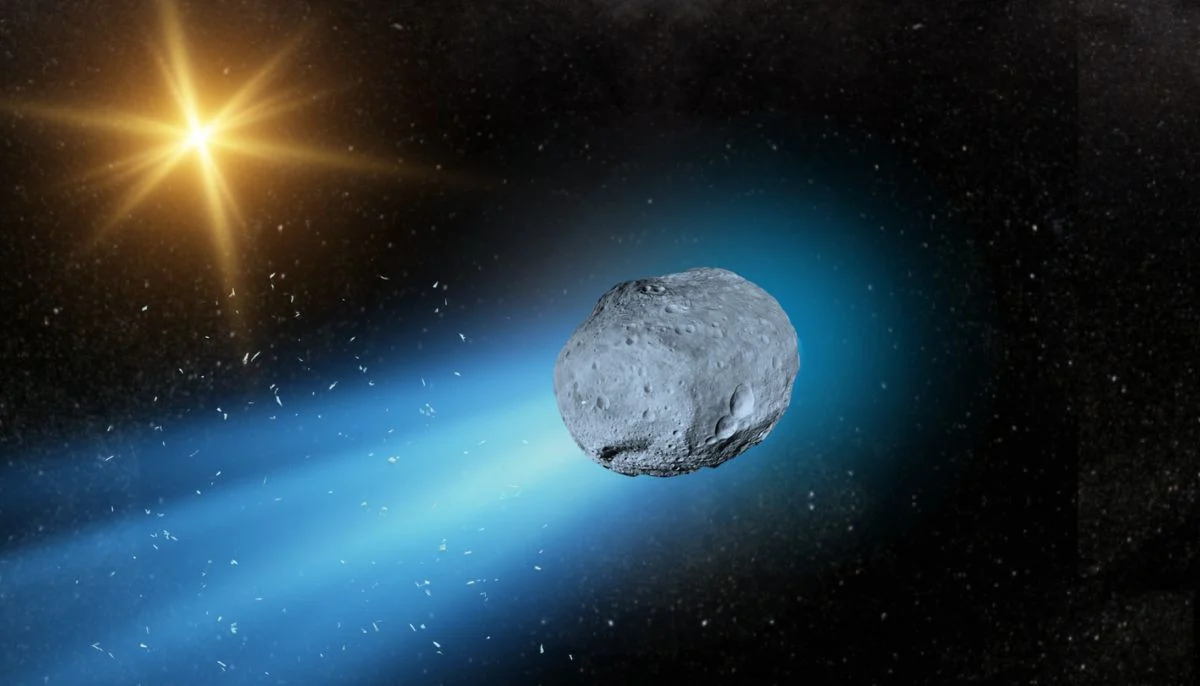
Unlike ordinary comets, which formed alongside the Sun and have remained gravitationally connected to it for billions of years, 3I/ATLAS entered the Solar System on an open trajectory. It came from interstellar space and will eventually disappear back into it.
Scientifically, however, it represents an extraordinary opportunity.
Observations with the Atacama Large Millimeter/submillimeter Array, or ALMA, in Chile have revealed a particularly unusual feature: 3I/ATLAS contains extraordinary quantities of methanol.
“NASA says the comet poses no danger to Earth.”
EuroAsia.News
Methanol, CH₃OH, is a relatively simple organic molecule commonly found in comets. What surprised researchers was not its presence but its abundance relative to hydrogen cyanide, another molecule frequently measured in cometary comae.
ALMA observations found methanol-to-hydrogen-cyanide ratios of approximately 70 and 120 on two observing dates, putting 3I/ATLAS among the most methanol-rich comets studied through radio astronomy.
That makes the comet something like a chemical time capsule.
Comets contain ices and dust preserved from the environments where planetary systems formed. Because much of that material has experienced relatively little geological processing compared with planets, its chemistry can preserve clues to temperature, radiation and molecular conditions in the original protoplanetary disk.
As ALMA researcher Nathan Roth put it, studying 3I/ATLAS resembles obtaining a fingerprint from another solar system.
The comparison with Solar System comets is particularly valuable.
Scientists have studied hundreds of bodies formed around the Sun. An interstellar comet provides an independent sample — effectively allowing researchers to ask whether the chemistry that produced our own planets was typical or unusual.
And methanol is only part of the puzzle.
NASA's James Webb Space Telescope subsequently made the first direct detection of methane gas in an interstellar visitor. Webb observed 3I/ATLAS after it had passed closest to the Sun and found an unusually high proportion of methane relative to water. The telescope also confirmed that the object remains exceptionally rich in carbon dioxide compared with typical Solar System comets.
The timing of the methane release was also intriguing.
Methane is highly volatile and should normally escape easily when heated. Yet Webb detected it relatively late. Scientists believe this may indicate methane-rich ice buried beneath the comet's surface, protected until solar heating penetrated deeper layers.
That effectively allows researchers to investigate the internal structure of a body created around another star.
ALMA observations add another detail. Some methanol appears to originate not only directly from the comet nucleus but from icy grains released into the surrounding coma. These grains warm in sunlight and release molecules themselves, behaving almost like a cloud of tiny subsidiary comets around the central body.
Every observation therefore reconstructs another part of 3I/ATLAS's history.
What makes comet 3I/ATLAS different from any comet before it?
The comet 3I/ATLAS was discovered on 1 July 2025 and has since become the subject of some of the most unusual tracking work in ESA's history.
Comet 3I/ATLAS did not form here. It originated somewhere in the distant reaches of the Milky Way and is estimated to be at least 7 billion years old and possibly 10 billion, making it the oldest comet ever identified.
Its original planetary system could now look entirely different from when the comet was expelled.
That expulsion itself is not difficult to imagine. Young planetary systems can be chaotic. Large planets can gravitationally scatter smaller bodies, accelerating them until they escape their parent star entirely.
Our own Solar System almost certainly expelled enormous numbers of comets during its early history.
Somewhere in the galaxy, objects originally formed beside the Sun may therefore also be passing through alien planetary systems.
Interstellar objects turn astronomy into a form of cosmic archaeology.
Instead of observing another star's planetary system only through light, scientists can analyse matter manufactured there.
3I/ATLAS will eventually fade beyond the reach of our instruments and continue its journey through the Galaxy.
But for a brief period, another planetary system effectively delivered a sample to Earth's doorstep.
We only had to recognise it.