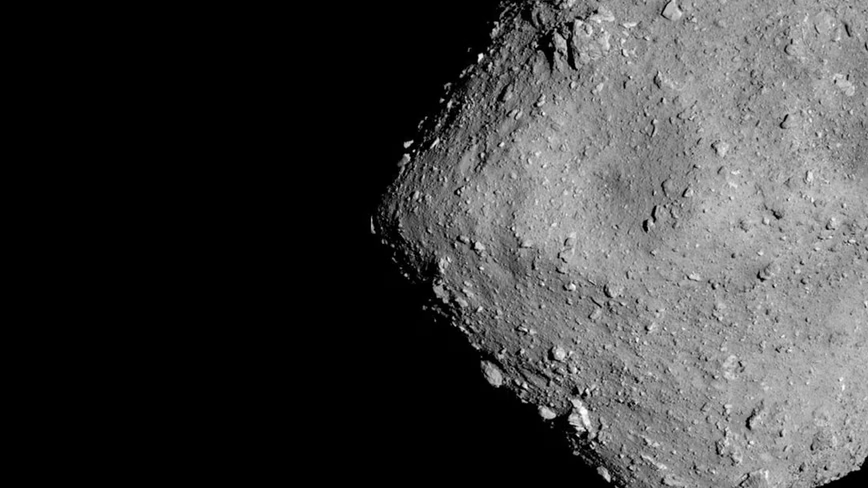
The discovery raises a fundamental question: did asteroids help make life on Earth possible?
A collection of black asteroid dust weighing just 5.4 grams is helping scientists investigate one of humanity's biggest mysteries: where did life's essential ingredients originate?
Samples collected from the asteroid Ryugu by Japan's Hayabusa2 spacecraft contain all five nucleobases used by living organisms to store genetic information, researchers confirmed in a study published in Nature Astronomy in March 2026.
The finding has attracted renewed attention because it strengthens an extraordinary possibility: some of the chemical ingredients required for life on Earth may have formed in space long before our planet became habitable.
RNA uses uracil instead of thymine. Together, these five molecules form the molecular alphabet underlying genetic information.
Researchers led by Toshiki Koga identified all five in two separate samples from Ryugu, an approximately 900-metre-wide asteroid orbiting the Sun.
The material originates from the early Solar System, approximately 4.5 billion years ago. That makes it roughly 1 billion years older than some of Earth's earliest widely accepted evidence of life, dating back at least 3.5 billion years.
“Five molecules, billions of years DNA uses four chemical bases: adenine, guanine, cytosine and thymine.”
EuroAsia.News
Japan's Hayabusa2 spacecraft launched in December 2014, reached Ryugu in June 2018 and returned its sample capsule to Earth in December 2020.
After travelling hundreds of millions of kilometres, it delivered just 5.4 grams of material. Yet that tiny quantity has generated scientific findings that could influence theories of life's origins for decades.
Japan and NASA reach similar conclusions
Ryugu is not the only asteroid containing life's chemical ingredients.
NASA's OSIRIS-REx mission returned approximately 121.6 grams of material from asteroid Bennu in September 2023 — more than 22 times the mass delivered by Hayabusa2.
In 2025, researchers reported finding all five nucleobases in Bennu samples as well.
The two discoveries are particularly important because both missions collected material directly from asteroids, reducing the contamination risks associated with meteorites that fall to Earth.
Earlier studies had found similar compounds in the Murchison meteorite, which landed in Australia in 1969, and the Orgueil meteorite, which fell in France in 1864.
However, scientists identified an intriguing difference between these extraterrestrial materials.
Ryugu contains approximately balanced amounts of two nucleobase families: purines and pyrimidines. Murchison is richer in purines, while Bennu and Orgueil contain relatively more pyrimidines.
Researchers suspect that differences in ammonia concentrations and chemical conditions within the original parent bodies helped determine which molecules formed.
Did asteroids seed the early Earth?
Earth formed approximately 4.54 billion years ago. During its early history, the planet experienced repeated impacts from asteroids and other bodies.
If those objects carried nucleobases, amino acids and other organic compounds, they could have supplied part of the chemical inventory needed for increasingly complex prebiotic reactions.
But scientists emphasize an essential distinction: discovering the ingredients of life is not equivalent to discovering life itself.
Nucleobases alone cannot reproduce, evolve or form organisms. Living systems also require additional molecular structures and highly organized chemical processes.
The Ryugu discovery does not prove that life originated in space. It demonstrates something arguably more fundamental: molecules essential to biology can form naturally without biological activity.
That suggests the chemistry leading toward life may be widespread across the Solar System.
The next challenge is determining how these scattered molecules combined into the first self-replicating systems on Earth — and whether similar processes occurred on Mars, Europa or other worlds.
Five tiny molecules inside an ancient asteroid have brought scientists one step closer to answering a question more than 4 billion years old.