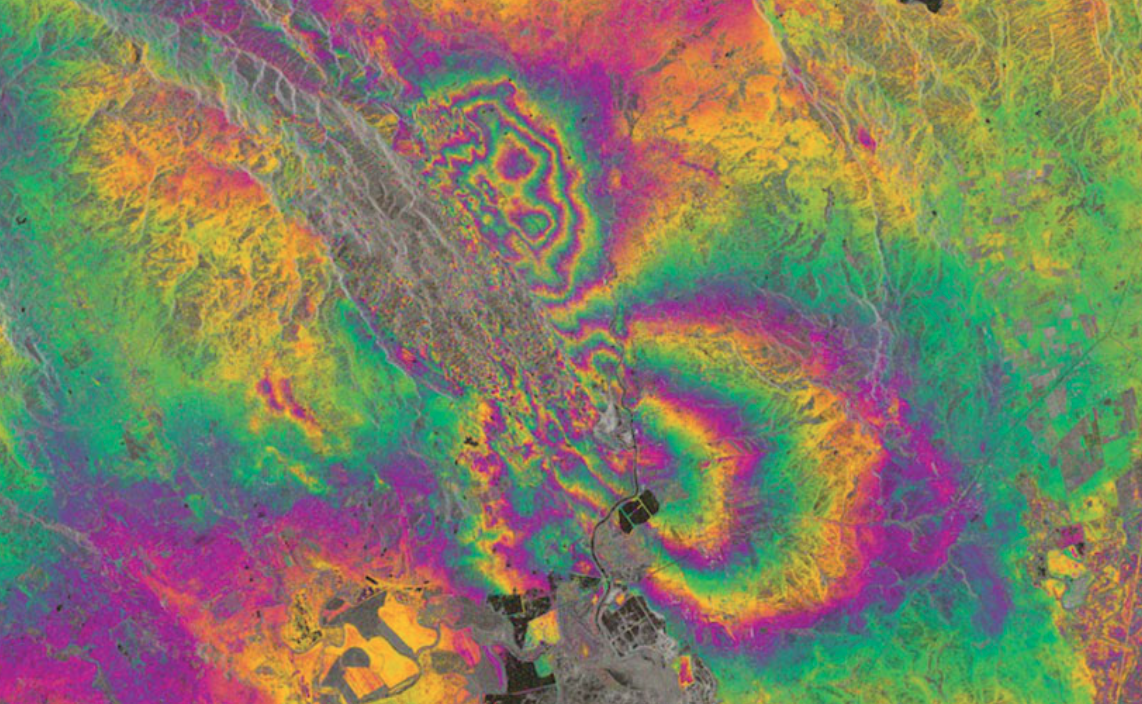
For over a century, seismology has been a science looking strictly downward. Researchers tracked the movement of the planet by looking at deep underground faults, tectonic plates, and subterranean acoustic paths. However, a major paradigm shift is taking place across global geophysics. New telemetry indicates that the truest boundaries of a major earthquake do not stop at the Earth's surface. Instead, they punch directly into space, warping the upper atmosphere in ways that could change how we monitor our planet.
The Physics of the Ionospheric Punch
This energy generates low-frequency acoustic and gravity waves that ripple through the air. As these waves travel upward into thinner air, their amplitudes expand. By the time they reach the ionosphere—between 60 and 300 kilometers above the surface—they crash into the charged plasma grid. This creates massive, measurable disruptions in the Total Electron Content (TEC) of the atmosphere, leaving a clear atmospheric footprint of the disaster below.
“When a massive seismic event occurs, it releases a massive amount of mechanical energy.”
EuroAsia.News
**
Mapping the Skies with GNSS Technology**
Geophysicists are tracking these changes using Global Navigation Satellite System (GNSS) networks. Whenever a satellite signal passes through a distorted patch of ionospheric plasma, the signal slows down. By measuring these micro-delays, scientists can map atmospheric ripples in real time. Recent peer-reviewed studies tracking major seismic events have successfully observed these co-seismic waves crossing entire continents, transforming our planetary GPS networks into a giant, high-altitude seismograph.
The Precursor Controversy: Prediction vs. Noise
This breakthrough has reignited one of the most intense debates in modern science: can these atmospheric disruptions help predict earthquakes before they happen? While post-event ripples are proven science, identifying "pre-earthquake" signals remains highly controversial. Many scientists remain deeply skeptical, noting that changes in the ionosphere are often caused by routine solar flares or geomagnetic storms. Disentangling a true tectonic warning sign from normal background space weather is an ongoing hurdle.
A New Model for Planetary Connections
Despite the skepticism, new theoretical models are pushing the boundaries of the field. Researchers at Kyoto University recently proposed a shocking mechanism: the relationship might work both ways. Their model suggests that massive solar storms could cause ionospheric shifts that apply subtle electrostatic pressure to water-filled faults in the Earth's crust, potentially triggering stress on fragile fault lines. While still theoretical, it highlights a fascinating new perspective: our planet's deep interior and the edge of space exist in a continuous, dynamic loop.