James Webb has now confirmed a galaxy only 280 million years after the beginning of the Universe, Euclid has found record-breaking quasars powered by enormous early black holes, new measurements of the Big Bang’s afterglow remain remarkably consistent with standard cosmology — and DESI is producing an increasingly precise map of how the Universe expanded afterwards.
The surprise is not that the Big Bang model is collapsing. It is that galaxies, stars and black holes appear to have organised themselves much faster than scientists expected.
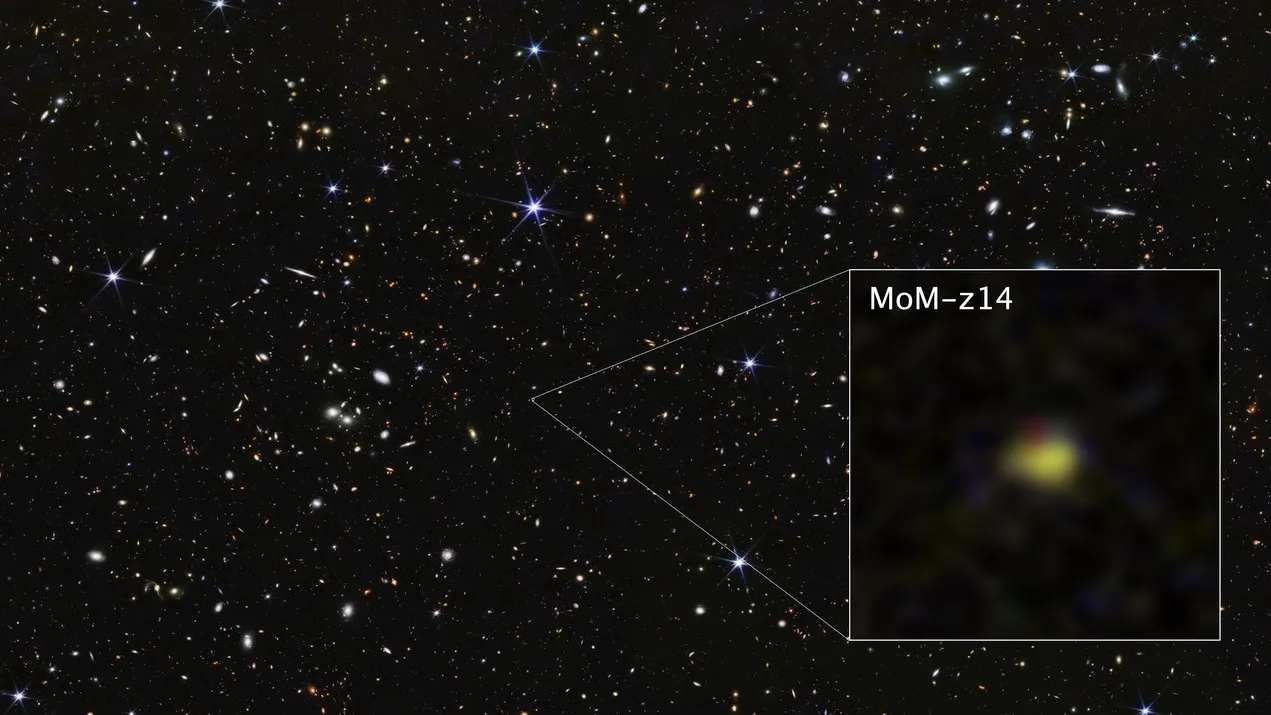
NIRSpec then measured a spectroscopic redshift of z = 14.44, establishing it as the most distant confirmed galaxy currently known. We see MoM-z14 as it existed only about 280 million years after the Big Bang, while its light has travelled through expanding space for roughly 13.5 billion years before reaching Webb. (NASA Science)
“The most spectacular new result is a tiny yellow-red object called MoM-z14. James Webb's NIRCam first detected it as an extremely faint infrared source.”
EuroAsia.News
The extraordinary part is not simply its distance. MoM-z14 is brighter, more compact and more chemically enriched than many models expected at such an early time. Heavy elements require earlier stars to have formed, burned their fuel and dispersed processed material. In other words, by 280 million years after the beginning, the Universe had apparently already completed several important stages of stellar evolution.
That does not disprove the Big Bang. It creates a different problem: how did structure form so quickly?
Galaxies may be even heavier than we thought
An August 2026 Nature Astronomy result makes the problem more interesting. Researchers analysing JWST observations found evidence that some distant massive galaxies may contain many more low-mass stars than previously assumed. If that interpretation is correct, their stellar masses could be up to four times larger than earlier estimates.
That would make some already surprisingly massive early galaxies even harder to reproduce in conventional galaxy-formation simulations. (Nature)
Another JWST study published this year identified a massive, already evolved galaxy at redshift z = 3.449 whose stars were dominated by random motions rather than the orderly rotation normally associated with young galaxies. Such mature “slow rotators” had been expected to develop considerably later. Yet this one existed when the Universe was less than two billion years old.
The accumulating message from Webb is therefore becoming difficult to ignore: the early Universe was extraordinarily efficient at manufacturing complex structures.
The black-hole problem becomes even stranger
Galaxies are only half the puzzle.
Webb has measured a roughly 50-million-solar-mass black hole inside the tiny early galaxy Abell2744-QSO1, more than 13 billion light-years away. The black hole is so massive relative to its host galaxy that researchers argue it may have formed as a very large “seed”, rather than beginning as the remnant of an ordinary star and slowly growing from there.
The classical picture was straightforward: stars form, the largest stars collapse into black holes, black holes feed and merge, and after hundreds of millions or billions of years some become supermassive.
But observations are increasingly finding the giant black holes too early.
ESA's Euclid telescope added another major piece of evidence in July. It discovered 31 previously unknown quasars at redshifts between 6.6 and 7.8. Two are the most distant quasars yet identified. The record holder, EUCL J172902.75+641018.1 at z = 7.77, was shining when the Universe was only around 670 million years old.
A quasar is produced when an enormous black hole consumes matter so violently that its surroundings can outshine an entire galaxy. Finding so many at this early epoch strengthens the argument that the first black holes either grew at extraordinary rates or began life much larger than traditional stellar-collapse models assumed.
But the Big Bang itself is holding up remarkably well
The new galaxies receive the headlines, but some of the most important 2026 measurements point in the opposite direction: the underlying early-Universe model remains strikingly successful.
One of the cleanest tests concerns the number of light relativistic particle species present shortly after the Big Bang. Researchers combined measurements of primordial helium and deuterium with the cosmic microwave background from Planck, the Atacama Cosmology Telescope and the South Pole Telescope, plus DESI galaxy measurements.
They obtained an effective relativistic-particle number of N_eff = 2.990 ± 0.070. The Standard Model predicts 3.044. The agreement is extremely close and represents the tightest such constraint yet obtained. (arXiv)
That matters because the abundance of helium and deuterium was determined during Big Bang nucleosynthesis, only minutes after the Universe began. The cosmic microwave background was released much later, about 380,000 years after the Big Bang. Agreement between these completely different epochs is powerful evidence that the basic hot-Big-Bang framework remains intact.
The Atacama Cosmology Telescope's latest data similarly show no statistically significant requirement to abandon the standard ΛCDM cosmological model, despite extensive tests involving extra radiation, early dark energy and modified physics. (NASA Technical Reports Server)
DESI is questioning what happened much later
Where the biggest cosmological uncertainty is emerging is not at the Big Bang itself, but in the Universe's later expansion.
DESI has now mapped more than 47 million galaxies and quasars, creating the largest high-resolution three-dimensional map of the Universe.
Earlier combinations of DESI data with other observations produced intriguing evidence that dark energy might evolve with time, rather than remaining the simple cosmological constant assumed in ΛCDM.
But July 2026 brought an important complication. New DESI measurements using the Lyman-alpha forest — absorption patterns created when ancient quasar light passes through intergalactic hydrogen — produced the strongest constraints from this method yet. The new central result moved closer to standard ΛCDM, suggesting that some earlier indications of evolving dark energy could weaken as more data arrive. (desi.lbl.gov)
The dark-energy story is therefore very much unresolved.
A five-trillion-pixel Universe
The scale of the new observational revolution is equally extraordinary.
In August scientists released the largest two-dimensional colour map of the Universe yet assembled: 5.6 trillion pixels, built from more than 263,000 telescope exposures and containing nearly four billion celestial objects. This imaging survey forms the visual foundation from which DESI constructs its 3D cosmic map.
Meanwhile Webb has produced one of the sharpest maps yet of invisible dark matter, using gravitational distortions in nearly 800,000 galaxies. The new reconstruction resolves the dark-matter scaffolding on which visible galaxies developed at approximately twice the detail of earlier maps.
And Euclid, designed principally to study dark matter and dark energy, is beginning to demonstrate what happens when enormous sky coverage is combined with space-based resolution.
Roman is now on its way
The next jump has already begun.
NASA's Nancy Grace Roman Space Telescope launched on August 30, 2026 aboard a Falcon Heavy and is travelling toward the Sun-Earth L2 point, roughly one million miles from Earth. Roman combines Hubble-class image quality with a field of view at least 100 times larger than Hubble's. It is designed to survey billions of galaxies and measure the evolution of dark energy and large-scale structure.
Webb is extraordinarily powerful but looks deeply into relatively small regions of sky. Roman will observe enormous areas quickly. Combined with Euclid and DESI, it should allow astronomers to determine whether the strange objects Webb keeps discovering are extremely rare exceptions — or representative of an early Universe that evolved fundamentally faster than existing models predict.
That distinction could become one of the defining scientific questions of the next decade.
The latest observations are therefore producing an intriguing paradox.
The evidence for a hot, expanding Universe remains extremely strong. Measurements made minutes after the Big Bang and hundreds of thousands of years later continue to fit the standard model with remarkable precision.
Yet when astronomers look several hundred million years further forward, the Universe suddenly appears surprisingly mature.
*Galaxies are brighter.
Some may be considerably heavier.
Heavy elements appear earlier.
Massive black holes already exist.
Quasars are blazing only 670 million years after the beginning.*
The question facing cosmology in 2026 is increasingly what happened immediately afterwards — and whether our models have dramatically underestimated how quickly the first Universe could build stars, galaxies and black holes.