The global payments industry is entering one of its most significant transformations since the introduction of credit cards. Money that once took hours or days to move between accounts can increasingly be transferred within seconds, around the clock. According to McKinsey, instant-payment flows across the 15 largest economies using such systems reached almost $22 trillion in 2024 and could grow by 15–18 percent annually over the next five years.
Yet the development of instant payments demonstrates that technology alone does not determine success. India, Brazil, Mexico and the United States have all built real-time payment infrastructure, but the results have been dramatically different.
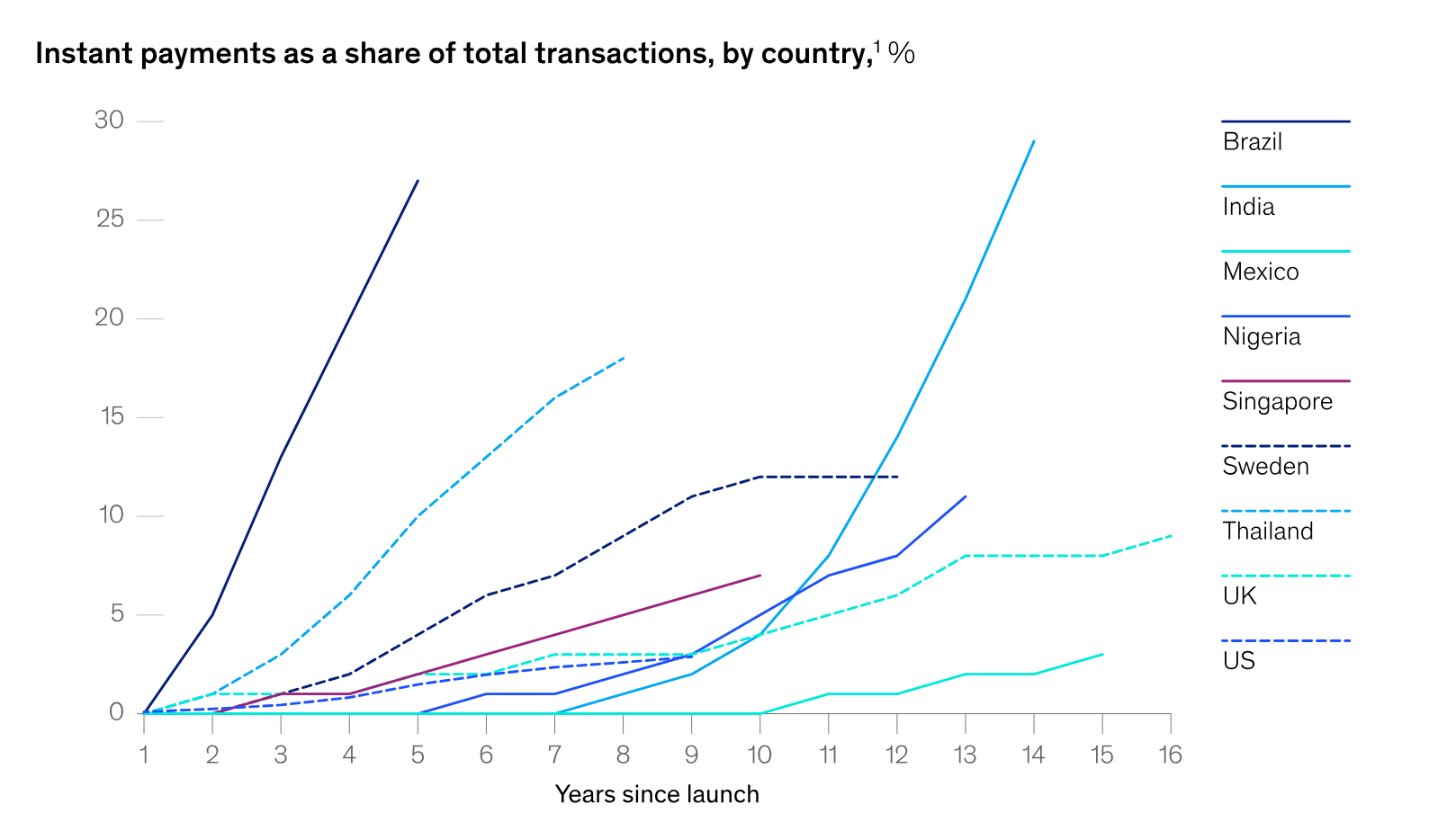
India has become the global leader. Its Unified Payments Interface, or UPI, launched in 2016 and now processes more than 19 billion transactions every month, representing almost one-third of the country's payment transactions. Government support, near-zero transaction costs, integration between banks and payment applications, and India's rapidly developing digital identification infrastructure created an environment in which instant payments could expand quickly.
Within only a few years, instant payments grew to almost 30 percent of total transaction volume. Among Brazilian small and medium-sized businesses, Pix now represents approximately 40 percent of sales. Its development is increasingly moving beyond simple transfers towards merchant payments, instalment financing and eventually large-scale B2B transactions.
“Brazil followed a similar path with Pix, introduced by the central bank in 2020.”
EuroAsia.News
Mexico demonstrates the opposite problem. Although the country has operated its SPEI real-time banking infrastructure for years, instant payments still account for less than 5 percent of transactions. Initiatives such as CoDi and DiMo have struggled to change established consumer behaviour. Cash remains important, while banks and merchants were never given the same coordinated incentives that supported adoption in India and Brazil.
The United States presents another interesting case. It now has two major instant-payment networks—The Clearing House's RTP system and the Federal Reserve's FedNow—but adoption remains relatively limited. RTP processed around 447 million transactions in 2025 and FedNow approximately eight million. By comparison, Zelle processed 4.2 billion transactions during the same period.
The explanation is partly economic. American consumers already have cards, ACH transfers, digital wallets and established peer-to-peer payment services. Credit cards also generate considerable income for banks through interchange, lending and associated services. Replacing them with cheaper account-to-account payments therefore does not necessarily benefit every participant in the existing system.
Europe appears likely to develop a middle path. Instant payments already represent around 10 percent of retail payments in several mature European markets, while the expansion of SEPA Instant Credit Transfer is creating the foundations for near-immediate euro transfers across borders. Cards are unlikely to disappear, but account-to-account payments could increasingly dominate transfers, invoices, merchant settlement and treasury operations.
For banks and payment companies, this transformation creates both a threat and an opportunity. When the transfer itself becomes instantaneous and inexpensive, charging substantial fees merely for moving money becomes increasingly difficult. Financial institutions therefore have to generate revenue elsewhere—from lending, treasury management, foreign exchange, fraud prevention, merchant software, analytics and embedded financial services.
The next stage may be even more disruptive. McKinsey notes that stablecoin-based settlement could compete directly with conventional instant-payment networks, particularly in international B2B payments. Domestic real-time systems can transfer money instantly within one banking system, but stablecoins potentially extend that principle across borders and outside traditional banking hours.
The broader lesson is clear: instant payments are not simply faster bank transfers. They are gradually changing the economics of the entire payments industry. India and Brazil demonstrate what happens when governments, banks, technology providers and merchants move together. The United States and Mexico show that building the infrastructure alone is insufficient.
The winners in this transition may therefore not be those processing the greatest number of transactions, but those capable of building services around them. The payment itself is becoming almost invisible; the financial services surrounding it are becoming the real product.