Dollar stablecoins still dominate digital finance, but Europe is beginning to build a market of its own. The important change in 2026 is not simply that more euro tokens exist. It is that several very different models are now competing: a global crypto-native network led by Circle, bank-backed institutional coins, payment-infrastructure stablecoins and tokens that connect an ordinary IBAN directly to a blockchain wallet.
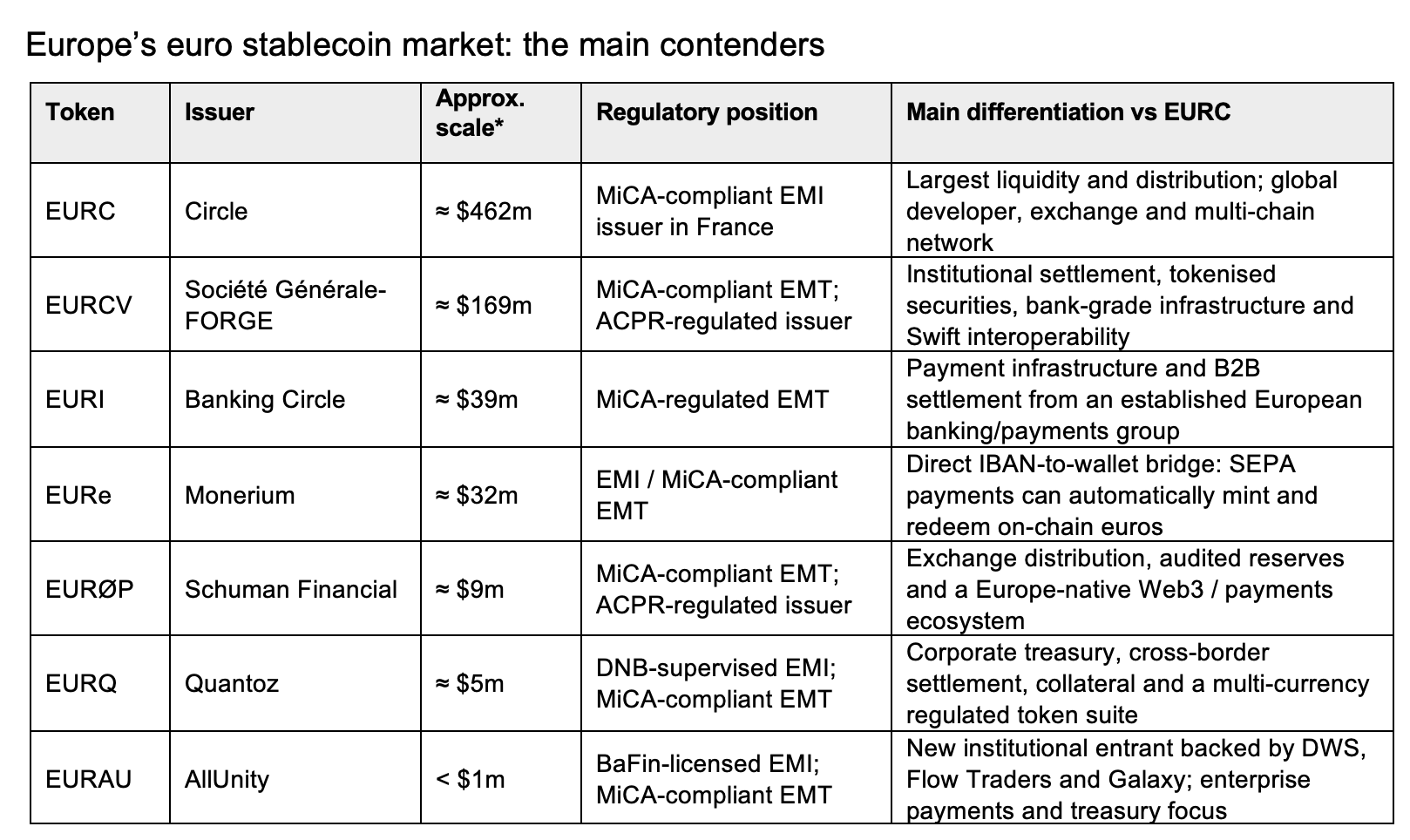
The market remains small by dollar-stablecoin standards. CoinGecko’s broad EUR-stablecoin category stood at roughly $742 million on 20 August 2026, although that figure includes legacy, synthetic and other structures alongside MiCA-regulated electronic-money tokens. Circle’s EURC is clearly the liquidity leader. Circle reported €392.8 million of EURC in circulation on 10 August, while market data placed EURC at about $462 million in market value on 20 August.
Société Générale-FORGE’s EUR CoinVertible, Monerium’s EURe, Banking Circle’s EURI, Schuman Financial’s EURØP, Quantoz’s EURQ and AllUnity’s EURAU all target different parts of the euro’s emerging on-chain economy.
“But EURC is no longer alone.”
EuroAsia.News Crypto
Circle’s advantage is straightforward: distribution. EURC benefits from the infrastructure, developer tools, exchange relationships and institutional credibility Circle already built around USDC. Its French entity holds an Electronic Money Institution licence and issues EURC in the EU under MiCA. For a business or trading platform that wants a widely recognised digital euro with strong secondary-market liquidity, EURC is currently the reference point.
Monerium shows a very different model. EURe is less important because of its outstanding token supply than because of how tightly it connects banking and blockchain. A user or company can obtain a EUR IBAN linked to a wallet; incoming SEPA payments can be converted into EURe on-chain, while redemption can send euros back through SEPA. Monerium says more than €8 billion has already moved between banks and DeFi through its infrastructure. That makes EURe closer to a programmable euro bank rail than a conventional crypto trading token, and gives it a use case EURC does not replicate in exactly the same way.
Société Générale-FORGE is attacking the market from another direction. EURCV is now the second major regulated euro token by scale and is designed around institutional finance, tokenised securities and settlement. In January, SG-FORGE and Swift demonstrated settlement interoperability involving tokenised bonds, illustrating why a bank-issued stablecoin may matter even in a region where SEPA Instant already exists: the target is not merely faster retail transfers, but atomic settlement between digital cash and digital assets.
Banking Circle’s EURI and Quantoz’s EURQ are more payment- and treasury-oriented. Quantoz explicitly positions EURQ for global commerce, corporate cash management, cross-border payments and collateral, while also issuing other regulated currencies. Schuman Financial’s EURØP is building distribution through exchanges and financial apps. AllUnity’s EURAU is much smaller today, but its backers — DWS, Flow Traders and Galaxy — give it an institutional network that could matter more than early circulation figures.
There are also older and smaller euro-backed tokens. STASIS EURS, launched in 2018, still reports roughly 6.9 million tokens in circulation and has a long operating history. StablR’s EURR is a MiCA-authorised euro EMT, but a May 2026 cybersecurity incident forced the issuer to suspend minting and redemption while it works through a recovery process with the Maltese regulator. The episode is a reminder that regulation addresses reserve, redemption and governance requirements, but does not remove technology and operational risk.
The next major entrant could change the competitive landscape again. Qivalis has grown from a small banking initiative into a consortium of 37 financial institutions across 15 European countries. It is seeking authorisation from the Dutch central bank and plans to launch a fully reserved euro stablecoin in the second half of 2026. If Qivalis succeeds, its real advantage may not be the token itself but immediate access to a pan-European bank distribution network.
That points to the central issue for any new euro stablecoin. Simply offering another 1:1 euro-backed token is unlikely to be enough. Circle already has liquidity; Monerium has the bank-to-wallet bridge; Société Générale has institutional settlement; Banking Circle and Quantoz target payment infrastructure and treasury; and Qivalis is assembling bank distribution. A new issuer therefore needs a sharper reason to exist — for example integrated global business accounts and local payout rails, superior FX, programmable B2B settlement, ERP integration, trade finance, tokenised-asset settlement or a sector-specific network.
Europe is not short of regulated digital euros anymore. What it still lacks is one euro stablecoin with the global network effect of USDC or USDT. The next stage of the market will therefore be less about issuance and more about adoption: which token becomes easiest for banks, businesses, wallets, exchanges and payment platforms to use. On that measure, EURC starts in front — but Europe’s bank- and payment-led challengers are finally becoming substantial enough to make the race interesting.