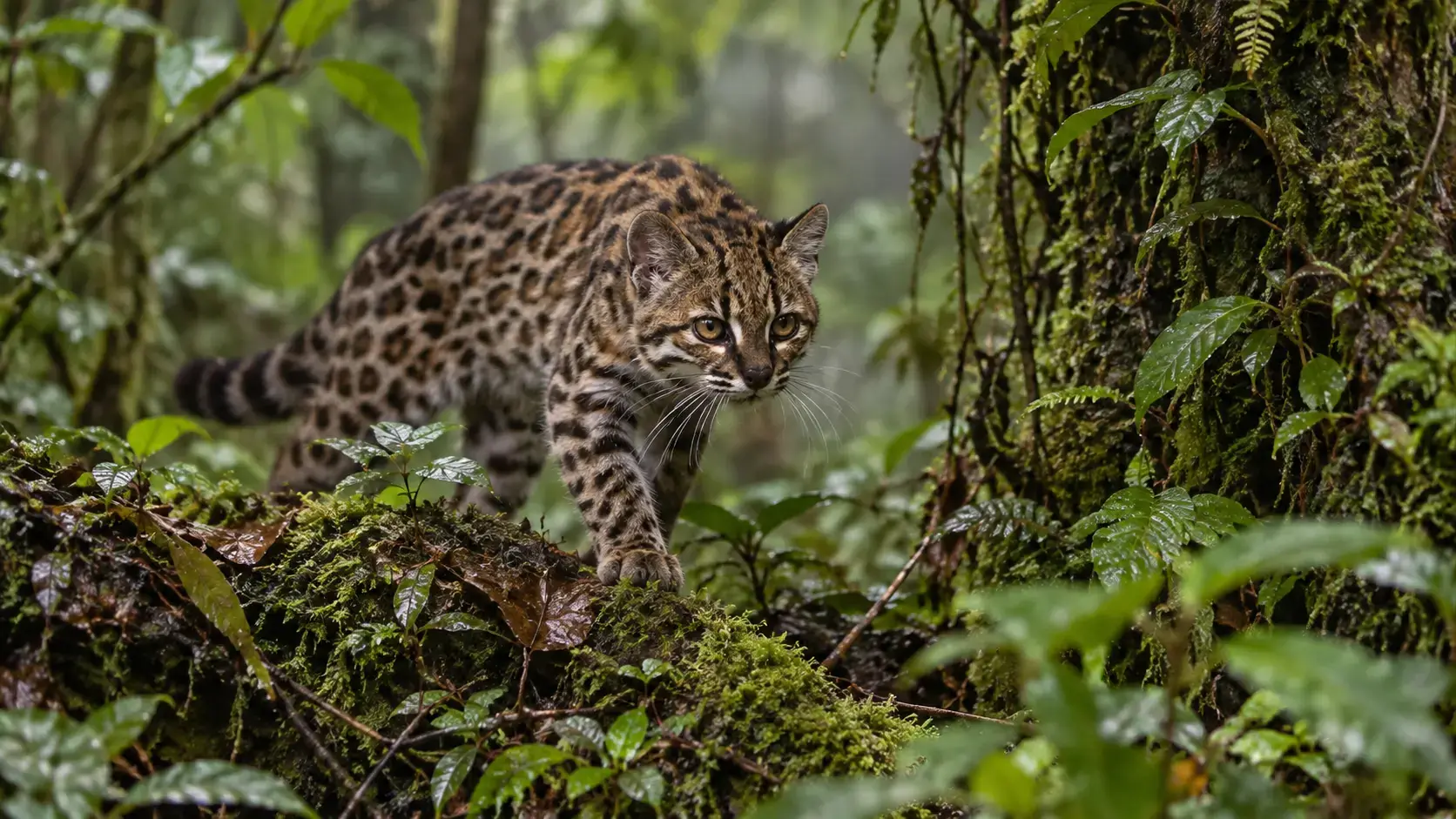
A tiny spotted cat from Bolivia has rewritten one branch of the mammal family tree. Scientists have formally described Leopardus tilcayo, a small wild cat from the Yungas cloud forests of the eastern Andes, making it the first living cat species newly described by science in more than 100 years. The previous comparable case was the Uruguayan pampas cat, Leopardus fasciatus, described in 1923.
The animal was not found during an expedition into unexplored jungle. Local people had known it for generations and called it “tilcayo.” One of the animals that helped establish the new species had even spent about a year in a household after being found as a kitten near a forest road. When it became clear this was no domestic cat, it was taken to the Senda Verde wildlife sanctuary near Coroico.
He resembled South America’s small spotted “tiger cats,” but something looked different. Tigrino is only about 45 centimetres long and weighs roughly 1.4 kilograms — less than many domestic cats — with a light brown coat, dark rosettes and rounded ears.
“There the male, now known as Tigrino, caught the attention of Bolivian biologist Paola Nogales-Ascarrunz.”
EuroAsia.News
Genetics turned suspicion into discovery. An international team analysed complete genomes from 38 cats in the South American genus Leopardus. Twenty-six represented different populations of the contested tiger-cat complex, while eight genomes came from museum specimens. This combination of modern DNA and “museomics” allowed researchers to compare living cats with historical material.
The result was much bigger than one unusual Bolivian cat. What had long been treated as variants of one widespread tiger cat actually consisted of five genetically distinct species. The Bolivian Yungas population formed its own evolutionary lineage and was formally named Leopardus tilcayo. Researchers estimate that it separated from related tiger cats around 1.4 million years ago. The same study also described a new Peruvian subspecies, Leopardus tigrinus antisuyo.
The finding shows how much biodiversity can remain hidden even among familiar mammals. Tiger cats are small, secretive, mostly nocturnal and often look remarkably similar across regions. Classification based mainly on appearance struggled to distinguish populations evolving separately for hundreds of thousands of years.
The conservation implications may be even more important. If populations once treated as one widespread species are actually several species with much smaller ranges, each may be more vulnerable than assumed. L. tilcayo is currently confirmed only from Bolivia’s Yungas, a humid mountain-forest belt on the eastern Andes. The habitat is under pressure from deforestation, agriculture, fires and gold mining, and the findings have been submitted for future IUCN assessment.
There is also an important irony. Science is calling Leopardus tilcayo a new species, but it is not new to the people who live beside it. Its scientific name preserves the local word “tilcayo,” recognising knowledge that existed long before genomic sequencing confirmed the distinction.
The discovery is more than another name in a zoological catalogue. It shows how genetics, museum collections and local knowledge can combine to reveal species hiding in plain sight — sometimes only when their habitat is already under pressure.
After more than a century without a newly described living cat species, the feline family tree has grown again. Hopefully the tilcayo can be protected before scientists discover how rare it really is.